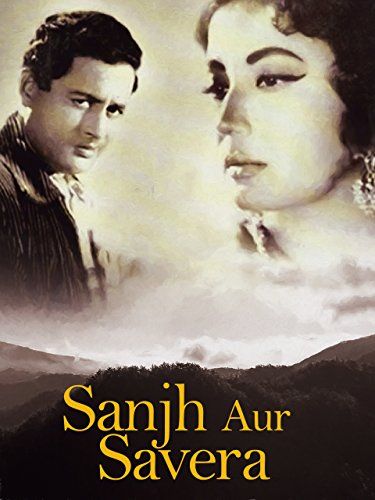
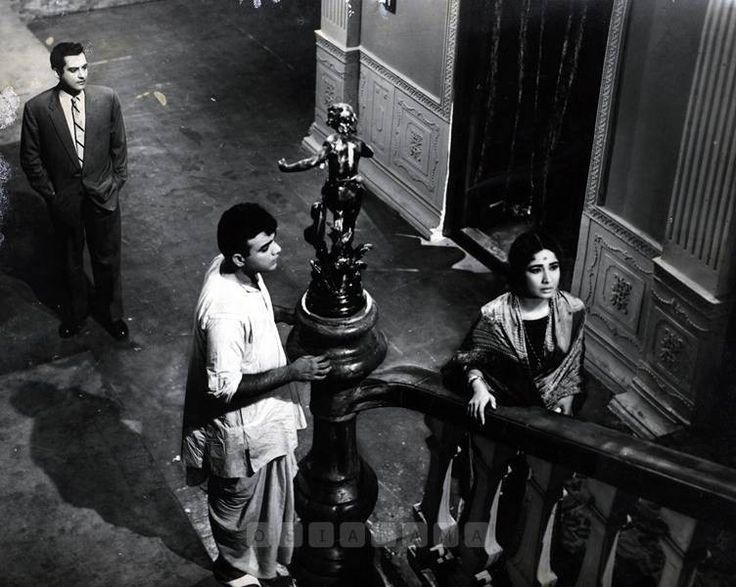
Sanjh Aur Savera is a 1964 Hindi romantic drama film starring Guru Dutt, Meena Kumari, and Mehmood. Directed by Hrishikesh Mukherjee and produced by Sevantilal Shah, the film features music composed by the celebrated duo Shankar–Jaikishan. Known for its emotional depth and restrained performances, Sanjh Aur Savera explores themes of love, identity, and deception against the backdrop of a traditional Indian setting.
Dr. Shankar Chaudhry, a wealthy and respected doctor living in Bombay, shares his home with his younger sister, Manju, and his widowed mother, Rukmini. One day, Rukmini arranges Shankar’s marriage to Maya, the daughter of advocate Madhusudan. Although neither Shankar nor his mother have met the bride, he agrees to the proposal.
At the wedding, Maya suddenly faints but quickly recovers under the care of her cousin, her brother Prakash, and her father, Madhusudan. The following day, Maya moves into Shankar’s household as his wife. However, when Shankar approaches her intimately, she refuses him, citing her observance of a sacred fast.
Later, during a visit to Banaras—where Madhusudan now lives—Shankar and Maya marry again in a traditional ceremony at the revered Bhagwan Vishwanath Temple. Their relationship deepens after the ceremony, turning emotionally and physically intimate, and soon, Maya becomes pregnant.
One day, Shankar returns home to find both Prakash and Maya missing. His attempts to locate them are in vain. Eventually, a shocking revelation comes to light: the woman he believed to be his wife is actually an imposter—and is likely married to Prakash.
Meena Kumari as Gauri is the central figure around whom the deception in the story revolves. She assumes the identity of Maya, the daughter of advocate Madhusudan, and marries Dr. Shankar Chaudhry under false pretenses. Her real name is revealed later, and it’s implied she is actually married to Prakash. Meena Kumari portrays this role with emotional restraint and mystery, adding depth to the character’s dual identity and internal conflict.
Guru Dutt as Dr. Shankar Chaudhry is a well-to-do, respected doctor in Bombay who agrees to an arranged marriage without meeting the bride. Unaware of the deceit, he tries to build a sincere relationship with his new wife. When the truth begins to unravel, his character is forced to confront betrayal and emotional turmoil. Guru Dutt plays Shankar with his trademark subtlety and quiet intensity.
Mehmood as Prakash is presented as Gauri’s cousin but is later revealed to be her actual husband or partner, complicit in the scheme. Mehmood, known for his comic roles, plays a more serious character here, involved in a morally complex situation.
Manmohan Krishna as Advocate Madhusudan is believed to be Maya’s father and a respected figure whose name lends legitimacy to the marriage. As the story unfolds, it becomes unclear whether he is part of the deception or also a victim of it.
Hrishikesh Mukherjee, one of Hindi cinema’s most respected and versatile filmmakers, was known for blending realism with accessible storytelling. In Sanjh Aur Savera, he departs from his usual light-hearted or socially driven themes to direct a more somber romantic drama infused with mystery and emotional conflict. His direction brings subtlety and restraint to a complex narrative involving identity fraud, marital deception, and emotional awakening. Mukherjee skillfully draws nuanced performances particularly from Meena Kumari and Guru Dutt—and handles the film’s moral ambiguity with characteristic sensitivity and grace.
Dhruva Chatterjee, a prolific screenwriter known for his gripping narratives involving suspense, complex relationships, and moral dilemmas, crafted the core of Sanjh Aur Savera around a gradually unfolding mystery—the true identity of Maya/Gauri and the emotional disintegration of Dr. Shankar as he faces betrayal. Collaborating with him, Anil Ghosh contributed to the screenplay’s pacing and scene structure, bringing his experience with domestic and interpersonal themes to lend emotional realism to the story. Together, Chatterjee and Ghosh shaped a screenplay that skillfully blends romance and intrigue within a traditional Indian milieu, while providing the emotional depth necessary for the actors to deliver impactful performances.
The music of Sanjh Aur Savera, composed by the legendary duo Shankar–Jaikishan, features a melodious and emotionally resonant soundtrack brought to life by some of Hindi cinema’s greatest playback singers. Mohammed Rafi and Suman Kalyanpur lend their voices to both the original and revival versions of the haunting duet “Ajhun Na Aye Balamwa,” while Suman Kalyanpur also delivers the tender solo “Chand Kanwal Mere Chand Kanwal.” Lata Mangeshkar’s devotion-filled “Man Mohan Krishna Murari” and the heartfelt “O Sajna Mere Ghar Angna” add spiritual and emotional depth. Mohammed Rafi’s evocative vocals shine in “Taqdeer Kahan Le Jayegi Malum Nahin” and the introspective “Zindagi Mujhko Dikha De Rasta.” The title track, “Yehi Hai Woh Sanjh Aur Savera,” sung by Rafi and Asha Bhosle, beautifully captures the film’s core theme of emotional transition from darkness to light. Together, these songs enrich the film’s mood and narrative, exemplifying the elegance of 1960s Hindi film music.
Photos courtesy Google. Excerpts taken from Google.
 Writer Sunita