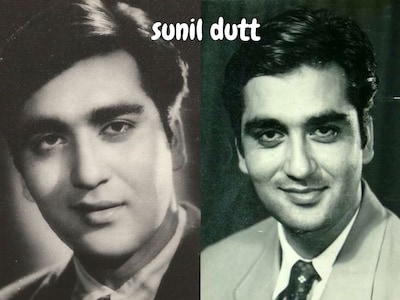
Sunil Dutt (born Balraj Raghunath Dutt) was a well-known Indian actor, filmmaker, and politician. He worked in over 80 Hindi films during his five-decade-long career and won three Filmfare Awards, including two for Best Actor. Known for his powerful acting and meaningful films, he is considered one of the finest actors in Indian cinema. In 1968, the Government of India awarded him the Padma Shri, the country’s fourth-highest civilian honour, for his contribution to films.
After graduating from Jai Hind College in Bombay (now Mumbai), Sunil Dutt began working at a top British advertising agency. His passion for the performing arts grew when he became an announcer on Radio Ceylon’s Hindi service. As the host of a popular show, he interviewed many celebrities, which gave him his first glimpse into the glamorous world of cinema. Thanks to his strong command of the Urdu language, Dutt became a well-loved voice on the Hindi radio service.
While covering the Dilip Kumar film Shikast in 1953, Sunil Dutt met director Ramesh Saigal. Impressed by Dutt’s voice and personality, Saigal offered him a role in his upcoming film. This led to Dutt’s debut in Railway Platform (1955). To avoid confusion with the well-known actor Balraj Sahni, Saigal gave the newcomer a new screen name—Sunil Dutt—instead of using his real name, Balraj Dutt.
Sunil Dutt rose to fame with Ek Hi Raasta (1956) and Mother India (1957). While Ek Hi Raasta was a major hit, Mother India became an all-time blockbuster and the most successful film of the 1950s. As the fiery Birju, Dutt became Bollywood’s first anti-hero. The film gained international acclaim, was dubbed in multiple languages, and found success across Europe, Latin America, the Middle East, and North Africa. It won several awards and was later included in the book 1001 Movies You Must See Before You Die.
Sunil Dutt’s success continued with Sadhna (1958), a superhit, followed by Bimal Roy’s acclaimed and commercially successful Sujata (1959), which won a National Award. While Insaan Jaag Utha did moderately well, films like Hum Hindustani (1960), Chhaya (1961), and Main Chup Rahungi (1962) saw moderate success. In 1963, he delivered two major hits, Gumrah and Mujhe Jeene Do, winning his first Filmfare Best Actor Award for the latter. In 1964, he directed and starred in Yaadein, a critically acclaimed experimental film with only one actor, earning a National Award and a Guinness World Record for the fewest actors in a narrative film.
Sunil Dutt reached the height of his career in the mid-1960s. In 1965, he starred in Waqt, a blockbuster and the highest-grossing film of the year, followed by the superhit Khandan, which earned him his second Filmfare Best Actor Award. In 1966, Mera Saaya was a major success, known for its hit music, while Amrapali flopped. His best year came in 1967 with three major hits: Milan, for which he won the BFJA Best Actor Award; Mehrban, a family drama success; and the suspense thriller Hamraaz, which became a blockbuster and marked his third consecutive hit of the year.
n 1968, Sunil Dutt scored another superhit with Padosan, a musical comedy where he played the lovable buffoon Bhola. The film became a cult classic and is ranked among the “Top 25 Must See Bollywood Films” by Indiatimes. Dutt’s comedic performance surprised audiences and highlighted his versatility. Critics praised the film’s humor, performances, and R.D. Burman’s lively soundtrack, which was credited with transforming the comedy genre in Hindi cinema.
Between 1969 and 1972, Sunil Dutt had a few successful films like Chirag (1969) and Bhai-Bhai (1970), both opposite Asha Parekh, but most of his other films during this period, including Reshma Aur Shera, Jwala, Zindagi Zindagi, and Zameen Aasmaan, failed at the box office. His comeback began in 1973 with the hit dacoit drama Heera. This was followed by a string of successes including Pran Jaye Par Vachan Na Jaye (1974), Zakhmee (1975), Geeta Mera Naam (1974), and Umar Qaid (1975), reestablishing him as a bankable star.
In 1976, Sunil Dutt starred in two major hits—Nagin, a horror blockbuster with an ensemble cast, and Nehle Pe Dehla, an action drama that was also a commercial success. In 1977, he continued his winning streak with Paapi and Aakhri Goli. In 1978, Dutt directed and starred in Daaku Aur Jawan, which became a superhit. That year, he also appeared in Ram Kasam (a hit) and Kaala Aadmi (a flop). In 1979, he reunited with Rajkumar Kohli for the horror hit Jaani Dushman, one of the top-grossing films of the year, and followed it with another hit, Muqabla, known for its chartbuster song “Govinda Govinda.” He ended the year with Ahinsa, a film that earned both critical praise and commercial success.
Sunil Dutt began the 1980s with a key role in Shaan (1980), which received good reviews but was only moderately successful due to high costs. In 1981, he launched his son Sanjay Dutt’s career with Rocky, a hit released shortly after the passing of his wife, Nargis. He then founded the Nargis Dutt Foundation for cancer care. In 1982, he appeared in the successful Badle Ki Aag, and in 1983, directed and starred in Dard Ka Rishta, a hit despite its serious theme. After a brief low phase in 1984–85, with only Raaj Tilak doing well, he made a strong comeback in 1986–87 with critically acclaimed hits Kala Dhanda Goray Log and Watan Ke Rakhwale.
After Dharamyudh (1988), Sunil Dutt took a brief break and returned in 1991 with three films: Yeh Aag Kab Bujhegi (which he also directed), Kurbaan, and Pratigyabadh. While Pratigyabadh flopped, Yeh Aag Kab Bujhegi was a moderate success, and Kurbaan became a major hit. He later appeared in supporting roles in Virodhi, Kshatriya, Parampara, and Phool before retiring to focus on politics. Dutt made a final film comeback in Munna Bhai M.B.B.S. (2003), starring his son Sanjay Dutt. The film was a blockbuster, widely acclaimed, and marked Sunil Dutt’s last and memorable screen appearance before his death in 2005.
In 1982, Sunil Dutt was appointed Sheriff of Bombay, an honorary, non-political role given by the Maharashtra government for one year. He later entered active politics and was elected as a Member of Parliament from North West Mumbai five times—in 1984, 1989, 1991 (resigned in 1993 to protest religious violence), 1999, and 2004. Throughout his political career, he was known for working tirelessly for slum dwellers, refugees, and displaced people.
Sunil Dutt won the 1999 election from North West Mumbai and was re-elected in 2004. Following his re-election, he was appointed as the Cabinet Minister for Youth Affairs and Sports in Prime Minister Manmohan Singh’s government. For his efforts toward peace and communal harmony, he received several national honors, including the Maulana Abul Kalam Azad Award for National Integration and Communal Harmony (1997), the Khan Abdul Ghaffar Khan Award for International Peace and Unity (1997), and the Rajiv Gandhi National Sadbhavana Award (1998).
Sunil Dutt is remembered as one of Indian cinema’s greatest, most humble, and handsome actors. Known for his method acting and sincere politics, he earned admiration for his honesty, compassion, and simplicity. Rediff.com praised him as “Hindi cinema’s man of solid character,” highlighting his iconic roles like Birju in Mother India and Bhola in Padosan. A top actor of the 1960s and 1970s, he featured in Box Office India’s “Top Actors” list in 1966 and 1967, and was included in Outlook India’s “75 Best Bollywood Actors” list in 2022.
Sunil Dutt was widely admired not just as an actor but as a human being. Shaikh Ayaz of The Indian Express called him “a screen legend” and praised his role as a devoted husband, father, and industry leader. Yash Chopra lauded his sincerity and willingness to contribute, even in guest roles. V. Gangadhar of The Tribune emphasized Dutt’s commitment to public service and his grounded nature. Jayant K. Sinha of The Economic Times highlighted his patience, courage, and humility despite personal losses and political challenges. The Quint noted that stardom never changed him, and Reader’s Digest recognized him as a rare figure who balanced fame with selfless service and integrity.
On his 95th birth anniversary, Radio City paid tribute to Sunil Dutt, saying that he left a lasting impact on Bollywood with his strong performances and timeless charm. Over five decades, he acted in many different types of films, showing his versatility. But beyond the glamour, his life was also about facing personal struggles with strength, making him a true legend.
In tribute to Sunil Dutt, his co-stars praised his character and kindness. Vyjayanthimala called him a true gentleman and a progressive artist. Asha Parekh said he was like a saint—gentle and supportive, especially during Chirag. Mala Sinha remembered him as warm, respectful, and always punctual. Singer Mahendra Kapoor said Dutt was always cheerful and full of positive energy, inspiring everyone around him.
In the history of Indian cinema, Sunil Dutt stands out as a true method actor, social activist, and politician who wore many hats and excelled in every role he took on—both on and off the screen.
Photos courtesy Google. Excerpts taken from Google.
 Writer Sunita