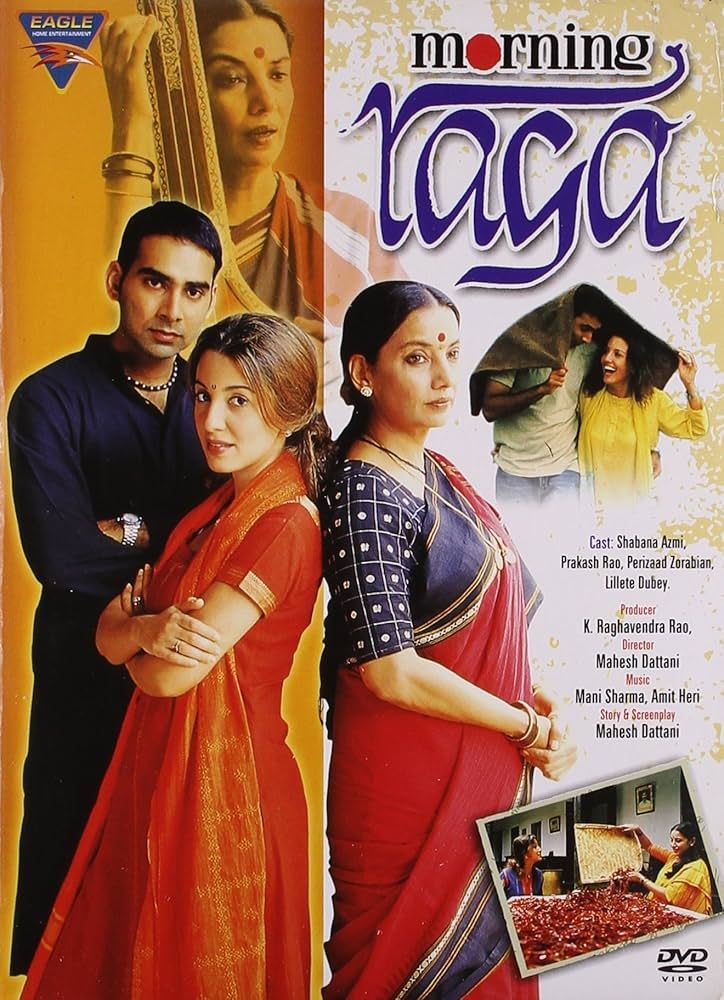
Morning Raga (2004) is an Indian English-language musical drama film written and directed by Mahesh Dattani, and produced by K. Raghavendra Rao under Arka Media Works. The film features a distinguished cast including Shabana Azmi, Prakash Kovelamudi, Perizaad Zorabian, Lillete Dubey, and Nassar.
Set in the backdrop of Andhra Pradesh, the film combines English with the Godavari dialect of Telugu, reflecting its cultural roots. Morning Raga centers around three Telugu characters, each haunted by personal tragedies, whose paths intersect through their shared love of music. As their stories unfold, music becomes both a means of connection and a tool for healing.
The film begins with a beautiful sequence howing peaceful village life in South India, set to a Carnatic classical song sung by Swarnalata (Shabana Azmi), a respected woman from a wealthy landowning family. Another important figure in the village is Abhinay (Prakash Kovelamudi), a young man who has inherited his father’s (Nassar) large property after losing his t ayoung age. But Abhinay doesn’t want to follow the traditional path of managing land. Having grown up in the city, he dreams of starting a music group that plays Western pop—something completely unfamiliar and unusual in his traditional village.
It is the death anniversary of Abhinay’s mother, and his father performs the usual Hindu rituals by the river, just as he does every year. This time, Abhinay is with him after many years. As they reach the riverbank, a woman who has just finished her own rituals is about to leave. She is Swarnalata. When she sees Abhinay standing with his father, she stares at him with deep emotion. Abhinay notices her intense gaze and, feeling curious, decides to follow her through the village after hesitating for a moment.
While walking, Abhinay becomes distracted. Suddenly, a car comes speeding toward him. It almost hits him but swerves at the last second and crashes into some bushes instead. The near accident leaves Swarnalata visibly shaken, and she runs away toward her home. Abhinay, who has fallen, cannot go after her.
He then meets the driver of the car, a stylish and modern city girl named Pinky (Perizaad Zorabian). Since her car is damaged and she has nowhere to stay in the village, Abhinay takes her to his home. His father warmly invites her to stay for a few days while the car is being repaired.
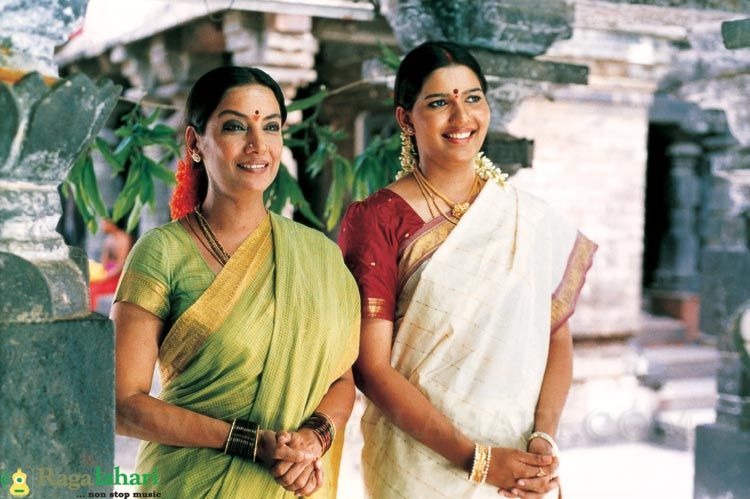
Swarnalatha, a Carnatic singer, has lived with grief for 20 years after losing her son and best friend, Vaishnavi, in a tragic bus accident. Vaishnavi’s son, Abhinay, now dreams of forming a music troupe that creates timeless music. He leaves his job composing jingles and returns to his village, upsetting his father, who wants him to manage their ancestral land.
On his mother’s death anniversary, Abhinay hears Swarnalatha sing at the temple and realizes she knew his mother. As he follows her, he is hit by a car driven by Pinky, a modern city girl. The accident deeply affects Swarnalatha, recalling the old tragedy at the same bridge.
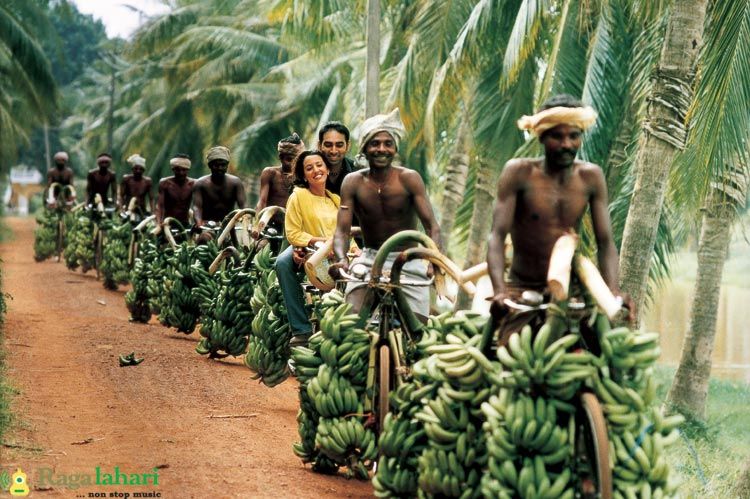
Pinky’s car breaks down, and she stays in the village. The next day, she and Abhinay head to Hyderabad, find bandmates, and begin rehearsals. Though their rock fusion group gets some chances, they struggle for respect.
Abhinay later gives Swarnalatha his mother’s violin and invites her to join the troupe, but she refuses. Her husband then suggests the troupe perform at their house during Ganesh Chaturthi.
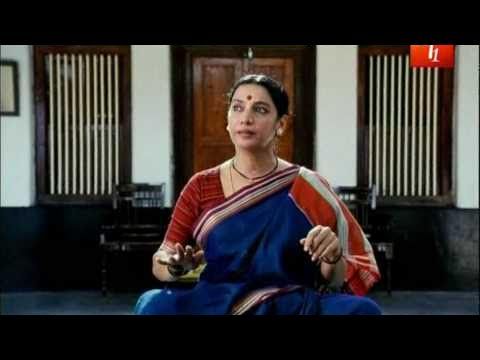
On Ganesh Chaturthi, the troupe arrives and Swarnalatha begins singing “Mahaganapathi Manasa Smarami.” However, she shifts into an advanced svaram section that the band cannot accompany. That evening, Abhinay again asks her to sing in the city, but she refuses. Hurt, Abhinay reminds her that he is the son of her best friend and that she owes him something.
The next morning, Abhinay’s father voices his disapproval of his son’s music career in front of Swarnalatha. Moved by this, she agrees to sing for Abhinay. She and her husband set off for the city, but their car breaks down, and they take a bus—which must cross the bridge tied to her trauma. Overcome with fear, Swarnalatha stops the bus and collapses. They return home, and her husband informs Abhinay she won’t be able to perform.
Later, Swarnalatha calls Pinky and offers to teach her Carnatic music. Pinky begins her lessons, and Abhinay plans a concert featuring her, though he still hopes Swarnalatha will change her mind. Swarnalatha, however, refuses, believing the bridge is a punishment for her past ambition.
One day, frustrated by Swarnalatha’s fear, Pinky drives her across the bridge. Swarnalatha panics and cries out, “Stop the car! We’re all going to die.” Pinky then reveals that it was her drunk father who caused the bus accident years ago.
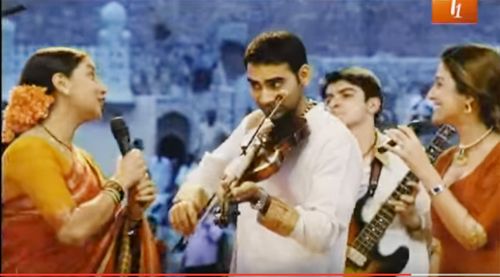
In the final scene of Morning Raga, Swarnalatha overcomes her long-held trauma and steps onto the stage at Pinky’s urging. She performs the Carnatic krithi “Thaaye Yashoda”, and before singing, she softly declares, “I sing this song for my son, Abhinay.” In that moment, Swarnalatha becomes a symbolic Yashoda to Abhinay, offering him the love, support, and guidance, he lost with his own mother’s death. Her performance marks not just her return to music, but also a personal transformation, as she finally lets go of the guilt that held her back. The concert becomes a triumphant celebration of healing, connection, and the union of past and present.
In Morning Raga, Mahesh Dattani brings his theatrical sensibility to the screen, combining music, memory, and emotion in a visually lyrical narrative. The film explores the clash between tradition and modernity, personal trauma and healing, through the lives of characters connected by music.
Classical Carnatic ragas are not just background they’re central to character development and emotional expression. The film opens with poetic visuals of rural South India, echoing the serenity of Carnatic music. Dattani attempts to fuse the old (classical music, rural setting) with the new (Western pop, urban culture), mirroring the inner conflicts of the characters.
Shabana Azmi plays Swarnalatha, a classically trained Carnatic singer haunted by the tragic loss of her son and best friend in a bus accident two decades earlier. She lives in emotional isolation in her village, refusing to cross the bridge tied to her trauma. Her character represents tradition, loss, and the healing power of music. Azmi brings grace and depth to this emotionally complex role.
Prakash Kovelamudi plays Abhinay, the son of Swarnalatha’s deceased best friend, Vaishnavi. A modern, city-raised musician, he dreams of forming a fusion music troupe that blends classical and Western styles. His return to the village sets off the emotional journey of the film, as he tries to reconnect Swarnalatha with music and help her overcome her past.
Ranjani Ramakrishnan a real-life Carnatic violinist, she appears in the film in the role of Vaishnavi (Abhinay’s mother), and performs several classical violin segments. Her musical presence in the film adds authenticity to the portrayal of Carnatic music, especially in emotionally significant flashback scenes.
Morning Raga features cinematography by Rajiv Menon, known for his lyrical and expressive visual style. He beautifully captures the lush South Indian landscapes, especially the Godavari region, using soft, natural light to reflect the serenity of Carnatic music. Menon contrasts the peaceful village with the bustling city, highlighting the film’s theme of tradition versus modernity. His close-ups and lingering shots, especially of Swarnalatha, subtly convey emotional depth and inner conflict, enhancing the film’s musical and dramatic resonance.
The film blends Carnatic classical music with modern fusion elements. Its soundtrack was composed by Mani Sharma and Amit Heri, offering a unique mix of tradition and experimentation.
“Mahaganapatim” – Sung by Bombay Jayashree, a classical invocation in praise of Lord Ganesha, rooted in Carnatic tradition. Bombay Jayashree’s rich and meditative voice lends depth and spiritual resonance to the piece.
“Thaye Yashoda” – Sung by Sudha Ragunathan, a well-known Carnatic krithi describing the mischievous childhood of Lord Krishna. Sudha Ragunathan’s expressive rendition brings both emotion and technical mastery to this song.
Morning Raga is a story about the meeting of worlds. It brings together the modern and the traditional, weaving the past into the present, and blending Carnatic classical music with Western styles in a way rarely seen before. It explores the delicate interplay between fate, coincidence, and personal choice. At its heart, the film reflects the spirit of our times an era where diverse worlds constantly intersect and influence one another.
Photos courtesy Google. Excerpts taken from Google.
 Writer Sunita