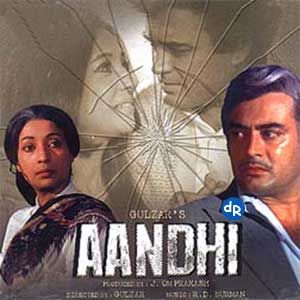
Based on a story by Kamleshwar and co-written by Bhushan Banmali and Gulzar (who also directed the film), Aandhi (1975) opens with what has become Gulzar’s signature drawing us in with a compelling present that hints at a layered past. Starring Sanjeev Kumar and Suchitra Sen, this political drama stirred controversy upon its release due to claims that it was based on Prime Minister Indira Gandhi and her estranged husband. Gulzar, however, clarified that while the character of Aarti Devi was visually inspired by both Indira Gandhi and Tarkeshwari Sinha, the narrative itself was entirely fictional.
The couple meets after years, Gulzar crafts understated drama with a subtle thread of wit. Through quiet moments and unspoken tensions, come to understand what once brought Aarti Devi and J.K. together, and then, how their bond began to fray first with small perforations, then with irreparable tears. This unraveling unfolds even as, in the present, Aarti’s political campaign gains momentum. A stone-throwing incident jolts J.K., whose concern raises red flags for her campaign manager, hinting at a past that refuses to remain buried.
J.K. is a quiet, dignified hotel manager. One evening, he comes to the aid of a young woman, Aarti, the daughter of a prominent politician, who is found drunk and in a vulnerable state. Touched by his kindness and calm strength, Aarti gradually falls in love with him. The two marry in a simple, private ceremony.
For a while, their life together is peaceful. However, as time passes, differences begin to emerge particularly around Aarti’s growing political ambitions and J.K.’s preference for a quieter, more grounded life. Their conflicting priorities and expectations create tension, ultimately leading them to separate, setting the stage for the film’s central emotional and political drama when they meet again years later.
Years later, J.K. and Aarti cross paths again when she, now a successful and well-known politician, happens to stay at his hotel during an election campaign. Though time and distance have separated them, the emotional bond remains. Both feel a lingering closeness, but Aarti hesitates to rekindle their relationship, fearing that it could damage her public image and political career.
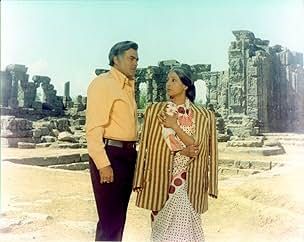
The tension reaches a peak when the opposition party holds a rally to defame Aarti Devi, questioning her personal life and values. In a powerful and dignified moment, Aarti confronts the crowd. She addresses the public directly, explaining that she made the difficult choice to leave her husband and family not out of selfishness, but to dedicate herself fully to serving the nation.
The public is moved by Aarti Devi’s heartfelt speech and her honest admission of sacrifice. Her sincerity wins back the trust of the people, and they applaud her strength and dedication. J.K. arrives at the rally and quietly offers his support, standing by her side. Overwhelmed with emotion, Aarti declares that she will leave politics and return home, believing that her personal happiness matters more.
J.K., in a moment of quiet wisdom and enduring affection, tells her that what truly matters is her own sense of fulfillment—whether it lies in public service or in personal life. His words, tender yet empowering, reaffirm her path. Encouraged, Aarti chooses to continue her political journey. She contests the election and wins.
In the film’s final scene, J.K. drives her to the helipad. As the helicopter lifts off, he watches silently, accepting the differences that once separated them. The moment captures their mutual respect, emotional closure, and the quiet acknowledgment that love need not always culminate in union—it can also mean letting go, and honoring the other’s destiny.
Aandhi is a beautiful tapestry of the man-woman relationship that doesn’t shy away from unraveling its romantic veneer to expose the underlying tensions and emotional strain that any marriage must navigate. In that sense, two people brought together by love but pulled apart by ideology face an even steeper challenge in sustaining their bond.
Gulzar doesn’t judge his characters and magically, neither do we. They behave not as archetypes, but as real, flawed human beings, caught in a storm of circumstances they can’t fully control. Both would rather retreat into their respective comfort zones than risk the vulnerability it takes to salvage what matters most.
Aandhi is a deeply mature exploration of how age brings a quiet grace—one born not of resignation, but of acceptance. With time, decisions that once divided can be seen in a new light, guided by wisdom and made for the right reasons.
Director, poet-filmmaker Gulzar, Aandhi transforms from a political drama into a tender, introspective story of love, loss, and sacrifice. With emotional subtlety and poetic realism, Gulzar avoids melodrama, focusing instead on quiet moments, internal conflict, and lyrical flashbacks. The result is a timeless work of layered storytelling and emotional truth.
Suchitra Sen delivers one of her finest Hindi film performances as Aarti Devi—a disciplined, ambitious politician torn between duty and desire. With quiet intensity and dignified restraint, she portrays a woman shaped by love and sacrifice, her character subtly echoing Indira Gandhi. Though occasionally a bit stiff, especially in the political scenes, Sen shines in the older, more introspective shades of Aarti. A.K. Hangal lends warmth and grounded emotion as the loyal aide torn between the woman he raised and the man he respects, adding emotional depth to the narrative.
Sanjeev Kumar is simply terrific as J.K., a gentle, principled hotel manager whose quiet life is upended by the return of his estranged wife, Aarti. With grace, restraint, and that signature twinkle in his eyes, Kumar embodies a man torn between pride and longing. He captures the ache of unresolved love and the quiet torment of emotional restraint, delivering a performance that is both deeply moving and effortlessly powerful few actors could have brought such nuance and magnetism to a role like this.
The narrative balances political intrigue with strong performances from Om Prakash as a sly campaign manager and Om Shivpuri as the ruthless opposition with the quiet turmoil of a relationship frayed by conflicting ideals. In one sharp moment, a remark about changing weather turns prophetic: “There’s going to be a storm” aptly capturing the emotional and political turbulence at the film’s core.
The soulful music of Aandhi was composed by Rahul Dev Burman, with evocative lyrics by Gulzar. The soundtrack is celebrated as one of the most emotionally resonant in Hindi cinema, blending lyrical depth with haunting melodies. All the songs were beautifully sung by Kishore Kumar and Lata Mangeshkar, and are picturised on the lead pair, Sanjeev Kumar and Suchitra Sen, capturing the emotional nuances of their relationship.
“Tere Bina Zindagi Se“ is a melancholic yet tender duet that captures the emotional complexity of separation—the ache of lost moments and the quiet persistence of love. It reflects the lingering bond between J.K. and Aarti, even after years apart.
“Tum Aa Gaye Ho Noor Aa Gaya“ a tender and uplifting song that celebrates the joy of reunion. It beautifully captures the emotional intimacy rekindled between the estranged couple. The arrival of a loved one is equated with the arrival of light, hope, and warmth—making it one of the most romantic and heartfelt moments in the film.
“Is Mod Se Jate Hain” a contemplative and emotionally layered song, it expresses the uncertainty and quiet sorrow of parting ways. Gulzar’s introspective lyrics, paired with R.D. Burman’s understated composition, evoke the feeling of standing at a crossroads where choices must be made, and familiar paths left behind. The song beautifully symbolizes the bittersweet moments of transition in life and love.
These songs remain timeless, not only for their musical brilliance but also for how seamlessly they integrate into the film’s narrative, enhancing its emotional depth and complexity.
At the 23rd Filmfare Awards, Aandhi received critical acclaim. Suchitra Sen was nominated for Best Actress, while Sanjeev Kumar won the Filmfare Award for Best Actor for his nuanced performance. The film also won the Filmfare Award for Best Film (Critics), further cementing its status as a landmark in Indian political and emotional cinema.
Photos courtesy Google. Excerpts taken from Google.
 Writer Sunita