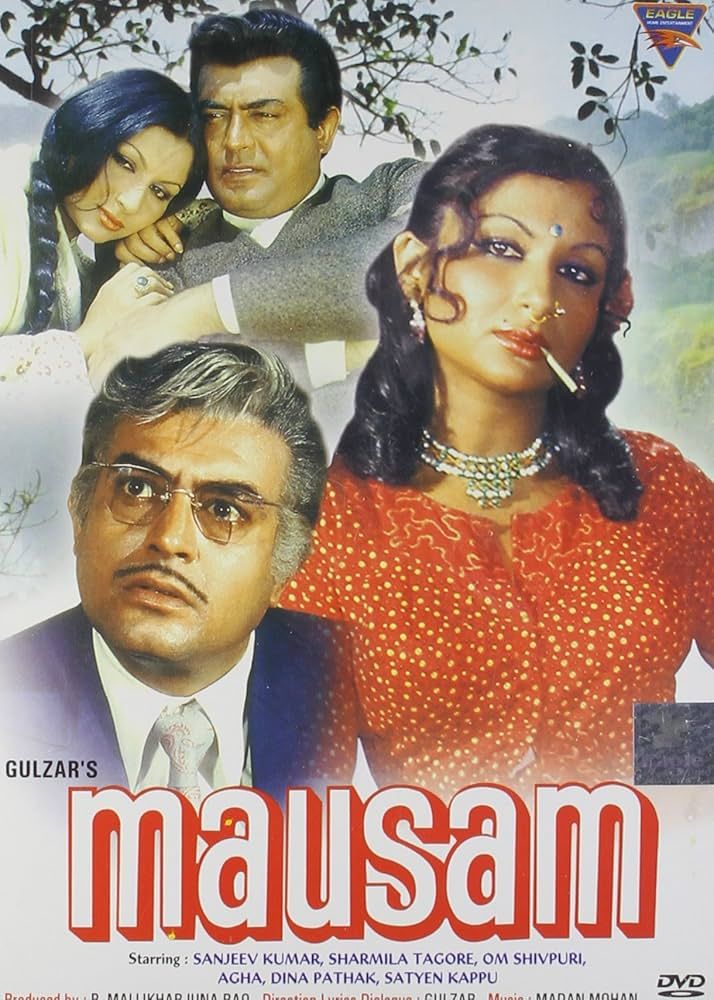
Mausam is a 1975 Indian Hindi-language musical romance film directed by Gulzar and starring Sanjeev Kumar and Sharmila Tagore. Loosely inspired by A.J. Cronin’s 1961 novel The Judas Tree, the film explores themes of love, loss, regret, and redemption.
Mausam opens with the soft strains of “Dil Dhoondta Hai Phir Wohi”, as a car winds its way through the misty hills of Darjeeling. Inside is Dr. Amarnath Gill (Sanjeev Kumar), a wealthy and successful physician seeking rest and solitude. His subordinates have arranged a quiet bungalow for him, complete with a cook. Gill reminisces that he last visited these hills 25 years ago when, as he says with a smile, he met with an “accident”: he fell in love. His companions laugh, brushing it off as a youthful escapade.
The next morning, Gill wakes early and stops at a roadside tea stall, reflecting on how much the town has changed. He tells the tea-seller that back then, there were hardly any vehicles or hotels; he had stayed as a paying guest. The past begins to stir within him, quietly setting the stage for a deeper journey.
While visiting Darjeeling, Dr. Amarnath Gill learns that Harihar Thapa, a local healer, died heartbroken after his daughter Chanda was abandoned by a doctor who never returned. Gill is shaken, he was that doctor. Twenty-five years earlier, while recovering from an injury, he had fallen in love with the innocent Chanda during his stay at Thapa’s home, only to leave and never come back.
Initially upset that her father won’t charge Dr. Gill, Chanda warms to him as their home fills with lighthearted affection. When Gill falls ill, Chanda cares for him tenderly, and their bond grows through playful banter—especially over a walking stick they keep stealing from each other. Amidst teasing and warmth, love blossoms between them.
In the present, Dr. Gill visits a factory where Chanda once worked and learns that her husband had died soon after their marriage. She later moved to Dhaolpur with her daughter. Haunted by guilt, Gill traces her path. A local vaid tells him that Chanda worked with him briefly, but left after her abusive brother-in-law threatened to take away her daughter. Determined to secure a better future for her child, Chanda endured great hardship before eventually leaving for Siliguri.
In Siliguri, Dr. Gill visits Chanda’s last known address and learns from the locals that she had died just months earlier—still waiting for his return. Though her daughter Kajli had sent money for her care, she never came to visit and stopped writing after Chanda’s death. Gill is deeply moved to discover that Chanda had preserved an ivory necklace for Kajli’s dowry—a tender reminder of their lost love and his broken promise. The necklace rekindles memories of old quarrels and shared dreams. As he prepares to leave, fate intervenes—at a chemist’s shop, he unexpectedly comes face to face with someone from his past.
A disturbed Dr. Gill returns to the brothel to see Kajli. Struck by her uncanny resemblance to Chanda, he is further unsettled by her abrasive, foul-mouthed demeanor and bitter cynicism toward love and kindness. When he expresses concern, Kajli scoffs at his intentions, sneering sarcastically, “He wants to adopt me!”
The next night, Gill returns and pays Kajli to accompany him on his visit to Darjeeling. Amused but guarded, she agrees and moves in. As Gill gently tries to reform her—discouraging her foul language, smoking, and provocative dress—Kajli resents the intrusion, pointedly reminding him that he paid for her company, not control. Misunderstood both by Kajli and his own acquaintances, Gill quietly bears the emotional weight of being in the presence of the daughter of the woman he once loved a young woman shaped by trauma, yet unknowingly echoing Chanda in her gestures, her spirit, and even her defiance.
Haunted by Kajli’s striking resemblance to Chanda, Dr. Gill forms a quiet bond with her while concealing their true connection. Driven by guilt, he gently tries to reform her, offering kindness in place of judgment. Misreading his compassion as romantic interest, Kajli confesses her hatred for the man who once abandoned her mother unaware that she is speaking to him. As guilt tightens its grip on Gill and Kajli begins to change, Mausam unfolds as a poignant exploration of remorse, redemption, and the fragile possibility of healing. Gulzar masterfully weaves past and present into an emotionally layered narrative.
The relationship between Dr. Gill and Kajli is fraught with suppressed truths, emotional tension, and unspoken pain. While Kajli, unaware of his past, begins to fall for him, Gill seeks atonement not love hoping to rescue her from the life fate has thrust upon her.
Gulzar served as the director, screenwriter, and dialogue writer, playing a central creative role in shaping the film’s tone, structure, and emotional depth. Gulzar infused the narrative with his signature sensitivity and poetic realism. His direction balances past and present through gentle flashbacks, allowing the characters’ inner lives especially Amarnath and Kajli to unfold gradually and with emotional restraint. Gulzar’s treatment avoids melodrama, instead focusing on introspective moments, moral complexity, and subtle human emotions. Gulzar’s vision is what elevates Mausam into a poignant exploration of love, loss, guilt, and redemption.
Sanjeev Kumar plays a middle-aged doctor who returns to a hill town after 25 years to atone for abandoning his former lover, Chanda. Instead, he finds her daughter Kajli, now a sex worker, and seeks redemption by giving her a better life. His performance, marked by quiet introspection and emotional depth.
Sharmila Tagore delivers a powerful dual performance as Chanda, a gentle village girl abandoned by her lover, and Kajli, her daughter, a defiant yet vulnerable sex worker. She skillfully contrasts innocence with emotional toughness, capturing Kajli’s journey from mistrust to heartbreak.
The background score for the film was composed by Salil Chowdhury, while the songs were composed by Madan Mohan.
“Dil Dhoondta Hai,” composed by Madan Mohan with lyrics by Gulzar, appears in Mausam in two versions that mirror the film’s emotional arc. The sad version, sung by Bhupinder Singh, captures Dr. Amarnath’s regret and longing through a haunting, minimalist arrangement. In contrast, the main duet with Lata Mangeshkar evokes romantic nostalgia and tender memories. Gulzar’s poetic lyrics express a deep yearning for life’s quiet, fleeting moments, making the song a timeless classic of Hindi cinema.
The songs “Chhadi Re Chhadi,” “Mere Ishq Mein,” and “Ruke Ruke Se Qadam” in Mausam reflect the complex emotional landscape of the film’s characters.
Mausam received critical acclaim and several prestigious honors, notably at the 23rd National Film Awards, where it won Second Best Feature Film and Best Actress for Sharmila Tagore. At the 24th Filmfare Awards, the film won Best Film and Best Director for Gulzar, while earning nominations in multiple major categories, including Best Actor (Sanjeev Kumar), Best Actress (Sharmila Tagore), Best Supporting Actress (Dina Pathak), Best Music Director (Madan Mohan), Best Lyricist (Gulzar for “Dil Dhoondta Hai”), and Best Story (Kamleshwar). These accolades reflect the film’s powerful storytelling, nuanced performances, and poetic musical depth.
Photos courtesy Google. Excerpts taken from Google.
 Writer Sunita