
Heidi is a 1937 American musical drama film directed by Allan Dwan. The screenplay was written by Julien Josephson and Walter Ferris, and the story is loosely based on Johanna Spyri’s classic 1880 children’s book Heidi.
In the story, a brave and cheerful orphan girl is suddenly left in the care of her grumpy, reclusive grandfather. Later, she is taken away again and sent to live as a companion for a lonely, disabled girl in a wealthy household.
The story shows the orphaned Heidi Kramer (played by Shirley Temple) being treated badly by several people, but she stays cheerful and full of happiness no matter what happens to her. Her Aunt Dete (Mady Christians), who has been looking after her, gets a job with a rich family. So, she leaves Heidi at the home of her grandfather Adolph (Jean Hersholt), who lives alone in the mountains and doesn’t like being around people.
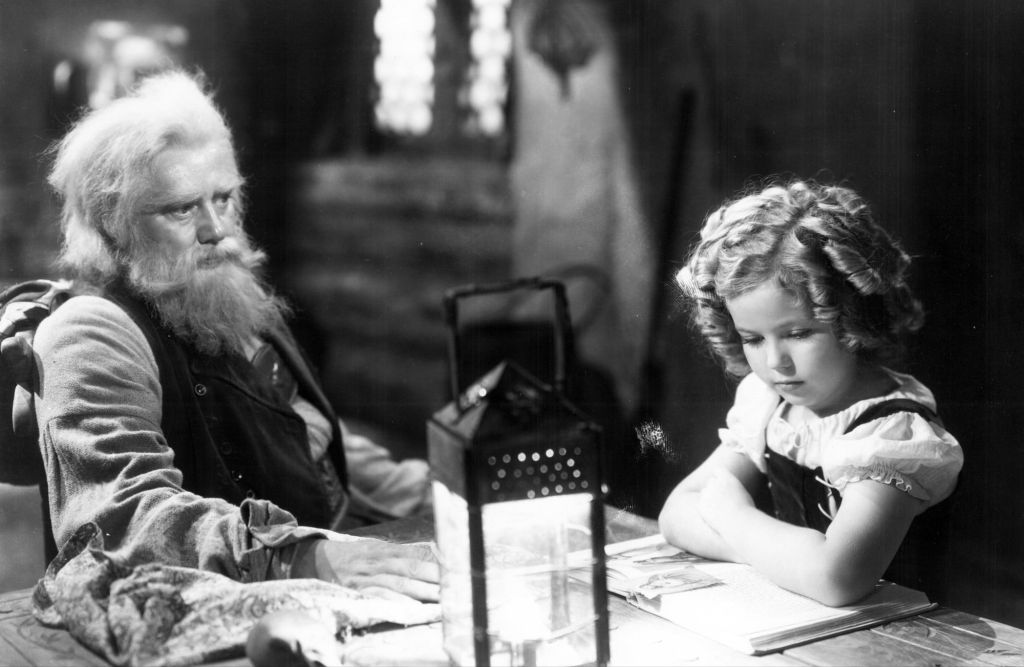
Adolph has been angry at the world ever since his son married someone he didn’t approve of, and the townspeople supported his son instead of him. But even with all his bitterness, Adolph can’t resist Heidi’s charm. Through a series of heartwarming moments, Heidi’s love and cheerfulness melt his anger, and he slowly reconnects with the villagers. The film also makes a clear reference to the Bible story of the Prodigal Son, showing themes of forgiveness and return. It suggests that people should keep faith in God, no matter their troubles.
Heidi is then taken away again by her aunt and brought to the wealthy Sesemann household in Frankfurt am Main. There, she is meant to be a companion to Klara (Marcia Mae Jones), a lonely, disabled girl who uses a wheelchair and is constantly supervised by the strict and unfriendly Fräulein Rottenmeier (Mary Nash). Before they leave, the local pastor sees Heidi and her aunt and learns that Heidi is being taken to Frankfurt. He passes this information on to Heidi’s grandfather, who immediately begins searching for her. Although Heidi is unhappy in her new environment, she tries to stay positive, but she always misses and longs to return to her grandfather.
Klara’s loving father comes to visit at Christmas. When Klara shows him that she can walk again, he is very happy and offers Heidi a home with them. But Heidi says she still wants to go back to her grandfather. Later, he tells Klara that he changed his mind because Heidi’s aunt told him her grandfather is a cruel man, and Heidi would be safer with them.
Fräulein Rottenmeier, who wants Klara to stay weak and depend on her, is caught being mean to Heidi. Herr Sesemann, Klara’s father, sees this and fires her. Rottenmeier then tries to get rid of Heidi by selling her to the gypsies, but Heidi’s grandfather arrives just in time to stop her.
Rottenmeier lies to the police when they arrive, saying that Heidi’s grandfather has kidnapped her. The police chase after him, but Heidi tells them the truth—that he is her grandfather and that Rottenmeier was trying to sell her to the gypsies. She also tells them that Herr Sesemann can confirm her story. In the next scene, Heidi is happily reunited with her grandfather on the mountain, and Herr Sesemann and Klara come to visit them.
Allan Dwan as the director, his role was to guide the overall vision of the film how the story was told on screen, how the scenes were shot, and how the actors performed. He worked closely with the cast and crew to shape the mood, pacing, and emotional tone of the film. Dwan helped bring out the best in Shirley Temple’s performance as Heidi and balanced the film’s mix of drama, emotion, and warmth. His direction helped turn Heidi into a charming and successful film that appealed to both children and adults.
Jean Hersholt’s acting as Adolph Kramer, Heidi’s grandfather, is warm, sincere, and emotionally layered. At the beginning of the film, he convincingly portrays a gruff and withdrawn old man who has shut himself off from the world. His body language, stern expressions, and quiet tone reflect a man who has been hurt and chooses isolation.
As the story unfolds, Hersholt skillfully shows a gradual change in his character. He softens naturally, showing subtle warmth in his eyes, gentler speech, and growing affection for Heidi. His transformation feels believable and touching, making the audience sympathize with him.
Critics praised Hersholt’s performance, with Variety calling him “excellent.” His portrayal brought depth to the role and created a strong emotional connection between Heidi and her grandfather one of the film’s most heartfelt elements.
Shirley Temple’s acting as Heidi is charming, heartfelt, and full of energy. She brings warmth and joy to the character, making Heidi a lovable and unforgettable figure. As a cheerful and kind-hearted orphan, Temple captures the innocence and optimism of a child who brings light into the lives of everyone around her.
She shows a wide range of emotions in the film happiness while living in the mountains with her grandfather, sadness and homesickness when taken away, and courage during difficult moments. Her expressions, timing, and natural way of speaking make her performance feel real and sincere, especially in emotional scenes.
Critics praised her work in Heidi, with Film Daily calling it “one of her best” and Lewiston Evening Journal saying she had never been given a more captivating role. Shirley Temple’s performance is a major reason why the film became so popular and remains a classic.
Arthur Miller, cinematographer, his work gave Heidi a warm, storybook feel, especially in scenes set in the beautiful Swiss Alps. He used soft lighting and wide scenic shots to highlight the natural beauty of the mountains and contrast it with the darker, more formal setting of the city (Frankfurt). His cinematography helped create the magical, emotional tone of the film.
David Buttolph and Charles Maxwell composed most of the background score for Heidi, using music to highlight the film’s sweetness, emotion, and dramatic moments especially the bond between Heidi and her grandfather. Ernst Toch, a classical composer, likely added deeper orchestral pieces, enriching the soundtrack. Together, their music enhanced the story’s charm, warmth, and emotional impact.
The movie was a big success when it was released. It helped Shirley Temple maintain her status as the number one box office star for the third year in a row, confirming her immense popularity during that era.
Film critics gave Heidi mostly positive reviews:
Frank S. Nugent said the movie had the sweet and harmless charm you’d expect in a children’s film. He also praised the supporting cast, saying they matched Shirley Temple’s high standards.
Variety magazine gave the cast a lot of credit for the film’s success and said Jean Hersholt (who played the grandfather) was excellent.
Harrison’s Reports called the film “a charming picture” full of emotional appeal.
Film Daily said Heidi was one of Shirley Temple’s best films and praised it for being full of sweet feelings and big laughs that made people really enjoy it.
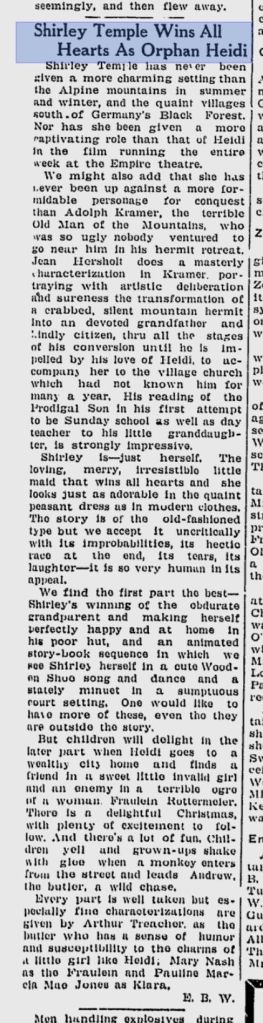
The Lewiston Evening Journal wrote that this was perhaps Shirley Temple’s most lovable role. Although the story was old-fashioned, the reviewer said people would accept its emotional moments, fast-paced ending, and mix of sadness and joy because it felt very human.
Set against the backdrop of 19th-century Europe, the film explores themes of innocence, resilience, and the healing power of love and kindness. With its emotional depth, uplifting music, and Shirley Temple’s charming performance, Heidi became one of the most beloved family films of its time.
Photos courtesy Google. Excerpts taken from Google.
 Writer Sunita