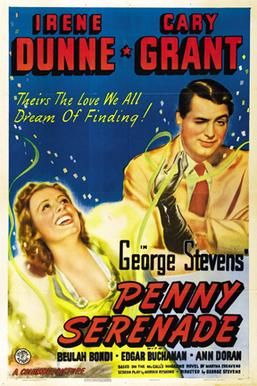
“Penny Serenade” (1941) is an American melodrama film directed by George Stevens, starring Irene Dunne and Cary Grant as a devoted couple who face emotional and financial hardships while trying to sustain their marriage and raise a child. Produced and distributed by Columbia Pictures.
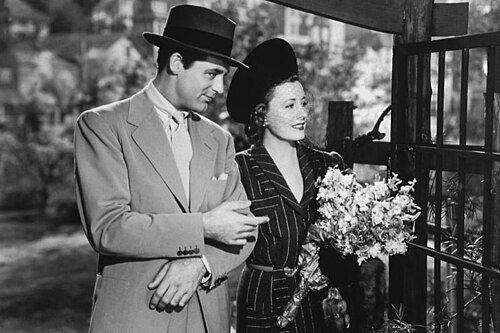
The film traces the meeting, courtship, and marriage of Julie Gardiner (Irene Dunne) and Roger Adams (Cary Grant), using popular songs of each era to mark the passage of time and key emotional moments. After a spontaneous wedding on New Year’s Eve, the couple spends the night in Roger’s train compartment as they head to San Francisco. Later, a pregnant Julie travels to Tokyo to join Roger, who is working there as a newspaper reporter.
However, their hopes are shattered when a devastating earthquake destroys their home and causes Julie to suffer a miscarriage. Heartbroken, they return to the United States, where Roger decides to start over by purchasing a small-town newspaper.
Grief-stricken and uncertain about their future, they find new hope when their close friend, Applejack Carney (Edgar Buchanan), suggests they consider adoption. While Roger works tirelessly to keep his small newspaper afloat in the fictional California town of Rosalia, Julie focuses on maintaining their home and preparing a nursery in anticipation of their new life as parents.
The couple applies to an adoption agency hoping for a two-year-old boy, but soon receives a call from Miss Oliver (Beulah Bondi) informing them that a five-week-old baby girl is available. Although Roger initially preferred a boy, he quickly becomes deeply attached to the infant. Together, he and Julie lovingly care for the child throughout the agency’s required one-year probation period.
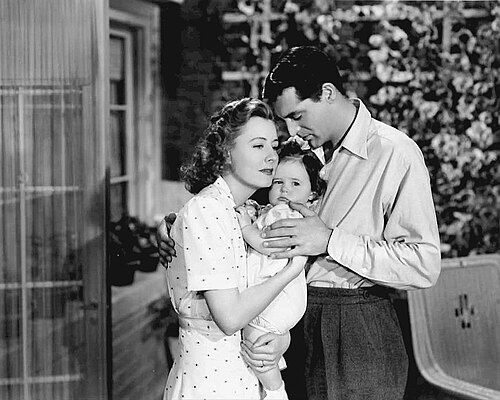
By the end of the probation period, Roger has lost his newspaper, and without a steady income, the law bars him from adopting the child. Desperate not to lose her, he appears before a judge and delivers a heartfelt plea, expressing how deeply he loves the baby and sees her as his own. Moved by his sincerity, the judge grants them custody, and Roger returns home to Julie their daughter now officially theirs.
Years later, Roger and Julie beam with pride as their young daughter, Trina, too small to play an angel in the Christmas pageant, joyfully takes on the role of the “echo” instead.
The following Christmas, Julie writes to Miss Oliver with heartbreaking news—Trina has died suddenly from an illness. Devastated by the loss, Roger falls into a deep depression. Believing he no longer needs her and that their shared bond has been broken, Julie quietly decides to leave him.
Just as Julie is preparing to leave for the train station, the couple receives an unexpected call from Miss Oliver—a two-year-old boy has just become available for adoption. Filled with renewed hope, Roger and Julie embrace, ready to heal and begin a new chapter together as they welcome another child into their lives.
According to George Stevens’ papers housed at the Academy of Motion Picture Arts and Sciences library, the director paid meticulous attention to the chronology of popular songs, ensuring they accurately reflected the time periods depicted in the script. Stevens used music not just as background, but as an emotional thread linking key moments in the couple’s journey. Songs like “The Japanese Sandman,” “These Foolish Things,” “Just a Memory,” “Three O’Clock in the Morning,” “Ain’t We Got Fun,” and “The Prisoner’s Song” were carefully selected to evoke specific eras and moods, underscoring his thoughtful and deliberate approach to storytelling.
Cary Grant’s performance in Penny Serenade is widely regarded as one of the most emotionally powerful of his career. Known mostly for his charm and comedic timing in romantic comedies, Grant shows a very different side here—vulnerable, restrained, and deeply moving.
He plays Roger Adams, a man whose journey from joyful newlywed to grieving father reveals a wide emotional range. His most memorable scene comes when Roger pleads before a judge to keep his adopted daughter—a quiet, heartfelt monologue that earned Grant an Academy Award nomination for Best Actor. In that moment, he abandons his usual suave persona and delivers a raw, honest performance that resonates with viewers even today.
Critics, including those from the Radio Times and The New York Times, praised him for giving a “subtly-shaded portrayal that keeps sentimentality at bay,” proving that Grant was not just a romantic lead but a versatile, serious actor capable of great depth.
Irene Dunne, who plays Julie Gardiner Adams in Penny Serenade, delivers a heartfelt and nuanced performance as a woman who endures joy, heartbreak, and quiet strength through the ups and downs of marriage and motherhood. Her character evolves from a romantic young bride to a nurturing mother and finally to a grieving woman trying to hold her marriage together after the loss of her child.
Dunne brings warmth, dignity, and emotional depth to Julie, particularly in scenes where she expresses silent grief or maternal tenderness. Her portrayal is deeply empathetic, capturing the resilience of a woman who finds purpose through love and caregiving.
Penny Serenade was released on April 24, 1941. As part of its unique promotion in Philadelphia, Ray Wolf, manager of the Affiliated Circuit’s Frolic Theatre, handed out chocolate pennies both door-to-door and at busy street corners during rush hours, creatively tying the giveaway to the film’s title and theme.
The New York Times review of Penny Serenade (May 23, 1941) calls it a tearjerker that surprises viewers with its emotional depth. Known for lighter roles, Cary Grant and Irene Dunne play a devoted couple whose love is tested by tragedy. Director George Stevens blends melodrama and nostalgia with sincerity, using songs like “You Were Meant for Me” to trace their journey. While the script is a bit long and some scenes strain credibility, strong performances—especially by Grant, Dunne, Edgar Buchanan, and Beulah Bondi make the film touching and heartfelt.
Photos courtesy Google. Excerpts taken from Google.
 Writer Sunita