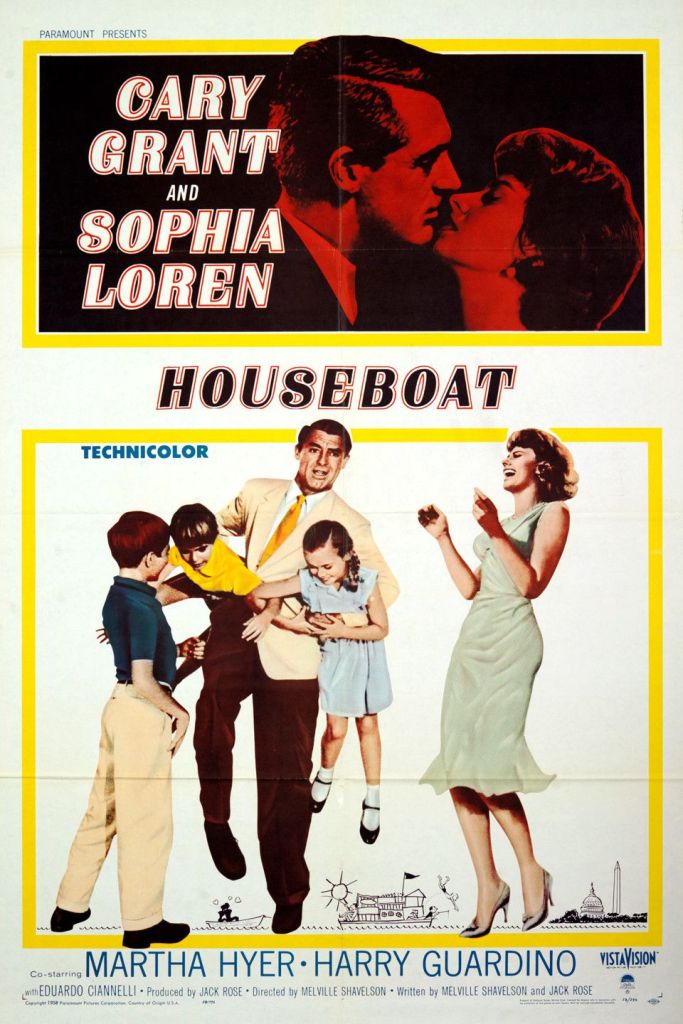
Houseboat is a 1958 American romantic comedy directed by Melville Shavelson and written by Shavelson, Jack Rose, and Betsy Drake. The film stars Cary Grant and Sophia Loren. The story follows a widowed lawyer who, along with his three children and their nanny, begins a new life aboard a houseboat.
Tom Winters (Cary Grant), a widowed U.S. State Department lawyer who has been working in Europe, returns to Washington, D.C. after the death of his wife to reclaim custody of his three children—David, Elizabeth, and Robert—from their wealthy maternal grandparents. While Tom insists on bringing them back to live with him, the children, still grieving their mother and feeling abandoned by their often-absent father, resist his authority and long to remain in the comfort of their grandparents’ countryside home with their aunt Carolyn.
Tom struggles to reconnect with his children, who remain distant and resentful. Hoping to broaden their cultural horizons, he takes them to hear the Boston Symphony. During a symphony performance, young Robert mischievously disrupts the concert by playing his harmonica until Tom quickly takes it away, much to the annoyance of the audience.
Cinzia Zaccardi (Sophia Loren), the conductor’s daughter, chafing under her father’s strict control, cannot help but laugh at the interruption. Shortly afterward, following a quarrel with her father, Cinzia runs off.
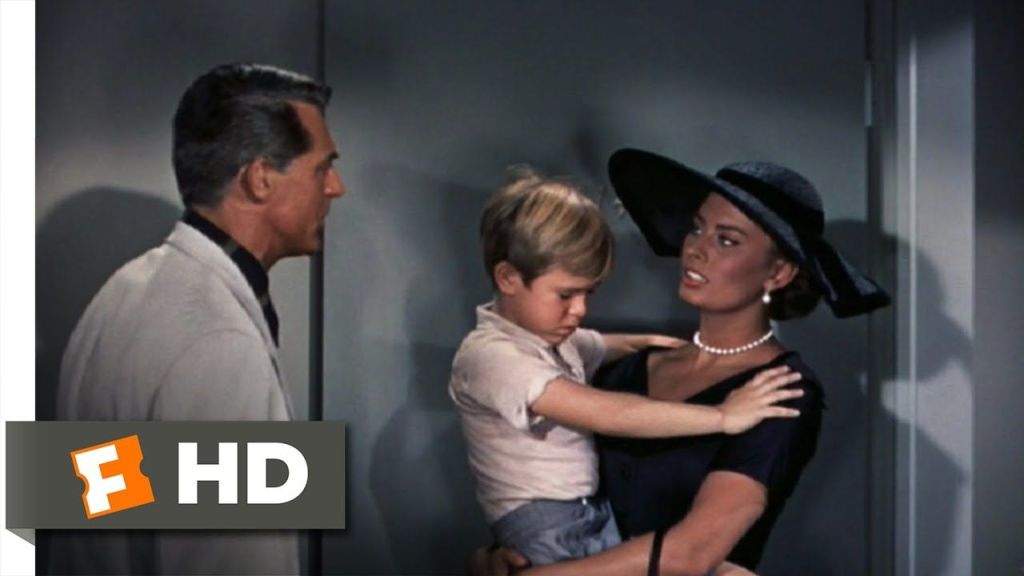
During this time, she meets Robert, who has wandered off and left his father distraught. Taking the boy on a small adventure, she rows him across the water and together they visit a nearby carnival, where they share pizza, play games, dance, and win a harmonica, forming an instant bond. Cinzia finally brings Robert home to a worried Tom.
The next day, Tom, desperate for help, hires Cinzia to care for the children, mistaking her for a maid. Though she has no experience with household duties, she accepts the position as an escape from her restrictive life. Tom tries to relocate the family to a country house, but a train accident destroys it, leaving them with no choice but to move into a dilapidated houseboat.

Tom moves his children into a rundown houseboat that was originally meant to be a fishing shack, determined to build a life with them on his own terms. Life on the boat is chaotic at first, as Cinzia, inexperienced in household chores, cannot cook, do laundry, or even make coffee, leaving Tom increasingly exasperated by her ineptitude. Yet her warmth, patience, and playful spirit gradually win over the children, who begin to see her as a maternal presence, while Tom, despite his frustrations, grows to admire her sincerity and resilience. As Cinzia bridges the emotional distance between father and children, the houseboat itself comes to symbolize their collective attempt to rebuild, and Tom slowly rediscovers the joy of family life—even as his disciplined nature continues to clash with her spontaneity.
Carolyn, who hopes to marry Tom herself, grows suspicious of Cinzia and dismisses her as unsuitable. She arranges social gatherings to draw Tom back into her circle, but he finds himself increasingly captivated by Cinzia’s warmth and independence. The relationship deepens when Tom learns of Cinzia’s true background as the daughter of a famous conductor. Although she fled from a life of privilege, her refinement and charm only make her more appealing to him. Their growing affection is tested, however, by the disapproval of both Carolyn and Cinzia’s father, who wants her to return to a more traditional life.
David, still unhappy with his new life, attempts to run away to live with Carolyn, but nearly drowns in the process. Tom rescues him, and the frightening experience brings father and son closer together. Meanwhile, Tom’s military aide, Captain Wilson, while somewhat drunk, jokingly comments on Cinzia’s living arrangement on the houseboat.
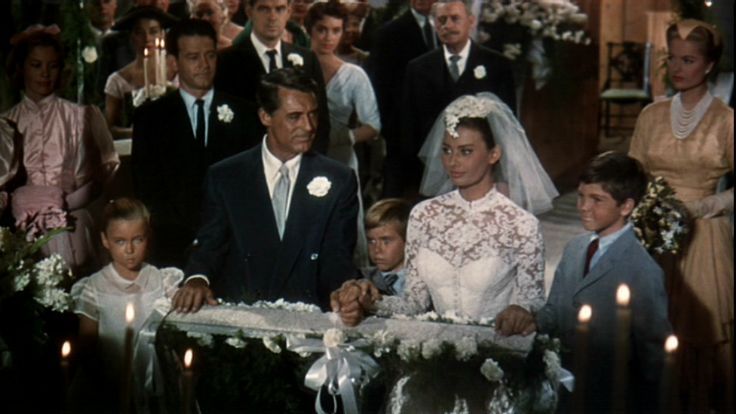
Despite the pressures from their families and societal expectations, the bond between Tom, Cinzia, and the children proves stronger than any obstacle. The family finally comes together in harmony: Tom openly aknowledges his love for Cinzia, and the children fully embrace her as a beloved part of their new life. In a heartwarming final scene, all three children join their father’s marriage, celebrating their unconventional but joyful family. Robert plays his harmonica, filling the houseboat with music and laughter, as the film closes on a note of renewal and the promise of happiness built on love, warmth, and togetherness rather than convention.
Cary Grant delivers his trademark charm and wit, carrying the film with a perfect balance of sophistication, warmth, and comic timing. His portrayal of widowed lawyer Tom Winters makes the character both relatable and engaging, providing the emotional anchor for the family-centric story.
Sophia Loren brings a mix of elegance, playfulness, and vivacity to Cinzia, the Italian nanny. Her performance captures both the character’s independence and warmth, creating a strong chemistry with Grant and endearing her to the children and audience alike.
The three child actors—David, Elizabeth, and Robert—stand out as lively and believable, adding both humor and heart to the story. Their performances help convey the challenges and joys of family life, making the film’s emotional beats resonate. Together, the cast forms a charming ensemble, blending comedy, romance, and family dynamics seamlessly.
The film’s score was composed by George Duning, providing a light, playful backdrop that complements the romantic and comedic tone of the story. The soundtrack also features two notable songs written by Jay Livingston and Ray Evans: “Almost in Your Arms (Love Song from Houseboat),” performed by Sam Cooke, and “Bing! Bang! Bong!”, sung by Sophia Loren. These songs add charm and emotional warmth, enhancing key moments between the characters.
Houseboat was widely praised as a charming, entertaining family comedy. Critics highlighted Cary Grant’s effortless charm, Sophia Loren’s appeal, and the children’s scene-stealing performances. The film was lighthearted, funny, and enjoyable for audiences of all ages.
Houseboat received recognition from several major film organizations. At the Academy Awards, Melville Shavelson and Jack Rose were nominated for Best Story and Screenplay – Written Directly for the Screen, and the song “Almost in Your Arms (Love Song from Houseboat),” with music and lyrics by Jay Livingston and Ray Evans, was also nominated. Sophia Loren earned a Bambi Award nomination for Best Actress – International, while Harry Guardino received a Golden Globe nomination for Best Supporting Actor – Motion Picture. The film was particularly celebrated by the Laurel Awards, winning Top Comedy and awarding Cary Grant Top Male Comedy Performance. Additionally, Shavelson and Rose were nominated for Best Written American Comedy at the Writers Guild of America Awards.
Photo courtesy Google. Excerpts taken from Google.
 Writer Sunita