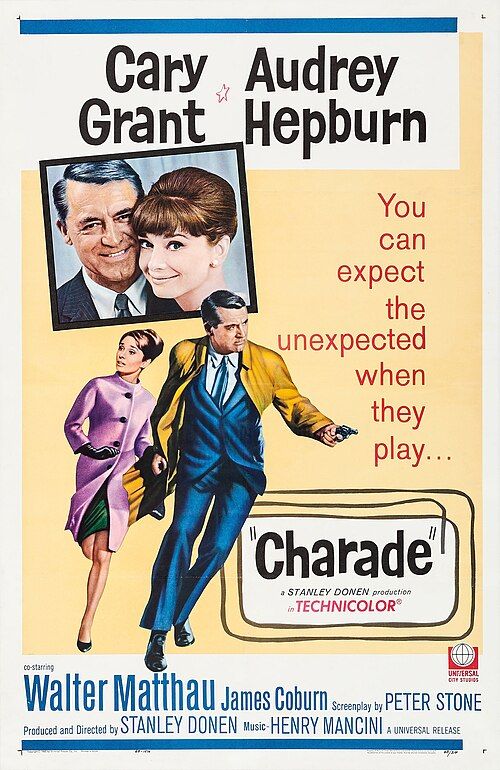
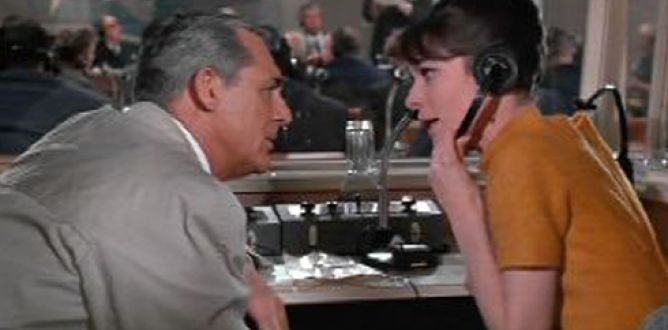
Charade is a 1963 American film that mixes romance, comedy, and mystery. It was directed by Stanley Donen and written by Peter Stone and Marc Behm. The main stars are Cary Grant and Audrey Hepburn, with Walter Matthau, James Coburn, George Kennedy, Dominique Minot, Ned Glass, and Jacques Marin in supporting roles.
The film was praised for its clever story and the strong chemistry between Grant and Hepburn. It was shot in Paris and has animated opening titles by Maurice Binder. The music, by Henry Mancini, includes the famous theme song “Charade.”
While on a ski holiday, Mrs. Regina Lampert (Audrey Hepburn) tells a friend that she wants to divorce her husband. During the holiday, she meets a charming stranger named Peter Joshua (Cary Grant).
When Regina returns to Paris, she finds her apartment completely emptied. A police inspector explains that her husband Charles had sold all their possessions and was later murdered after leaving the city. Reggie is given Charles’s small travel bag, which contains a letter addressed to her, a ship ticket to Venezuela, four passports under different names, and other curious items.
At Charles’s sparsely attended funeral, three strange men appear. One pokes the body with a pin, another uses a mirror to check for breath, clearly making sure Charles is truly dead.
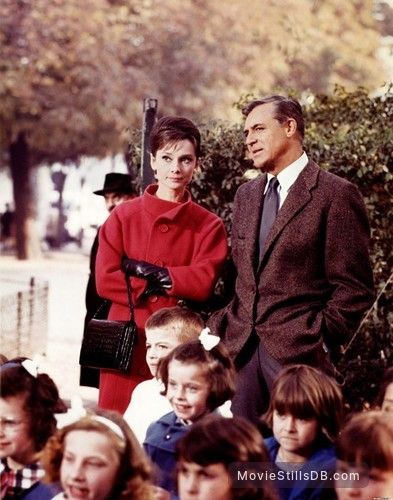
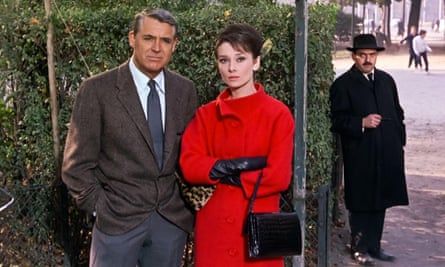
Reggie is called to the American Embassy to meet Hamilton Bartholomew, a CIA official. He tells her that the three men she saw are Herman Scobie, Leopold W. Gideon, and Tex Panthollow.
During World War II, these men, along with Charles and another man named Carson Dyle, were ordered to deliver $250,000 in gold to the French Resistance. Instead, they stole the gold. Carson was badly hurt in a German attack and left behind, while Charles took all the money for himself.
Now the three men want the missing fortune, and so does the U.S. government. Hamilton warns Reggie that they believe she has it, even if she doesn’t know where it is, and that her life is in serious danger.
Peter helps Reggie move into a hotel. The three criminals take turns threatening her, each one sure she knows where the stolen money is. Herman even tells her that Peter is working with them.
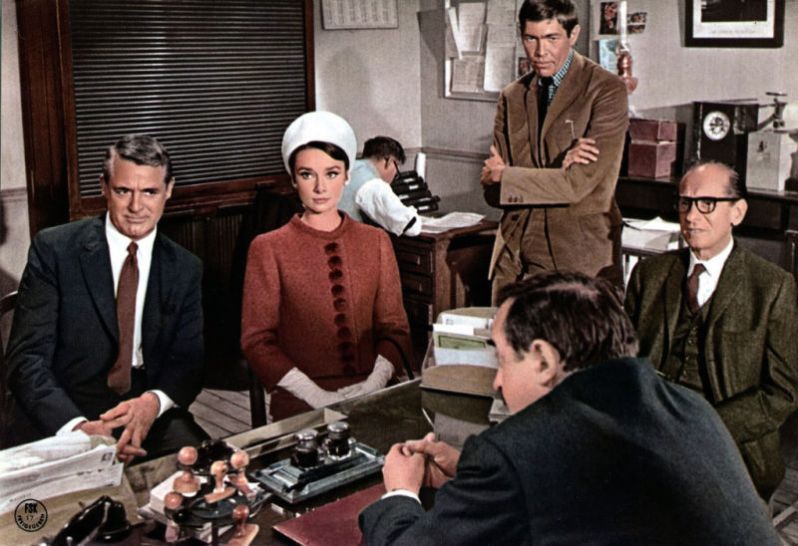
Peter then claims he is really Alexander, the brother of Carson Dyle, and says he only wants justice because the others killed Carson. But soon, Herman and Leopold are murdered. Hamilton later tells Reggie that Carson Dyle never had a brother.
When Reggie asks Peter about it, he admits he is actually Adam Canfield, a professional thief. Reggie is upset that he keeps lying, but she still decides to trust him.
Reggie and Adam visit an outdoor market, where Charles had his last appointment. They see Tex there, and Adam secretly follows him. At the stamp booths, Adam and Tex discover that Charles had bought rare, very valuable stamps and stuck them onto the envelope in his travel bag.
Both men rush to Reggie’s hotel, but the stamps are gone. Reggie suddenly remembers that she gave the envelope, with the stamps to Sylvie’s young son, Jean-Louis. She and Sylvie quickly find him, but he has already traded the stamps to a dealer.
They track down the dealer, who explains that the stamps are worth $250,000. Luckily, he gives them back to Reggie.
Reggie goes back to the hotel and discovers Tex’s dead body. Before dying, Tex wrote the word “Dyle” on the floor. Reggie becomes sure that Adam is the killer, so she calls Hamilton. He tells her to meet him at the Colonnade in the Palais-Royal.
When she goes there, Adam follows her. At the Colonnade, Reggie is trapped between Adam and Hamilton. Adam then reveals the truth: Hamilton is actually Carson Dyle, who survived the war and now wants revenge and the missing fortune.
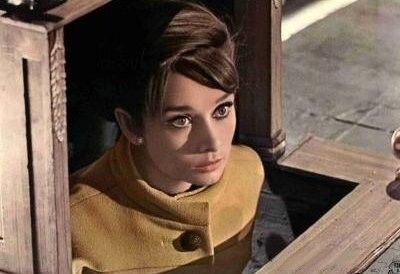
Reggie runs into an empty theater and hides in the prompt box. Just as Carson is about to shoot her, Adam opens a trapdoor beneath him, and Carson falls to his death.
The next day, Reggie and Adam go to the American Embassy to return the valuable stamps. Adam refuses to go inside with her.
Once inside, Reggie learns the truth: Adam is really Brian Cruikshank, a U.S. Treasury agent whose job is to recover stolen government money. Now that his real identity is revealed, Brian proposes marriage to Reggie. She happily accepts and jokes that she hopes they have many sons, so they can all be named after him.
Writers Peter Stone and Marc Behm first wrote the story as The Unsuspecting Wife, but no studio wanted it. Stone then turned it into a novel called Charade, published in Redbook magazine. After that, Hollywood became interested, and Stanley Donen bought the rights. Stone wrote the final script for Cary Grant and Audrey Hepburn, while Behm got story credit.
Cary Grant and Audrey Hepburn both give charming and captivating performances. Grant plays a suave, witty, and mysterious hero, balancing humor, romance, and suspense, while Hepburn shines as the clever, independent, and stylish Reggie, blending vulnerability with intelligence and wit.
Grant’s screen persona shows both a light and a darker, more mysterious side, as critic David Thomson noted: “There is a light and a dark side to him… and whichever is dominant, the other creeps into view.” In a playful reference to North by Northwest, his true identity as Peter is only revealed at the very end. He is smooth, clever, and sometimes threatening, creating a constant tension in his evolving relationship with Reggie.
Despite the 25-year age gap—Grant was 59 and Hepburn 33—the two create believable romantic chemistry. The filmmakers adjusted the script so that Hepburn’s character sometimes takes the lead in pursuing Grant, helping him feel more comfortable during their romantic scenes.
Charade earned several major award nominations and wins. At the Academy Awards, Henry Mancini and Johnny Mercer were nominated for Best Song for “Charade.” Cary Grant received Best Foreign Actor and Audrey Hepburn won Best British Actress at the BAFTAs. Hepburn also earned a Golden Globe nomination, alongside Grant, and the film won the David di Donatello Golden Plate. Peter Stone’s screenplay won the Edgar Allan Poe Award and was nominated by the Writers Guild of America. The film also placed in several Laurel Award categories, including comedy, acting, and music.
Charade was well received on release and continues to earn strong reviews. Critics praised its clever script, twists, and the chemistry between Cary Grant and Audrey Hepburn, though some noted its dark violence. Bosley Crowther of The New York Times admired its witty writing and Stanley Donen’s direction, while Time Out called it a playful audience-pleaser. More recently, Slant Magazine described it as a stylish, chaotic whodunit, comparing it to Agatha Christie’s And Then There Were None.
In 2022, the Library of Congress chose Charade for the U.S. National Film Registry as a film that is “culturally, historically, or aesthetically significant.”
Photo courtesy Google. Excerpts taken from Google.
 Writer Sunita