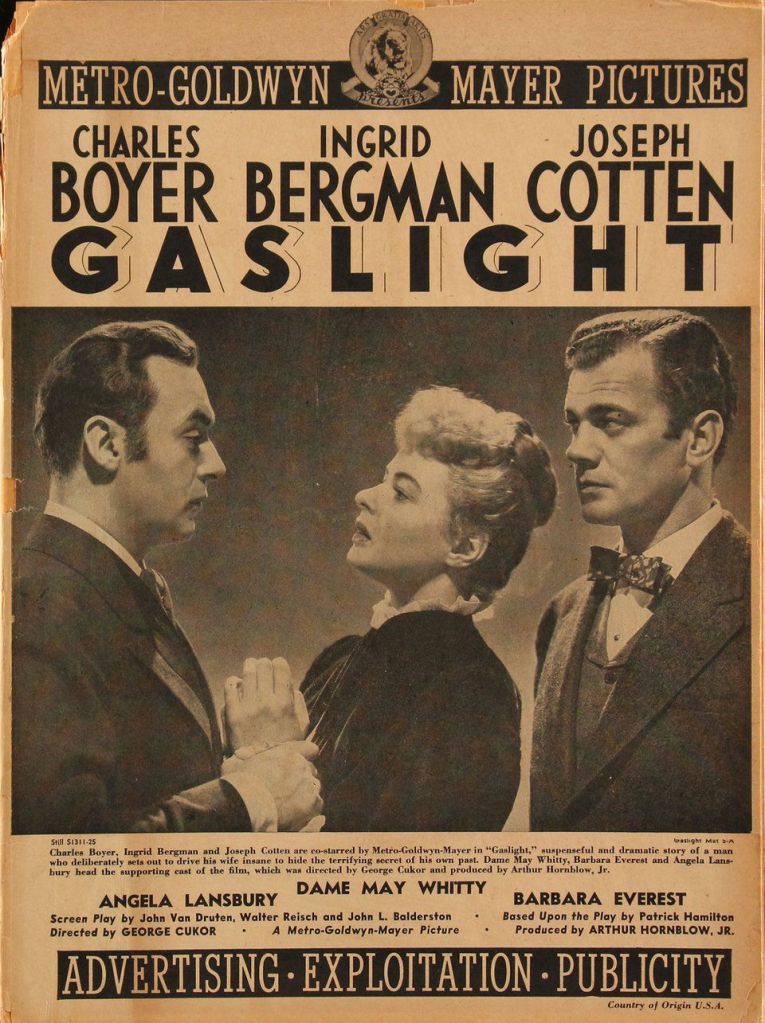
Gaslight (1944) is an American psychological thriller film directed by George Cukor, starring Charles Boyer, Ingrid Bergman, Joseph Cotten, and Angela Lansbury in her screen debut. Adapted by John Van Druten, Walter Reisch, and John L. Balderston from Patrick Hamilton’s 1938 play Gas Light, the film is a remake of the 1940 British version directed by Thorold Dickinson. Unlike its predecessor, Cukor’s version was made on a larger budget and grander scale, giving the story a more elaborate and atmospheric treatment.
The plot follows a young woman who returns from Italy with her new husband, ten years after her aunt was murdered in their London home. As the couple settles in, the husband’s unusual fascination with the house conceals a dark secret, one that depends on manipulating his wife into believing she is mentally unstable and driving her to doubt her own sanity.
In 1875, world-famous opera singer Alice Alquist is murdered in her Victorian London home. Her orphaned niece, Paula, is sent to Italy so she can one day follow in her aunt’s footsteps. There, she studies music with a famous maestro, who had also been Alice’s close friend and teacher
Years later, Paula grows into a young woman. She is still innocent and sensitive, but the memory of her aunt’s murder continues to trouble her. During one lesson, she sings an aria from Lucia di Lammermoor, a story about a woman who goes mad—an important clue for what will happen later. Although Paula has trained for many years, she suddenly loses focus. Her teacher notices that she has fallen in love.
The man she loves is Gregory Anton (Charles Boyer), a pianist with a dark personality, who has been playing in her lessons for weeks. After a fast, two-week romance, Gregory proposes. Paula is shy and hesitant but finally agrees, because Gregory is very insistent.
She says goodbye to her teacher and runs to Gregory, and they soon marry. As Paula begins to think about her new life, she asks for time to decide, but Gregory presses her to join him, so she boards a train to Lake Como. In a striking shot, director George Cukor frames Gregory’s smiling face through an iron grille, making him appear behind bars—an early hint of the prison-like life Paula will face. On the train, Paula meets a woman who lives next to her old house. The woman, unaware of Paula’s identity, recounts the frightening story of Alice’s murder. Disturbed, Paula steps off the train to find Gregory waiting with open arms; she runs to him, tears of joy streaming down her face, and embraces him.
After their marriage, they decide to live in London, in Alice’s house, which has been empty for many years. But Paula is still haunted by memories of her aunt’s murder. Gregory suggests putting away all of Alice’s belongings in the attic.
One day, Paula finds a letter that had been sent to Alice by a man named Sergis Bauer. Gregory reacts angrily when he sees it, but then quickly apologizes. He hires a young maid, Nancy, and warns her not to trouble Paula, whom he calls “a nervous lady.” Slowly, Gregory begins accusing Paula of being forgetful.
During a visit to the Tower of London, an old brooch he had given her suddenly disappears from Paula’s purse, even though she had kept it safely. This frightens her even more. At home, strange noises come from the attic, and the gaslights grow dim—but Gregory insists that these things are only in her imagination.
Meanwhile, Gregory openly flirts with Nancy, which increases Paula’s suffering. Her troubled behavior is noticed by Inspector Brian Cameron of Scotland Yard. He had once admired Alice and now sees her image in Paula. Cameron reopens the case and discovers that after Alice’s murder, the royal jewels she owned had gone missing.
Gregory slowly isolates Paula from the outside world and convinces her that she is a kleptomaniac (someone with an illness that makes them steal things). He makes her believe that missing paintings and other troubles in the house are her fault, and that she is not healthy enough to be around people.
Still, Paula attends a party hosted by an old family friend. There, Gregory accuses her of stealing his pocket watch and shows it “found” inside her purse. Shocked and humiliated, Paula becomes extremely upset and begins behaving hysterically in front of the guests.
After returning home, Gregory tells her that her mother also went insane and had to be placed in an asylum. He further insists that the letter Paula once found from Sergis Bauer never really existed. Gradually, Paula begins doubting her own sanity and completely breaks down.

Meanwhile, Inspector Cameron assigns a policeman to secretly watch Gregory. During the investigation, it is discovered that Gregory often slips into a nearby empty house and is planning to have Paula committed to an asylum. One evening, while Gregory is away, Cameron meets Paula and assures her that the noises in the attic and the dimming gaslights are real. He realizes that Gregory, who is actually Sergis Bauer, has been sneaking into the attic through the neighboring house to search Alice’s belongings. When he lights lamps in the attic, the gaslights in the rest of the house dim.
Cameron opens Gregory’s desk and shows Paula the very same letter from Sergis Bauer that Gregory had insisted was only her imagination. The truth is finally revealed: “Gregory Anton” is really Sergis Bauer, the man who murdered Alice. Years earlier, Paula had seen him, which prevented him from taking the jewels then. By marrying Paula, he gained access to the house and tricked her into believing she was insane, planning eventually to put her in an asylum and claim the entire estate for himself.
At that very time, Sergis finally discovers Alice’s valuable jewels, sewn into one of her famous costumes. When he returns downstairs, he notices that his desk has been opened. He questions Paula, who, exhausted, admits that a man came to visit her. To protect Paula, the kind cook Elizabeth says that no one had come and that Paula only imagined it. Hearing this, Paula loses hope once again.
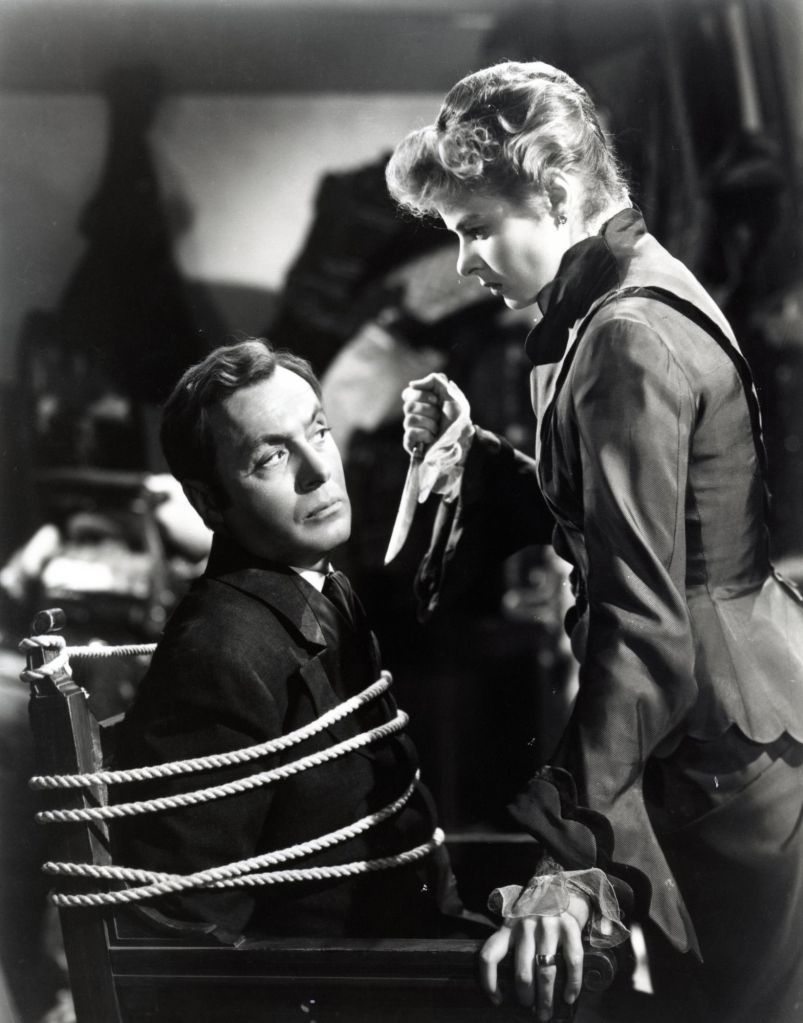
Meanwhile, Cameron arrives and confronts Sergis. He follows him to the attic and ties him to a chair. Now Paula begins to trust her own mind. Sergis asks her to cut the rope to free him, but Paula teases him, saying, “Is this knife real, or just in my imagination?” She also finds her lost brooch.
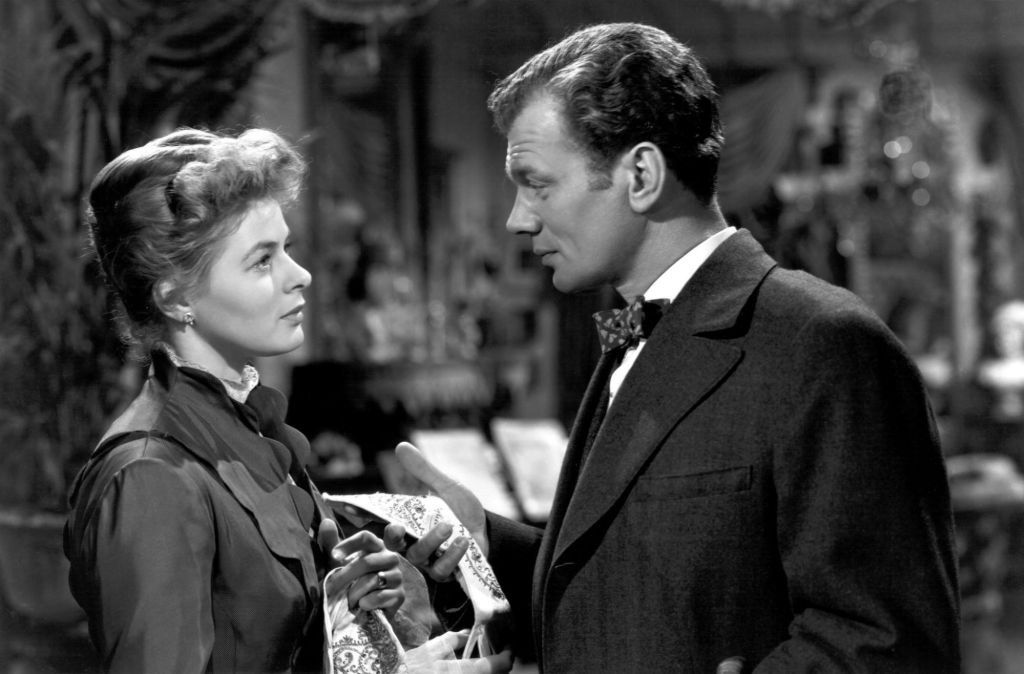
Finally, the police take Sergis away.
Paula says, “This night has been long and fragile, but it’s starting to clear.”
Cameron replies, “In the morning, when the sun rises, it’s sometimes hard to believe there was ever a night. You let me come here, see you, and talk to you. Perhaps I can help somehow. You are very kind.” Cameron expresses his wish to see Paula again, and she finally feels peace.
Set in foggy, gaslit Victorian London, Gaslight opens with the threat of a strangler in the city. A mysterious man leads the young Paula (Ingrid Bergman), only fourteen in the story, into a carriage, her startled expressions capturing fear and confusion in close-ups. The film is celebrated for its exquisite cinematography, with soft lighting highlighting Bergman’s delicate features, and for its remarkable Victorian costumes by MGM’s Irene Lentz, whose tight corsets and pointed waists make her tall, healthy figure appear fragile and vulnerable.
Bosley Crowther of The New York Times praised the actors: “Boyer drives the story forward with his hypnotic, unchanging gaze. The flickering gaslights and the suspenseful music make Miss Bergman’s mental struggle feel very real. Both actors give their roles full power. Joseph Cotten as the stubborn detective, Dame May Whitty, and Angela Lansbury in her small but memorable role as the maid are also very impressive.”
Similarly, Manny Farber writing for The New Republic highlighted Bergman’s contribution: “Much of the film’s quality comes from Miss Bergman. She can show hysteria, confusion, and love, giving depth even to ordinary moments. Very few actresses get this chance. Her energy and talent sometimes seem over the top, but she effectively shows the suffering and confusion of an innocent, inexperienced woman. At the same time, her faithful and loving wife image makes the cruelty and tension of the story even stronger.
Gaslight extends beyond cinema, highlighting psychological abuse: Gregory manipulates Paula by hiding her things, accusing her of forgetfulness, and making her doubt her own mind, while the attic and dimming gaslights create a suspenseful, mysterious atmosphere. The audience quickly sees the deception, questioning not who is behind it, but why.
After its release, Gaslight received numerous nominations and awards. It earned seven Academy Award nominations, including Best Picture and Best Actor for Charles Boyer. Ingrid Bergman won the Oscar for Best Actress, while Angela Lansbury was nominated for Best Supporting Actress. The screenplay (by John L. Balderston, Walter Reisch, and John Van Druten) and cinematography (by Joseph Ruttenberg) also received nominations. Additionally, the film won the Oscar for Best Art Direction – Black-and-White.
The film was praised internationally as well. It was nominated for the Grand Prix at the Cannes Film Festival. Ingrid Bergman won the Golden Globe for Best Actress – Drama, and the National Board of Review also honored her performance.
Gaslight’s legacy continued: it was included in the National Film Registry by the National Film Preservation Board. Bergman received nominations from the New York Film Critics Circle, and the film was inducted into the Film Hall of Fame by the Online Film & Television Association.
In this way, Gaslight made a lasting impact not just at the box office, but also among critics and award circles.
Photo courtesy Google. Excerpts taken from Google.
 Writer Sunita