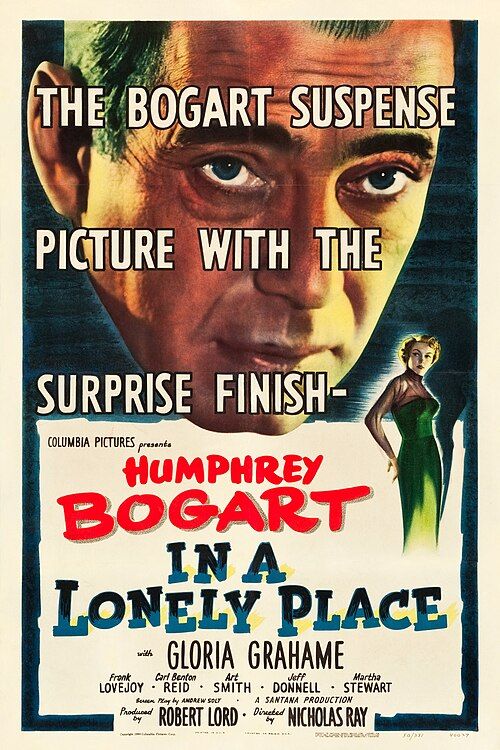
In a Lonely Place is a 1950 American film noir directed by Nicholas Ray and produced by Humphrey Bogart’s own company, Santana Productions. It stars Humphrey Bogart as Dixon Steele, a hot-tempered screenwriter suspected of murder, and Gloria Grahame as Laurel Gray, his neighbor who becomes romantically involved with him. The script, written by Andrew P. Solt, was adapted from Dorothy B. Hughes’ 1947 novel.
On the surface, the movie is about a murder mystery and a troubled romance. But it also works as a sharp comment on Hollywood life, fame, and the dangers of living close to stardom.
Dixon “Dix” Steele is a struggling Hollywood screenwriter who hasn’t had a hit movie since before World War II. On his way to meet his agent, Mel Lippman, his bad temper shows when he almost gets into a fight with another driver at a stoplight.
At a nightclub, Mel convinces Dix to adapt a book into a movie. The hat-check girl, Mildred Atkinson, is busy reading the very same book meant for Dix. Since she only has a few pages left, she asks if she can finish it. Dix, too tired to read it himself, invites her to his apartment so she can explain the story to him.
When they arrive, they pass Laurel Gray, a new tenant in the building. Mildred tells Dix the book’s plot, which proves what Dix suspected — the book is not very good. Instead of driving her home as promised, he gives her cab fare to leave.
The next morning, Dix is woken up by his friend Brub Nicolai, a police detective who had served under him during the war. Brub takes him to the police station, where Captain Lochner tells Dix that Mildred has been murdered and that Dix is a suspect. Dix remembers that Laurel saw him with Mildred the night before, and Laurel confirms this when questioned, helping clear him.
Afterward, Dix talks with Laurel, and it’s clear they are attracted to each other. Later, he visits her and learns that she is an aspiring actress who has only acted in a few small films. They grow closer, fall in love, and with Laurel’s encouragement, Dix becomes inspired to write again, throwing himself into his work, which makes Mel very happy.
At a dinner with Brub Nicolai and his wife Sylvia, Dix shows strange behavior by having them re-enact the murder the way he imagines it happened. This unsettles Sylvia, making her question whether Dix might actually be guilty.
Later, Captain Lochner speaks with Laurel and reminds her of Dix’s history of violent outbursts, planting seeds of doubt in her mind. Troubled by this, Laurel confides in Sylvia that she is beginning to fear Dix and question his innocence.
One night at a nightclub with Laurel, Dix sees detective Ted Barton arrive with a woman. Convinced Barton is secretly following him, Dix storms out angrily.
Later, Laurel’s masseuse Martha warns her about Dix’s troubled past with women. Annoyed by this interference, Laurel angrily throws Martha out of her apartment.
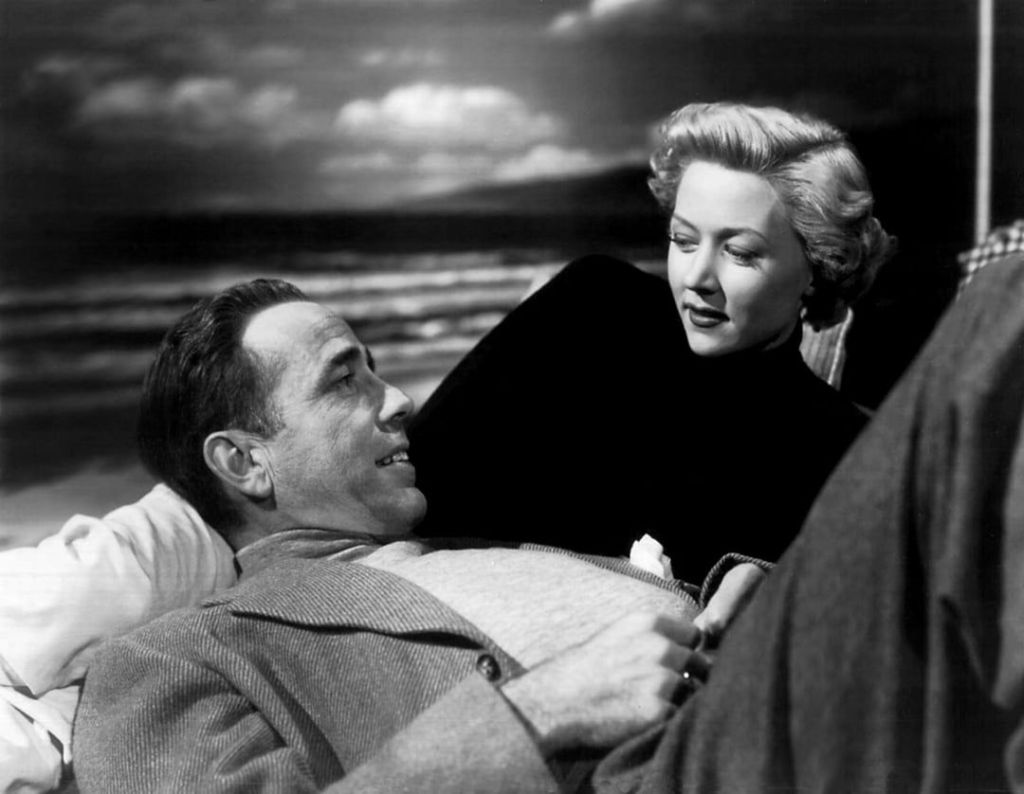
At a beach party with Brub and Sylvia Nicolai, Sylvia accidentally mentions that Laurel had another meeting with Captain Lochner. Enraged, Dix storms off.
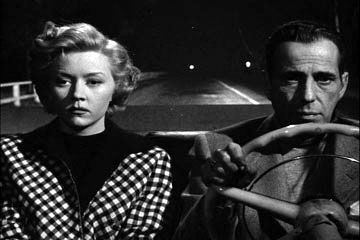
Laurel follows him and gets into his car, but Dix drives wildly and at high speed until they sideswipe another vehicle. Although no one is seriously hurt, Dix brutally attacks the other driver and beats him unconscious. He then picks up a large rock, about to kill the man, but Laurel manages to stop him just in time.
Dix goes to the police station to try to clear his name, where he unexpectedly meets Mildred’s boyfriend, Henry Kesler, who works at a bank. Dix points out to Brub Nicolai that Kesler seems like a stronger suspect, since he actually has a motive.
Later, at the Nicolai home, Laurel talks with Sylvia about Dix, which leads the Nicolais to re-enact the murder once again. Laurel also confides in Sylvia about Dix’s violent roadside assault, further revealing her growing fear and doubts about him.
Over time, Laurel becomes so troubled by her doubts about Dix’s innocence that she cannot sleep without taking pills. When Dix proposes marriage, she agrees, but only out of fear of what he might do if she says no.
Later, while Dix is away, Mel comes over to celebrate the engagement. Instead, he discovers that Laurel has no intention of marrying Dix and is secretly planning to run away to New York. She also urges Mel to deliver Dix’s finished script to a producer, hoping that at least his work will move forward even as she tries to escape.
At a dinner meant to celebrate their engagement, Dix becomes upset when he finds out that Mel has submitted his script to a producer without asking him first. During the meal, Dix intercepts a phone call meant for Laurel and angrily realizes it is from Martha. When Mel tries to step in, Dix lashes out and punches him, shocking everyone at the table.
Back at Laurel’s apartment, Dix notices that she has taken off her engagement ring and explodes with rage. He calms down for a moment but then answers the phone, where he learns about Laurel’s plan to escape to New York. Furious, he violently grabs her and nearly strangles her before stopping himself when the phone rings again.
This time it is Brub Nicolai, who tells them that Kesler has confessed to Mildred’s murder, and Captain Lochner now admits he was wrong to suspect Dix. But for Dix and Laurel, the damage is already done. Their relationship is beyond repair. With tears in her eyes, Laurel watches as Dix slowly walks away across the courtyard, returning alone to his apartment.
Nicholas Ray transforms In a Lonely Place from a routine crime drama into a searing study of love and self-destruction. His direction balances romance, suspense, and psychological tension, using intimate spaces and shifting moods to mirror the fragility of Dix and Laurel’s relationship. Ray’s gift lies in turning noir shadows into emotional landscapes, making the film feel hauntingly raw and timeless.
Bogart plays Dixon Steele, a hot-tempered yet talented screenwriter who comes under suspicion of murder. His relationship with his neighbor, Laurel Gray, gives the story the shape of a love affair that is both tender and dangerous.
The line — “I was born when I met you. I lived while I loved you. I died when you left me” that line captures the entire arc of Dix and Laurel’s relationship: she gives him new life, love makes him truly live, but when mistrust and violence drive her away, it feels like death a loss beyond repair.
That line is more than just love talk it tells the whole tragedy of the film. Dix and Laurel’s relationship begins with hope and the chance for Dix to change, but it slowly falls apart because of mistrust and Dix’s violent temper. In the end, both of them are left broken and lost.
If another actor had said those words, they might have sounded silly or too sentimental. But Humphrey Bogart makes them powerful. With his rough, tired style and his mix of toughness and hidden softness, the line feels raw and real. He shows Dix as a man pulled between love and his darker side, someone who wants peace but cannot escape his own anger.
Bogart’s performance turns the line into one of the most unforgettable and heartbreaking moments of the film. His role as Dix Steele is one of his most complex: Dix is smart but unstable, loving but violent. Bogart captures all these sides, the charm that wins Laurel’s trust, the vulnerability that makes him human, and the sudden rage that makes him dangerous. In the end, he makes Dix a tragic figure: a man who found redemption in love, but destroyed it with his own flaws.
When In a Lonely Place was first released, reviews were mostly positive, especially praising the performances of Humphrey Bogart and Gloria Grahame. However, some critics questioned whether the film would succeed at the box office because of its dark, unhappy ending.
In May 1950, Variety magazine gave the film a strong review, noting that Bogart played a sympathetic character despite being shown as quick-tempered and ready to fight. They pointed out that his character even helps a struggling, out-of-work actor with money, despite having little himself. The review also praised Nicholas Ray’s direction for keeping the suspense steady, describing Bogart as excellent in the role and giving Gloria Grahame equal credit for her strong performance as his love interest.
In 2007, the Library of Congress chose In a Lonely Place for preservation in the U.S. National Film Registry, recognizing it as “culturally, historically, or aesthetically significant.”
Photo courtesy Google. Excerpts taken from Google.
 Writer Sunita