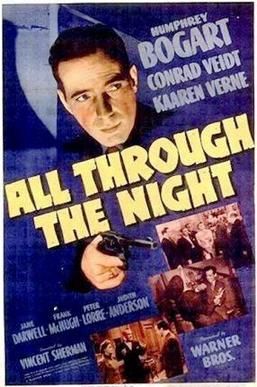
“All Through the Night” is a 1942 American movie that mixes comedy, crime, and spy thrills. It was directed by Vincent Sherman and stars Humphrey Bogart, Conrad Veidt, and Kaaren Verne. The film also includes many well-known character actors from Warner Bros. It was released by Warner Brothers.
The film’s story is about Broadway gamblers, told in a lively, streetwise style. They turn patriotic when they stumble onto a group of Nazi spies.
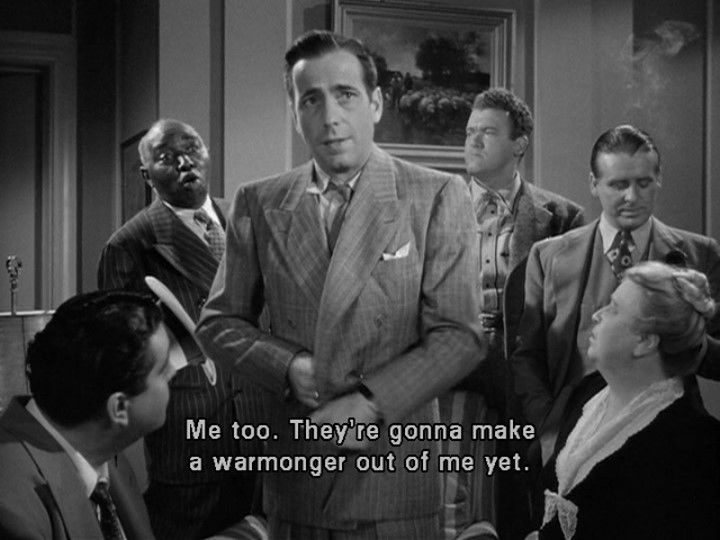
Alfred “Gloves” Donahue, a well-known Broadway gambler, is at a restaurant with his friends. They play with toy soldiers, pretending to fight Hitler. When the restaurant gives Gloves a cheesecake not made by his favorite baker, Mr. Miller, he gets annoyed. His mother, “Ma” Donahue, tells him that Miller is missing and she feels something bad has happened.
Gloves goes to the bakery and finds Miller dead. A young singer, Leda Hamilton, runs out when she hears the news. Ma Donahue thinks Leda knows something, so she follows her to a nightclub and makes trouble about Miller’s death.
The club’s owner, Marty Callahan, asks Gloves to come and fix things. At the club, Gloves has a drink with Leda, but her piano player, Pepi, takes her to a back room. There, Pepi shoots Marty’s partner, Joe Denning. Leda and Pepi run away in a taxi. Gloves finds Joe, who shows five fingers before he dies to tell who took Leda. Gloves rushes after them but drops one of his gloves at the crime scene.
Gloves is suspected of Joe’s murder by Marty and the police. He follows the taxi to an antiques auction house run by Hall Ebbing and his helper, Madame. Gloves pretends to be a bidder, but Pepi recognizes him. He sees Leda and trusts her, but she knocks him out. He is tied up in a storage room with his friend Sunshine, who was also caught earlier.
Later, Leda comes back and helps them escape before they can be shipped away in crates. While running, Gloves and Sunshine enter a room filled with maps, charts, a radio, and a picture of Adolf Hitler. They realize Joe’s clue before he died, these people are Nazi “fivers,” or secret Nazi agents. Gloves also finds a notebook with Miller’s name, Leda’s real name “Uda Hammel,” and the note that her father died in Dachau concentration camp.
Gloves and Leda escape, but Ebbing and his men chase them into Central Park. Leda tells Gloves she worked for Ebbing only to save her father’s life. During a fight, Leda finds a page that says her father is already dead.
Gloves and Leda go to the police, but when the police search the antique shop, it’s empty. They don’t believe Gloves’s story and try to arrest him. He jumps into the East River and escapes. He goes to his lawyer’s apartment, but Marty and his gang break in, wanting revenge for Joe’s death. Gloves proves he isn’t guilty, and the two gangs decide to team up to fight the Nazi spies.
Gloves, Sunshine, and Barney go to the police station, but Leda has already been bailed out by Ebbing. They see her being forced into a car and follow it to a big underground Nazi meeting. Gloves and Sunshine catch two Nazis and pretend to be them to get inside. But when Gloves is asked to give a report as the explosives expert he’s pretending to be, they stall with tricky double talk until their gang friends arrive and break up the meeting.
Ebbing runs away and tells Pepi to join him in a suicide mission to blow up a battleship. Pepi refuses, so Ebbing kills him and goes alone. Gloves follows him to the docks, but Ebbing traps him and forces him into a boat filled with explosives. At gunpoint, Ebbing orders Gloves to steer the boat straight toward an American battleship in the harbor. It looks like a suicide mission. Gloves drive the boat toward the battleship.
But at the last moment, Gloves tricks him. He suddenly turns the boat off course and jumps into the water. Ebbing, still on board, can’t escape. The boat crashes into a barge and explodes in a huge blast, killing Ebbing.
This was the big special-effects scene of the film, done with miniature boats and model explosions, which was a classic Hollywood technique at the time.
Later at the police station, Gloves and Leda learn that all charges against him are dropped and the mayor will honor him at city hall. Just then, Ma Donahue comes in, worried again—this time about the missing milkman, saying she’s “got a feeling” about it.
Vincent Sherman to his direction, all the parts—performances, pacing, and style—came together smoothly into one lively adventure. . His key job was to balance the comedy, action, and suspense so that the movie stayed both fun and exciting.
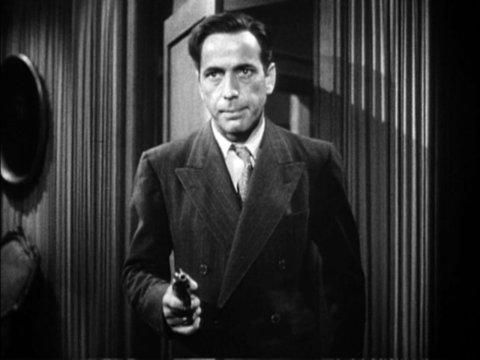
Humphrey Bogart plays Gloves Donahue, a likable gangster with a kind heart. He enjoys cheesecake, joking with friends, and watching sports. People like and respect him—he loves his mother, treats his men like younger brothers, and usually relies on his brains and fists instead of a gun. When his favorite cheesecake baker is murdered, Gloves and his gang start chasing the killers and stumble onto a secret Nazi plot to blow up a battleship in New York.
For Gloves, the title All Through the Night means standing guard against danger, even if he’s just a cheesecake, loving Broadway gambler. Like many ordinary Americans, he finds himself fighting in the dark hours against Nazi threats, protecting his city until the dawn of safety.
The boat chase and explosion in the film were created using miniatures instead of real battleships, but cinematographer Sidney Hickox shot them in a way that made them appear life-sized. By using clever camera angles and lighting, he created a sense of realism and scale. He mixed close-ups of Bogart in the motorboat, showing his fear and quick thinking, with wide shots of the miniature boats to give the illusion of an actual chase on water. Shadows and night lighting added to the tension and helped hide the use of models, making the sequence look both dramatic and convincing.
Editor Rudi Fehr kept the suspense high in the boat climax by cutting quickly between Bogart steering, Ebbing holding him at gunpoint, the battleship in the harbor, and the explosives on the boat. The pacing started slower to show the danger, then grew faster as the boat drew closer, building excitement. The final explosion hit hard because Fehr cut from the boat crashing into the barge, to the blast itself, and then to the aftermath, giving the climax maximum impact. Together, Hickox’s camera work and Fehr’s sharp editing made the finale thrilling, even though it relied on miniatures and studio effects.
Critics gave All Through the Night mixed but mostly positive reviews. Leonard Maltin praised its fun mix of spy, gangster, and comedy genres. The New York Times called it suspenseful and a “super-duper action picture,” though not top-class drama. Variety first found it lurid but later praised its fast action and audience appeal. Film Daily called it exciting, while The New Yorker criticized it for weak invention, wordy dialogue, and slow pacing.
Photo courtesy Google. Excerpts taken from Google.
 Writer Sunita