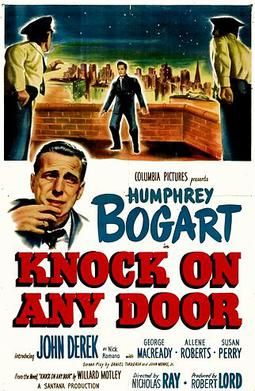
Knock on Any Door is a 1949 American courtroom drama, a suspenseful, realistic crime film. It was directed by Nicholas Ray and stars Humphrey Bogart and John Derek in the lead roles. The film is based on the 1947 novel of the same name by Willard Motley.
The story follows a young man named Nick Romano, who grows up in poverty and gradually turns to a life of crime.
In the film, Bogart plays Andrew Morton, a tough, skilled, and idealistic lawyer. His portrayal of Morton is both powerful and inspiring. His loyalty and self-sacrifice for his criminal client make him a model of dedication in the legal profession.
Morton himself rises from the slums, completes his law education, and begins by handling criminal cases before building a respectable property law practice. His old client, “Pretty Boy” Nick Romano, draws him back into that rough world. Romano (played by John Derek) is a gangster who lives by the motto, “Live fast, die young, and have a good-looking corpse.”
Earlier, Morton’s law office had handled the case of Romano’s father, but Morton had assigned it to an associate who mishandled it. As a result, Romano’s father was sent to prison, where he eventually died. This tragedy pushed the family into deep poverty, and Nick turned to a life of crime. Morton always blamed himself for this mistake and tried to make amends by helping Nick both personally and professionally.
Now, Nick is accused of shooting a policeman at close range, and if found guilty, he faces the death penalty.
Against the wishes of his law partners, Morton decides to defend Nick Romano, a young man who grew up in the slums.
Nick’s story is told through flashbacks, showing how he became a rebellious and delinquent boy from childhood. Morton’s wife, Adele, persuades her husband to guide Nick and help him become a better person.
However, Nick betrays Morton’s trust by stealing $100 from him after a fishing trip. Later, Nick marries Emma and tries to live an honest life, but because of his stubborn and defiant nature, he loses one job after another.
Nick tried to live an honest life, but after his wife’s suicide, he robbed a bar and, while fleeing, shot and killed a policeman.
He begs Morton to defend him, and Morton cannot refuse, even though doing so costs him his chance to become a partner at his law firm. Nick insists that he is innocent, though Morton is unsure, yet he takes the case. During Morton’s opening statement, a series of flashbacks reveal the sad history of his relationship with Nick and his family.
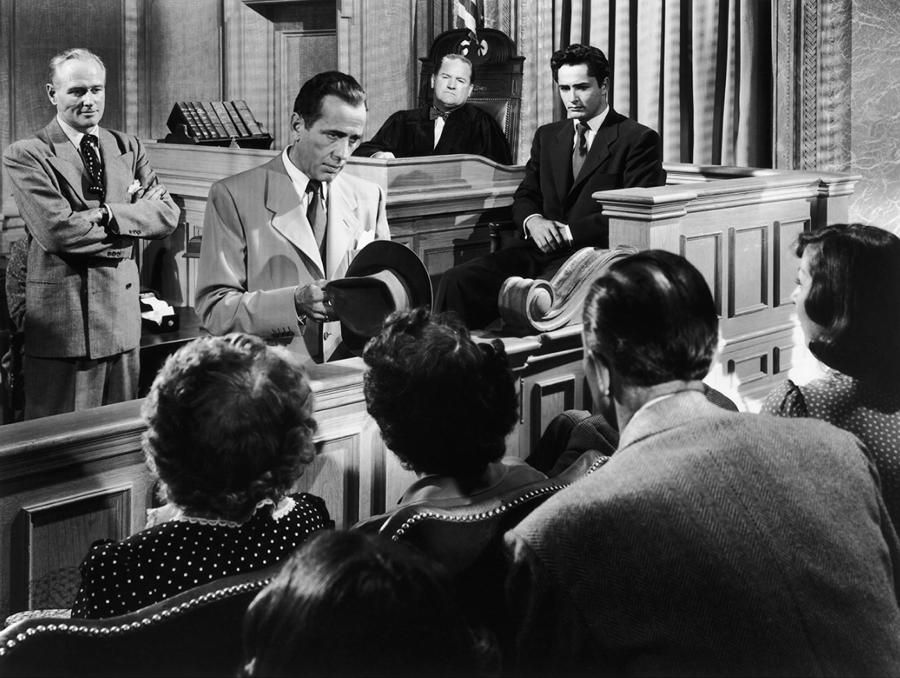
A large part of the film centers on the courtroom drama. Both District Attorney Kerman and Morton are aggressive in their tactics, sometimes bending the rules of evidence. Still, Morton succeeds in creating reasonable doubt and even discredits the bartender as a witness.
In court, Morton argues that poverty and slum life breed criminals and that society itself is partly to blame for the crimes of those raised in such miserable conditions. He insists that Nick is not a natural-born killer but a victim of his circumstances.
However, Morton’s argument fails to convince the jury. The experienced District Attorney Kerman keeps pressing Nick with relentless questions, provoking him into losing his temper. Despite being an experienced criminal who should know better, Nick ignores Morton’s advice and takes the stand, only to break down under Kerman’s fierce cross-examination. His confession shocks Morton, who had sincerely believed in his client’s innocence.
Nick then changes his plea to guilty. Now Morton’s only hope is to appeal against the death penalty. He dismisses the jury and pleads Nick guilty, hoping the judge will show mercy. Morton takes a different approach, arguing that poverty and social neglect create criminals like Nick Romano.
During sentencing, Morton delivers a deeply emotional speech, saying that “anyone who knocks on any door may find a Nick Romano,” a young man shaped by poverty, neglect, and society’s indifference, who ends up becoming a criminal.
Despite Morton’s heartfelt plea, the court sentences Nick to death in the electric chair.
Before the execution, Morton visits Nick one last time and watches him walk toward his death. In that moment, Morton feels deep sorrow and regret over the tragic end of a young life.
Director Nicholas Ray gave the film a realistic and emotional touch. He portrayed the harsh life of the slums and how society’s neglect can destroy young lives. The film beautifully combines realism, emotion, and social commentary, making it a powerful story about poverty, justice, and lost youth.
Ray used flashbacks, dark lighting, and fast-paced editing to give the film a film noir tone — serious, tense, and full of moral conflict. His direction focused on both social message and human emotion, helping the audience understand Nick Romano’s inner struggle between right and wrong.
Humphrey Bogart plays the role of Andrew Morton, a smart yet idealistic lawyer who defends a young man named Nick Romano (played by John Derek), accused of murdering a policeman.
In the film’s final courtroom scenes, Humphrey Bogart brilliantly displays his acting skill and emotional depth. He speaks to the jury with sincerity, trying to make them see that Nick is not just a criminal but a victim of his harsh life and environment. His voice is calm yet firm, filled with both pain and compassion.
Bogart’s eloquence and controlled performance make his speech unforgettable. In his emotional appeal to the court, he says, “Anyone who knocks on any door may find a Nick Romano,” meaning that if society continues to ignore poverty and neglect, it will keep creating more such victims.
George Macready, who played the role of the District Attorney, delivered a performance as powerful as Bogart’s. Their courtroom exchanges made the scenes tense and gripping.
The final courtroom sequence is considered one of the finest moments of Bogart’s career. His commanding presence, emotional restraint, and sincerity proved why he was one of Hollywood’s most respected actors.
The magazine Variety gave the film a positive review, calling it “an eloquent document on juvenile delinquency, its cause and effect.” The review praised Nicholas Ray’s direction, noting that he emphasized the realism of Willard Motley’s novel and gave the movie a tight, fast pace that keeps the audience fully engaged.
Photo courtesy Google. Excerpts taken from Google.
 Writer Sunita