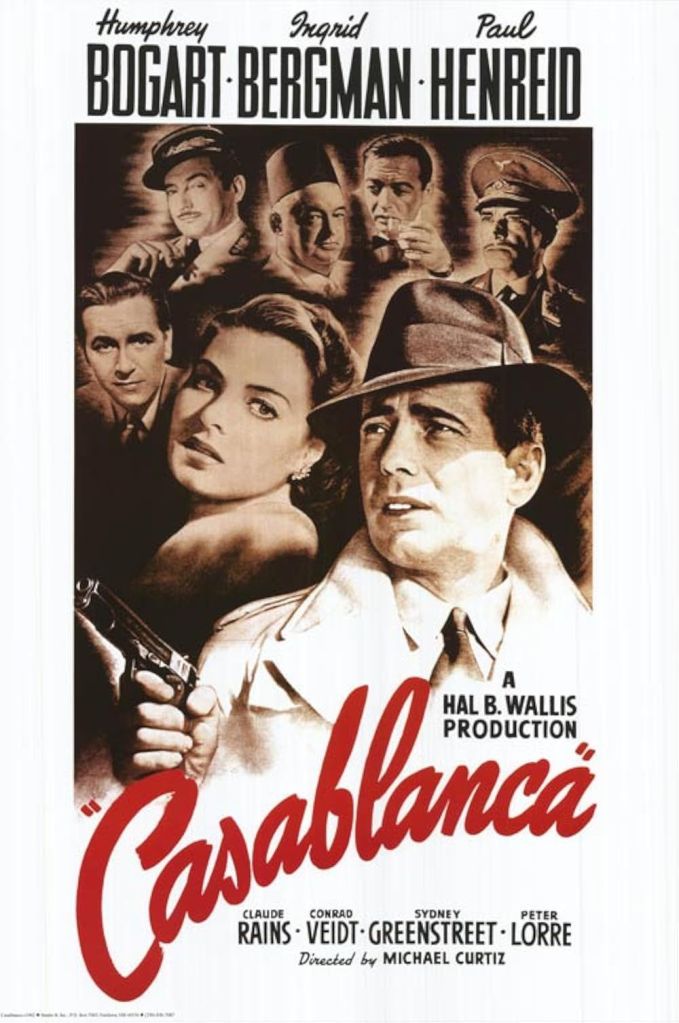
Casablanca is a 1942 American romantic drama film directed by Michael Curtiz. The film stars Humphrey Bogart, Ingrid Bergman, and Paul Henreid in the lead roles. The story is set in French Morocco during World War II, where an American expatriate, Rick (Bogart), runs his own café. Rick finds himself caught in a deep moral dilemma—whether to stay with his former lover Ilsa (Bergman) or help her husband, Victor Laszlo (Henreid), a leader of the Czechoslovak resistance, escape from the Nazis and continue his fight.
The screenplay is based on the unproduced stage play Everybody Comes to Rick’s by Murray Burnett and Joan Alison. Claude Rains, Conrad Veidt, Sydney Greenstreet, Peter Lorre, and Dooley Wilson appear in supporting roles, each adding depth, conflict, and emotional resonance to the story.
As the film begins, a rotating globe appears on the screen. On that map, a striking scene unfolds: people from all parts of Europe are fleeing for their lives. Some are travelling on foot, others speeding away in cars. And thus emerges a long, difficult, and perilous refugee route, from Paris to Marseilles, across the Mediterranean to Oran, and then by train, by car, or even on foot, travelling down the coast of Africa until they reach Casablanca in French Morocco.
The globe slowly stops turning, and within moments it transforms into a flat map of Europe. The map glides steadily downward until it finally halts at Casablanca, and across it appears the film’s title: Casablanca.
The name “Casablanca,” taken from the famous port city in Morocco, is where the entire story of the film takes place.
Here, the lucky ones—those with money, influence, or pure fortune, could obtain an “exit visa,” sail to Lisbon, and from there travel on to the New World. But the others? They remained stuck in Casablanca.
The scene then shifts to the old Moorish quarter of the city. Narrow, winding streets lie in calm silence, when suddenly the police announce that two German couriers have been murdered and that the killers are believed to be heading toward Casablanca. Instantly, chaos erupts—police running through the streets, whistles blowing, sirens wailing, arrests being made, and frantic interrogations beginning.
A white European man tries to run because he has no papers, but he is shot and killed. All that is found on him is a booklet of the “Free French.” Nearby, a Bulgarian refugee couple watches in fear.
An airplane lands with its engine shutting off, and the refugees waiting outside the terminal look toward it with hope. Jan and Annina dream that one day they too will be on such a plane. The aircraft bears the swastika insignia. As it comes to a stop, officials line up in formation. Major Strasser steps out—a cold, stern German officer. Captain Renault welcomes him.
Captain Louis Renault is the French police chief in Casablanca, appointed by the Vichy government.

American expatriate Rick Blaine runs a nightclub and casino in Casablanca called “Rick’s Café Américain.” French and Nazi German officers, refugees hoping to reach America, and those who exploit them all gather here. On the surface, Rick appears neutral, but in truth he once supplied arms to Ethiopia and fought on the Republican side in the Spanish Civil War. Outwardly he seems cool, detached, and practical, but inside he is emotional and deeply committed to justice.
As night falls, Rick’s Café Américain glows with life. The café is a luxurious yet mysterious place where music, gambling, liquor, and political maneuvering all happen at once. Inside, Sam plays “It Had to Be You” on the piano.
Sam is the pianist and singer at Rick’s Café. He is Rick’s trusted friend and is considered the heart of the establishment. Carl, the polite and kind head waiter, treats customers with courtesy and keeps the atmosphere light. Sasha, a slightly tipsy but cheerful bartender, adds humor with his antics.
The criminal Ugarte proudly tells Rick about the letters of transit he obtained after murdering two German couriers. These documents allow the holder to travel freely through German-occupied Europe and into neutral Portugal. Ugarte plans to sell the letters and decides to leave them at Rick’s café for safekeeping, persuading Rick to hold them for him.
But before he can reclaim them, Ugarte is arrested by the local police on the orders of Captain Louis Renault, the corrupt police chief. Ugarte dies in custody, and Rick keeps the letters a secret.

The reason behind Rick’s bitterness is his former lover, Ilsa Lund. She comes into his café with her husband, Victor Laszlo. Ilsa asks Sam to play “As Time Goes By.” Sam hesitates, but finally plays it. As the melody begins, a wave of memories fills the air. At that moment, the door of the betting room opens and Rick steps out. Hearing the song, his anger flares. He strides forward and snaps at Sam, “I thought I told you never to play that song!” Sam tries to signal him, and the moment Rick’s eyes fall on Ilsa, he freezes. Their eyes meet, and the atmosphere turns completely still.
The dim lighting, the soft ambiance, and the piano’s gentle notes give the scene a poetic quality. Rick bursts out in anger because Sam has played the forbidden song. But the instant he sees Ilsa, that anger trembles and stops. In that moment, Rick’s face reflects pain, memory, shock, and unresolved love—all at once. He is unable to speak for a few seconds; he simply looks at her. They both feel that their past has suddenly returned before them. Rick’s fury dissolves into hurt, and this marks the beginning of a new chapter in their emotional conflict.

Laszlo meets Rick, and the two speak politely. They express admiration for each other’s work. During the conversation, hints of Ilsa and Rick’s past in Paris begin to surface—memories of “La Belle Aurore” and her blue dress return. When curfew time arrives, Laszlo and Ilsa leave. Rick quietly watches them go, lost in old memories.
The song “As Time Goes By” becomes a bridge between the past and the present, carrying the emotional weight of both. This scene is a gentle collision of past memories and present reality. Rick and Ilsa speak more through their eyes than through their words.
Laszlo senses that something unspoken exists between Ilsa and Rick. But he maintains his dignity, for his focus remains on a far greater mission—his fight against the Nazis. His character is steadfast, disciplined, and able to keep his emotions under control.

In the dim light of the empty café, Rick sits alone, a glass of bourbon before him, and another empty glass kept as if reserved for Ilsa. Her memory, longing, and the pain of her absence simmer within him. Speaking to himself, almost in a murmur, he says, “Of all the gin joints in all the towns in all the world, she walks into mine.” He buries his head in his hands.
With a voice filled with pleading and hurt, he turns to Sam and says, “You played it for her… now play it for me. If she can stand it, I can. Play it!”

In this moment, Rick is completely shattered. His love for Ilsa is still burning inside him, but her sudden betrayal has filled him with confusion, anger, and a deep, consuming hurt. He keeps asking himself why she didn’t come. What had really happened? Had her love been real or not? The rainy moment at the Paris station refuses to leave his mind. Her letter was soaked in the rain, but her memories remain painfully fresh. The alcohol, the smoke, the empty glass—everything reminds him of her. In his heart, he is still standing at that station, in the rain, waiting for answers.
He recalls her last words to him: “Kiss me as if it were the last time.” Back then, he hadn’t understood the meaning. Now, every syllable pierces his heart. Outwardly, he appears calm, tough, and proud, but inside he is helpless and broken. His head resting on the table is not the posture of a drunk man, but the picture of someone wounded, torn apart.

Sam begins to play “As Time Goes By,” and the melody transports Rick straight back to Paris. Springtime, the view of the Arc de Triomphe, riding together in an open car, the countryside roads, standing on a boat with the wind brushing past them—Rick and Ilsa completely lost in each other. Her laughter, his touch, the joy on both their faces—those memories come alive once again.
Rick once asks her, “Who are you really?” but Ilsa smiles and says, “We said no questions.” There is pain hidden in her past, something she cannot reveal. Rick looks at her and says, “Here’s looking at you, kid,” and the moment seems to stand still.
The two of them dance in a Paris café to soft music, completely lost in love. In that emotional surrender, Ilsa whispers, “Kiss me as if it’s the last time.” In her voice, love mingles with the faint shadow of parting. A single thought fills her mind: “If tomorrow separates us, let this moment remain mine forever.”


At the Gare de Lyon station, Rick waits for Ilsa in the pouring rain. Only a few minutes remain before the last train departs, but Ilsa is nowhere to be seen. Sam comes running and hands him an envelope. In the letter, Ilsa writes that she cannot go with Rick and will never see him again, but she loves him with all her heart.

Reading the letter breaks Rick’s heart. The rain smudges the ink, and it feels as if the meaning of his life is slipping away with it. As Sam pulls him along, he steps into the last train. Just as the train begins to move, Rick throws the letter into the swirling smoke—an helpless attempt to cast away his past, his memories, and his pain.

Drunk and trying to escape his memories, Rick is suddenly pulled back into them when Ilsa appears at the doorway. All the confusion he had tried to drown resurfaces instantly. His attempt to forget Paris collapses in a single moment. The sight of her fills him with shock, anger, and pain all at once.
Ilsa has come to speak calmly, but the wound of her leaving is still raw in Rick’s heart. Hurt and intoxicated, he lashes out bitterly: “Tell me, who did you leave me for? Was it Laszlo? Or was there someone else in between?”
Hearing this, Ilsa walks away without saying a word.
.jpg)
The moment Rick sees Ilsa in the marketplace, old feelings immediately stir within him. As he speaks to her, he apologizes for his behavior the previous night, but almost at once, his bitterness returns and he begins asking sharp, hurtful questions. Ilsa calmly tells him that he has changed a lot, and that she will soon be leaving Casablanca.
Rick responds harshly, “You’ll lie to Laszlo someday too. You’ll still be with him.”
Ilsa pauses for a moment, then reveals the truth, “Victor Laszlo is my husband… and he was my husband even when I met you in Paris.”
Rick freezes as the words hit him. Ilsa walks away into the café, while Rick stands there staring after her in disbelief, his eyes hollow and shaken.
At last, the bitter truth becomes clear to him, Ilsa did love him, but she was already Victor Laszlo’s wife. Their entire Paris love story had been wrapped in a secret she could not reveal. The moment she speaks the truth, Rick is stunned; his anger, resentment, and every misunderstanding collapse in an instant.
When Laszlo begins making inquiries, Rick’s friendly business rival—and underworld figure—Signor Ferrari tells him that he suspects Rick has the letters of transit. That night, Laszlo returns to Rick’s café and tries to buy the letters. Rick refuses to sell them and tells him that if he wants to know the reason, he should ask his wife.

Rick walks from the café into his room, and in the dim light he suddenly sees Ilsa. The moment is charged with tension. When she calls him “Richard,” memories of Paris flare up inside him.
On the surface, he hides everything behind sarcasm:
“‘Richard’ again? Does that mean we’re back in Paris?”
But inside, there is a storm—pain, memories, disbelief. Hearing her say “Richard” reopens wounds he had tried to bury. Outwardly he mocks her, but inwardly the memories of Paris, the hurt, and the lingering love shake him to the core.

Ilsa, shaken and angry, points the pistol at Rick and says with firm determination, “I’ll tell you for the last time, — put those papers on the table.” Her voice carries more the weight of responsibility than fear.
Rick gives a bitter, hollow smile and replies, “If Laszlo and his cause mean that much to you, and you’re willing to do anything for it, fine. Let me make it easier for you.” He slowly walks toward her, pain and defiance visible in his eyes. Finally, standing right in front of her, he says quietly:
“Go ahead, shoot. You’d be doing me a favor.”
There is no anger in his voice, only heartbreak, exhaustion, and the emptiness of a man who feels completely defeated inside.
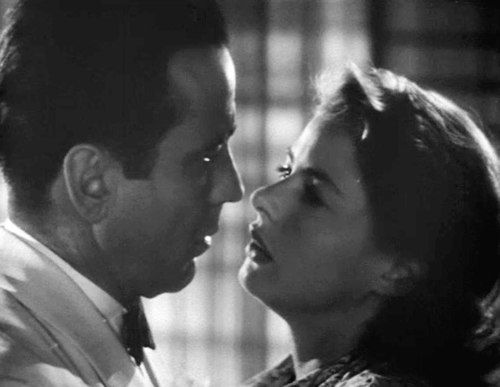
Her hand trembles. Tears stream down her face as she lowers the gun. Through her sobs she admits that she tried hard, so hard, to stay away from Rick, but she simply couldn’t. Her voice carries both pain and love, tangled together.
Rick doesn’t say a word. The moment he sees her tears, something inside him breaks. All the anger he held onto so fiercely melts away at once. The betrayal he believed in, the bitterness he carried, everything dissolves in the sight of her crying. He can’t bear to see her like that.
He hesitates only for a moment, then steps toward her and pulls her into his arms, holding her tightly, as if time itself has stopped.
Through her tears, Ilsa confesses that she still loves him. She explains that when they met in Paris in 1940 and fell in love, she believed her husband Victor Laszlo had died while trying to escape from a concentration camp. But when she later learned that Laszlo was alive and hiding near Paris, she left Rick without a word to take care of her gravely ill husband.
Hearing this truth, Rick’s bitterness finally fades. The weight he carried for so long lifts from his heart.
Ilsa gently rests her head on Rick’s shoulder and whispers, “I ran away from you once… I can’t do it again. I don’t know what’s right or wrong anymore. For both of us—you decide… honestly.”
Rick looks at her softly and says, “Here’s looking at you, kid.”
He decides to help her.
Just then, Laszlo arrives unexpectedly, having narrowly escaped a police raid. Rick quietly orders the waiter Carl to take Ilsa away. Aware of Rick’s love for her, Laszlo tries to persuade him to use the letters of transit to get Ilsa to safety.
Suddenly, there’s a loud crash at the café door, several gendarmes burst inside. The police arrest Laszlo on a false charge.
For a moment, Laszlo looks at Rick calmly and then walks toward the officers without protest. Rick’s face remains expressionless. Whatever he feels inside, he doesn’t show it—not even for a second.
Rick tells Renault that he has no real evidence against Laszlo, so at most Laszlo would get a fine or thirty days in jail. Therefore, he should release him. Rick convinces Renault to let Laszlo go and promises that he will frame Laszlo for a far more serious crime: the possession of the letters of transit.
To reduce Renault’s suspicion, Rick lies and says that he and Ilsa will use the letters themselves to go to America. Renault agrees to the deal.
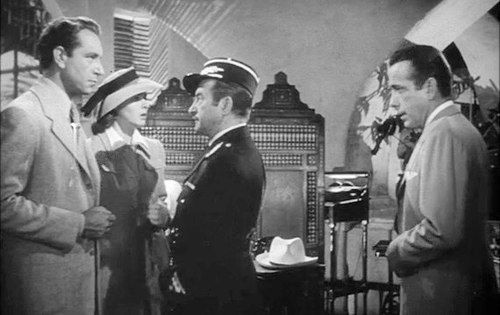
But when Renault tries to arrest Laszlo as planned, Rick suddenly pulls a gun. He points it straight at Renault. He orders that no one else is going to be arrested. Renault is furious, but Rick forces him to sit down. Rick warns him that if he moves, he’ll shoot.
Rick then makes him call the airport and authorize two letters of transit with no questions asked. Renault, seething on the inside, still obeys the order.

Meanwhile, Strasser grows suspicious and urgently sends a police unit to the airport. At the fog-covered airfield, the plane is ready for departure. Rick, Renault, Laszlo, and Ilsa arrive by car and drive up to the hangar. Rick tells Renault, “Your man will take care of Laszlo’s luggage.”

Rick hands the letters of transit to Renault and calmly tells him that the names on them will be “Mr. and Mrs. Victor Laszlo.” Both Renault and Ilsa are stunned. Confused, Ilsa asks, “Why my name, Richard?” Rick answers in a steady voice, “Because you’re getting on that plane.”
Rick reminds Ilsa that last night she asked him to think for both of them. After thinking it through, he realized only one thing: she must get on the plane with Victor. If she stays in Casablanca, there’s no future for any of them; both she and Laszlo might end up in a concentration camp. Her rightful place is with Victor—she is his strength, the reason he keeps fighting. If she walks away from that now, not today or tomorrow, but someday, she will regret it for the rest of her life.
Ilsa’s voice trembles as she asks, “What about us?”
Rick explains gently, “We’ll always have Paris. We lost it; we got it back last night. But I’ve got a job to do now, and you can’t be part of it. In this crazy world, the problems of three little people don’t amount to a hill of beans. Someday you’ll understand that.”
.jpg)
Tears well up in Ilsa’s eyes. Rick gently lifts her face and says his final line: “Here’s looking at you, kid.”
Slowly, Ilsa realizes that Rick is going to stay behind. He loves her deeply, but he also accepts that her place is with Laszlo—a man fighting for a greater cause. For her safety and her future, Rick chooses to sacrifice his own happiness. Even though he is breaking inside, he keeps a calm, steady resolve on his face. He lets her go because, for him, her happiness is the truest expression of love.

As the plane takes off, Rick and Renault quietly watch it disappear into the sky. Renault tells Rick that he is no longer just sentimental, but now a patriot as well. Rick agrees. Finally, Rick says, “Louis, I think this is the beginning of a beautiful friendship.” The two walk away together into the darkness of the night.
Until the very end, no one truly understands what Rick feels inside. He never openly displays his care for Ilsa, yet he constantly protects her, stops her from stepping into danger, maintains a careful distance while speaking to her, and prepares the entire plan for her safe escape with Laszlo. Without expressing his own love, he sacrifices himself for her future. To stop Strasser, he even risks his own life. At the airport, his quiet farewell—“Here’s looking at you, kid”—offered with Ilsa’s happiness as his highest priority, becomes the purest expression of his love. Rick’s love is revealed through actions: profound, selfless, and noble.

Humphrey Bogart’s performance as Rick in Casablanca is revealed through several striking moments that trace his journey from a sarcastic, detached personality to a man capable of profound sacrifice. At the beginning of the film, he is shown playing chess alone in his café, a detail Bogart uses to present Rick as a cold, withdrawn, and calculating man—someone who hides his emotions behind brief, clipped lines of dialogue.

Rick’s tough exterior hides a deep softness that surfaces in moments like helping the young Bulgarian couple or the way his eyes tighten when Ilsa enters the café. The Paris memories show him carefree and in love, but Ilsa’s letter at the station shatters him. His drunken anger later reveals both heartbreak and lingering love. With Laszlo, his calm voice shows acceptance that the fight against fascism is bigger than his personal pain.
At the airport, Rick’s transformation is complete—he lets Ilsa go with quiet dignity, making his love selfless rather than possessive. Bogart beautifully blends cynicism, hurt, and deep affection, turning lines like “Here’s looking at you, kid” into timeless expressions of quiet love. After shooting Strasser, Rick begins anew with Renault, ending with “I think this is the beginning of a beautiful friendship.” His journey from hardness to hidden tenderness becomes unforgettable.
Ingrid Bergman portrayed Ilsa Lund with remarkable tenderness and emotional complexity. Her performance is calm, graceful, and delicate, yet her eyes constantly reflect waves of love, guilt, and inner conflict. Caught between Rick and Victor, she expresses her turmoil not through grand dialogues but through subtle shifts in her gaze and gentle gestures—this is her greatest strength.
The contrast she creates between her free, joyful self in the Paris flashbacks and her anxious, broken self in Casablanca is beautifully natural. That is why Ilsa Lund remains one of the most memorable and finely nuanced performances in film history.
Casablanca is not just a classic film; it feels almost like an American myth, which is why it holds such a special place in popular culture. The film became famous worldwide thanks to the performances of Humphrey Bogart, Ingrid Bergman, and Claude Rains, and it achieved a “cult” status among college students. Ingrid Bergman became a major Hollywood star.
The true strength of Casablanca lies in Humphrey Bogart’s portrayal of Rick. He appears tough on the outside but is deeply emotional and capable of great love on the inside, which is why he is called an antihero. Bogart’s calm, thoughtful, and tightly controlled performance makes the character even more powerful.
The city of Casablanca itself plays an important role in the film. The conspiracies, political tension, danger, and chaos in the city make the story feel more alive and real. All these elements together create a strong emotional impact on the audience.
Some dialogues from the film, like “Here’s looking at you, kid” and “Play it, Sam”, became so famous that they are now considered permanent parts of American culture.
Critics praised the film. Time magazine simply called it “delicious.” Director Michael Curtiz focused more on camera rhythm and lighting than on the confusion caused by multiple languages, and that approach helped the film succeed.
All these expressionistic elements create a deep emotional effect that remains powerful even after many decades. Despite its dramatic plot, minimal special effects, and studio-bound shooting, Casablanca is still a shining example of emotionally resonant cinema.
Even though many writers worked on it, the screenplay became coherent and strong. Critic Roger Ebert said, “Despite having so many writers, the script is astonishingly beautiful and consistent.” Filming began on May 25, 1942, and was done mainly on studio sets, with only a few exterior shots. Producer Hal Wallis was praised for his attention to small details, while Michael Curtiz focused on telling the story visually. Cinematographer Arthur Edeson highlighted Ingrid Bergman’s beauty using soft lighting and catchlights. The use of shadows and dark lighting added emotional depth, drawing on film noir and German Expressionism.
The music was composed by Max Steiner, who used “As Time Goes By” and “La Marseillaise” as leitmotifs. Dooley Wilson, who played Sam, was dubbed for the piano sequences. In the iconic “anthem duel” scene, Laszlo leads the singing of “La Marseillaise,” overpowering the Nazi song. The filmmakers originally planned to use the Horst-Wessel-Lied, but copyright issues forced them to change it.
The film created a lasting impact by combining strong visuals, music, and meticulous direction.


In this scene from Casablanca, the clash between “Die Wacht am Rhein” and “La Marseillaise” is not just a battle of two songs, it is a battle between two ideologies. When the German officers sing “Die Wacht am Rhein,” their voices carry authority, oppression, and the arrogance of conquest. A sense of fear fills the atmosphere.
But at that very moment, Laszlo, the leader of the French Resistance, stands up and requests that “La Marseillaise” be played, and Rick quietly grants permission. As soon as the French begin singing, a wave of patriotism sweeps through the bar. Everyone rises and sings with full voice, and their collective strength completely drowns out the Germans’ anthem. Within seconds, the voice of freedom overwhelms the pride of tyranny.
Through this act, Laszlo rekindles hope in everyone present: “We have not given up yet.”
Strasser is furious and immediately orders Renault to shut down the club.
This entire moment shows that sometimes music itself becomes resistance—and a single song can be more powerful than a thousand words.
The film received excellent reviews upon release for its story, performances, dialogue, and emotional impact.
The movie is not just a romance or a war drama, it blends character depth, moral conflict, and psychological complexity in a remarkable way, making Casablanca one of the artistic and cultural gems of Hollywood’s Golden Age even today.
Casablanca received several awards and nominations. At the 1944 Academy Awards, the film won Best Picture and Best Director (Michael Curtiz). It also earned nominations for Best Actor (Humphrey Bogart) and Best Supporting Actor (Claude Rains). It won the Oscar for Best Screenplay, and was nominated for cinematography, editing, and music.
At the National Board of Review Awards, it ranked sixth among the Top Ten Films, and Curtiz won Best Director. The film was later included in the National Film Registry. Other recognitions came from the New York Film Critics Circle Awards and the Saturn Awards (for the DVD release).
At the Oscars, when Bogart stepped out of the car with his wife, the audience erupted with excitement, and the police had to protect him. The crowd shouted, “Good luck!” and “Here’s looking at you, kid!”
Casablanca is a timeless film, rich in emotion, full of moral questions, and deeply rooted in human values.
This is why, even after 80 years, it continues to resonate just as strongly with today’s audiences.
Photos courtesy Google. Excerpts taken from Google.
 Writer Sunita