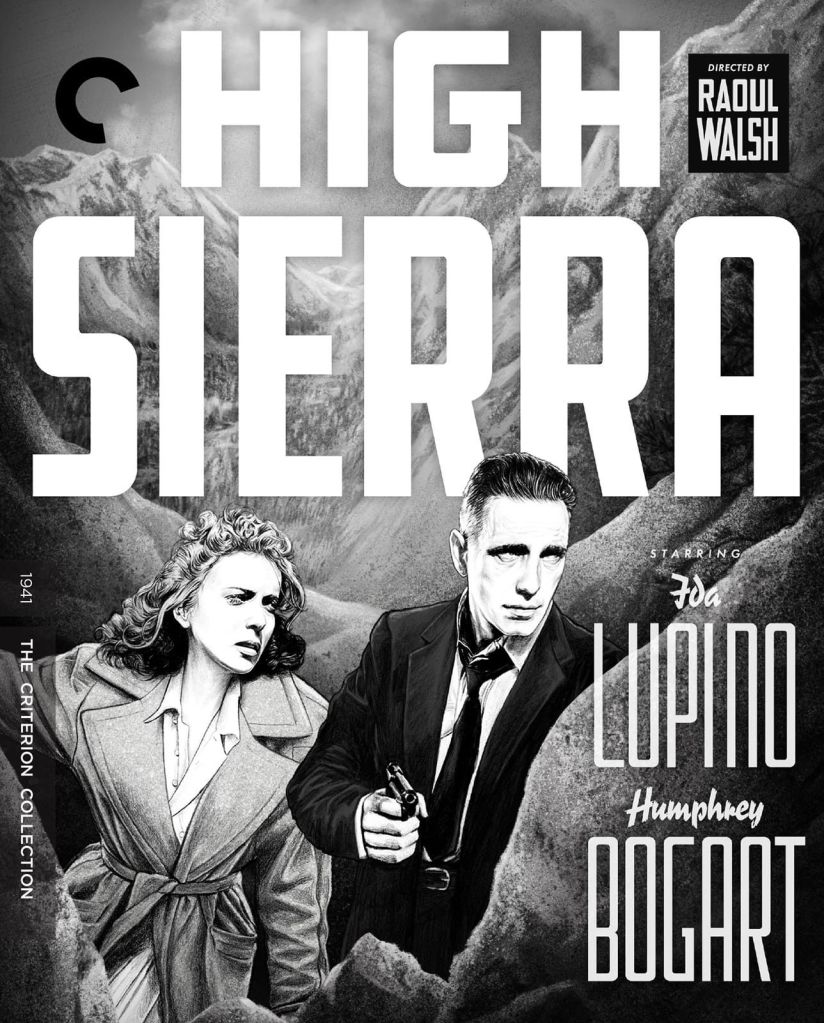
High Sierra is a 1941 American film noir directed by Raoul Walsh. Based on a novel by W. R. Burnett, the story was adapted into a screenplay by Burnett and John Huston. The film stars Humphrey Bogart as Roy Earle and Ida Lupino as Marie Garson. The narrative centers on Roy Earle, a seasoned criminal who becomes involved in a jewelry heist at a resort in California’s Sierra Nevada mountains. During this journey, he meets Marie Garson, a young former taxi dancer.
An aging gangster, Big Mac McGann, plans a hotel robbery at the luxurious resort of Tropico Springs in the Sierra Nevada range. To ensure the success of the heist, he recruits the experienced bank robber Roy Earle. Roy’s recent release from a prison in Indiana has been arranged by Big Mac through bribing the governor. Roy drives across the country to a deserted lumber camp in the mountains, where three accomplices are waiting to assist him: hotel clerk Louis Mendoza, along with Red Hattery and Babe Kozak. Babe is accompanied by his girlfriend Marie Garson, a “dime-dance” girl from Los Angeles.
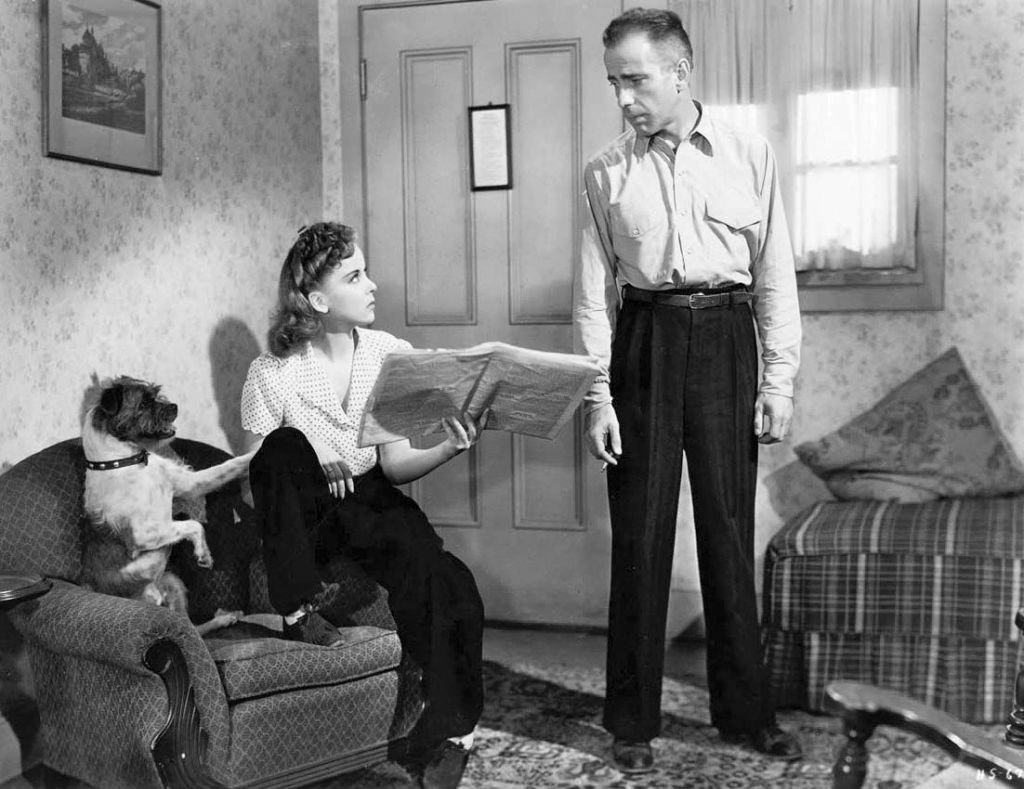
Roy initially wants to send Marie back to Los Angeles, feeling that her presence will be a liability; however, after some discussion, he allows her to stay. At the camp, a handyman named Algernon introduces Roy to a small dog called Pard. Roy grows fond of the dog. Meanwhile, Marie begins to fall in love with Roy, but he does not return her feelings.
At Tropico Springs, Roy witnesses a minor car accident involving the Goodhue couple and their granddaughter, Velma. Velma has been lame since birth and walks with the help of a cane. Roy becomes infatuated with her and offers to pay for surgery to correct her condition, despite her grandfather warning him that her marriage has already been arranged. While Velma is recovering, Roy proposes to her, but she refuses, choosing to remain faithful to her fiancé back East.
The hotel robbery is carried out, but everything goes wrong when a security guard unexpectedly intervenes. Roy escapes with Marie, taking the jewels from the hotel safe. Meanwhile, the getaway car carrying Mendoza, Red, and Babe crashes; Red and Babe are killed, and Mendoza is arrested and questioned by the police.
Roy and Marie arrive in Los Angeles with the stolen jewels, only to learn that Big Mac has died of a heart attack and that former police officer Jake Cranmer has taken over the operation. Cranmer tries to force the jewels from Roy, but Roy stands his ground and kills Cranmer by shooting him.
After this, Roy goes to see Velma to keep his promise, he had told her he would come once she was able to walk properly. He then meets Art, a dealer who buys and sells stolen goods (a fence), but Art says he cannot immediately pay the agreed sum of $30,000. Roy leaves the jewels with Art and gives Marie an engagement ring. The two hide out in a hotel, but soon they become frightened when Roy’s name and photograph begin appearing in the newspapers. Marie is also mentioned in the reports, and because of the information Mendoza has given the police, even the dog, Pard, is identified.
Believing that it will be safer if he is on his own, Roy sends Marie and the dog Pard to Las Vegas by bus. He returns to Los Angeles to collect the money for the jewels. Expecting to get the payment quickly, he gives Marie all the cash he has with him. On the way, as his car begins to run out of gas, Roy takes the risk of committing a robbery in a small town, but there he is recognized.
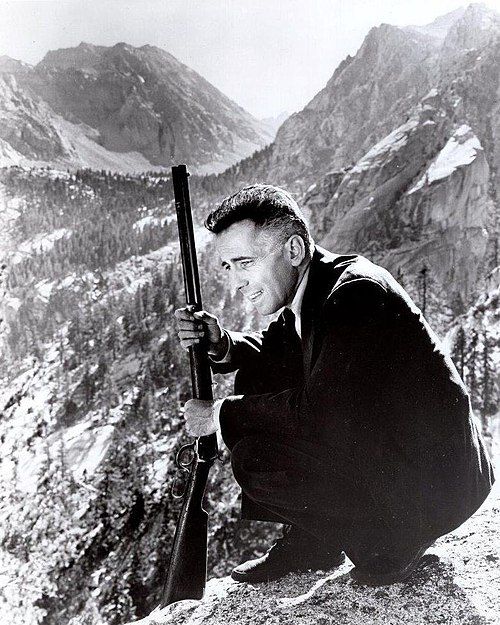
The police chase Roy and drive him back into the mountains. Roy is forced to abandon his car and flee on foot. Meanwhile, Marie hears news of the pursuit on the radio. Investigators question her and pressure her to help as bait to draw Roy out, but Marie refuses, knowing that Roy would rather die than return to prison. Despite this, the police take her along and begin a search in the mountains. Meanwhile, Roy is hiding behind a large rock on a mountainside slope.
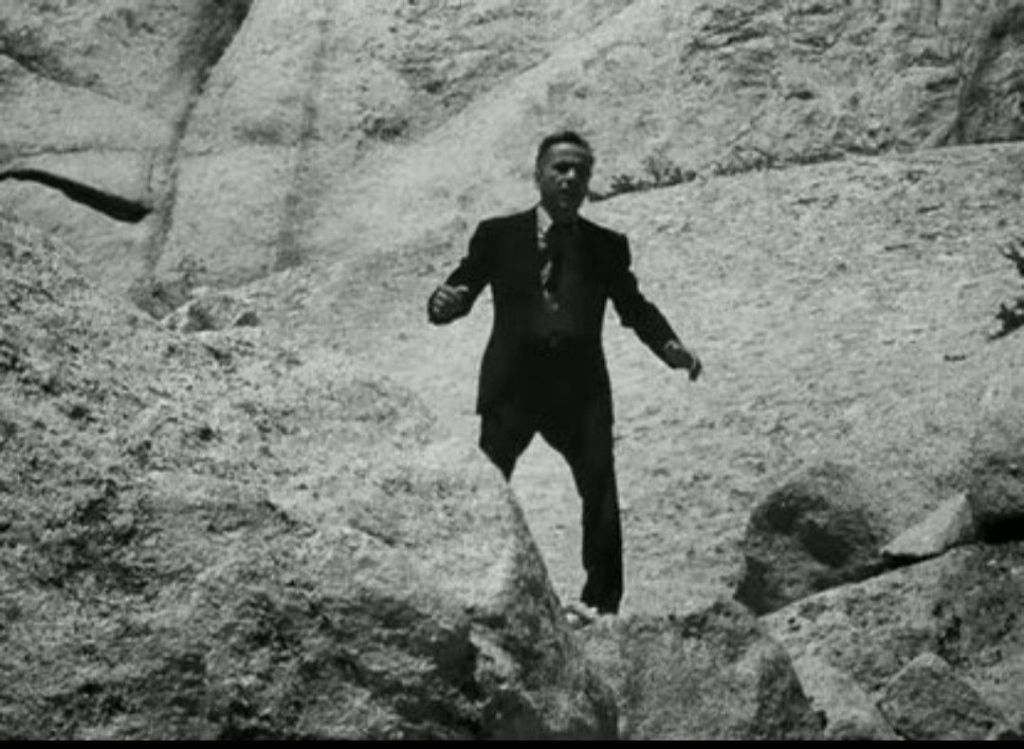
At dawn, Pard slips away from the police camp and manages to reach Roy. The dog’s barking distracts him. Believing that Marie has been discovered, Roy steps out onto the cliff, calling her name, and is shot dead by a sharpshooter. Below, Marie watches in horror as Roy’s body tumbles down the mountainside. As the officers rush in, Marie and Pard run to Roy’s body; Pard lies down beside him. As Marie is led away with Pard, she finds a small measure of comfort in the knowledge that Roy will never return to prison.
In High Sierra, Humphrey Bogart portrays Roy Earle with such depth and subtle shading that the audience not only sympathizes with him but even begins to forgive him while he commits crimes. Even in harsh moments—such as when he shoots a security guard, his humanity comes strongly to the fore. Roy’s relationships with “Pa” (Henry Travers), Marie (Ida Lupino), Velma (Joan Leslie), and Big Mac (Donald MacBride) all feel natural and believable. He treats the dog who accompanies him with affection, forms a tender bond with Marie, the taxi dancer, and willingly steps forward to help a lame young woman.
Rather than focusing solely on action, as many crime films of the period did, director Raoul Walsh gives Bogart ample space to build the character. As a result, Roy Earle emerges as a complex, fully realized human being. What Roy truly longs for is freedom—and in the end, he attains it forever, alone on a mountain peak. High Sierra stands as one of Bogart’s finest performances, and it was this role that firmly established him as a star of the highest rank.
“The likes of you and people like John Dillinger run straight toward death.”
This famous line from High Sierra points not only at Roy “Mad Dog” Earle, but also at an America standing on the threshold of change—an America slowly disappearing. The film marks the end of the classic gangster era and the emergence of the film-noir anti-hero. Released from prison, Roy heads toward California for one last robbery, drawn by the dreams of a new America, but what awaits him there is not rebirth, only a harsh recognition of fate. His infatuation with Velma, his struggle for redemption, and his death in the mountains together form a concise yet powerful portrait of a changing nation, a dying gangster culture, and the decisive moment of Bogart’s transformation into a superstar.
In High Sierra, Ida Lupino’s Marie and Humphrey Bogart’s Roy “Mad Dog” Earle are two wounded souls—clinging to hope, yet unable to escape destiny. Marie’s line, “A man keeps going only if he has hope,” expresses the emotional core of the film. Freed from prison, Roy travels toward California for a final heist, but his growing affection for a simple Midwestern girl (Joan Leslie) begins to change him from within. Raoul Walsh’s brisk yet controlled direction, the mountain pursuit, and the final confrontation on the peak serve as a bittersweet farewell to the gangster film tradition. Under the Hays Code, Roy must be punished, yet the ending—suggesting that “he is free”—gives his death a tragic, deeply human meaning. Bogart’s rough yet magnetic performance, combined with his heart-rending chemistry with Lupino, makes High Sierra both a chilling warning about a changing America and the decisive milestone in Humphrey Bogart’s rise to superstardom.
The New York Times critic Bosley Crowther praised the performances in High Sierra lavishly. He wrote that, viewed as a gangster film, it has everything—speed, excitement, suspense, and along with these a suggestive sense of futility that lends the story a tone of irony and compassion. According to Crowther, Humphrey Bogart plays the leading role with great force and “hard-boiled” vitality. Ida Lupino, Arthur Kennedy, Alan Curtis, and newcomer Joan Leslie handle their supporting roles effectively. Lupino, in particular, stands out as the “respectful, loving moll.” Overall, Crowther felt that High Sierra functions almost as a perfect summation of the gangster-film tradition—trust the old guard and Warner Bros.: they may die, but they never surrender.
Several important sequences of the film were shot on location at Whitney Portal, about halfway up Mount Whitney. The screenplay, co-written by Bogart’s close friend John Huston, is based on a novel by W. R. Burnett, who was well known for his crime fiction. High Sierra proved to be a decisive turning point in Bogart’s career, moving him from supporting roles to a full-fledged leading man. Its success also helped Huston make the transition to directing, leading to his direction of The Maltese Falcon later the same year (1941), again starring Bogart.
In the film’s final sequences, the use of location shooting is especially striking, depicting the authorities’ pursuit of Roy Earle from Lone Pine to the foothills of the surrounding mountains.
📸 Photo Courtesy: Google ✍️ Excerpts: Google
 Writer Sunita