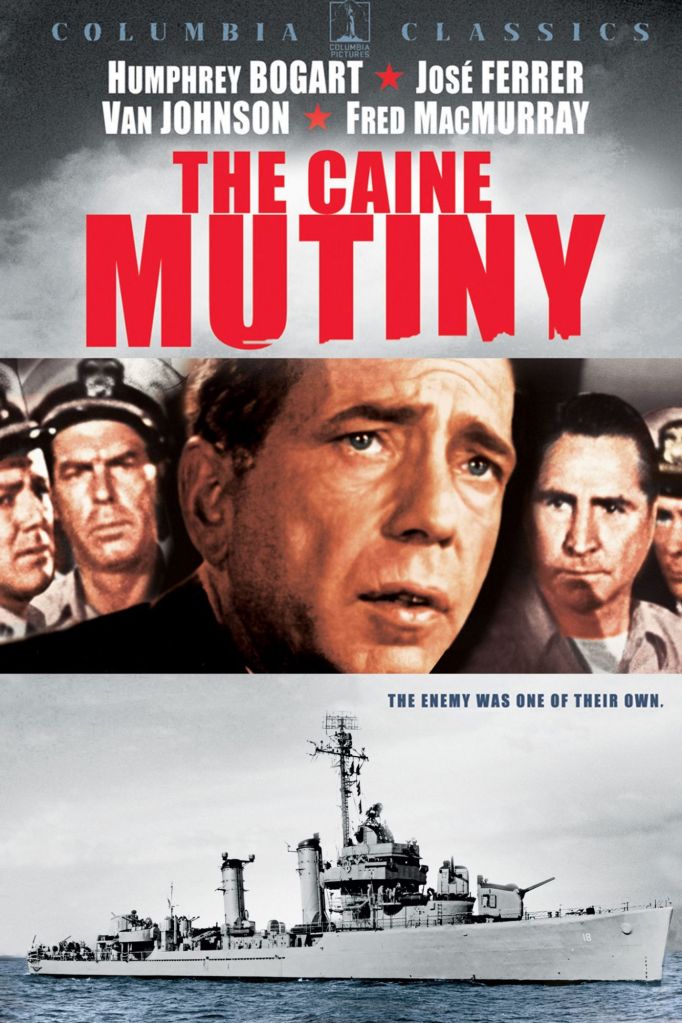
The Caine Mutiny is a 1954 American film about a military trial. It was directed by Edward Dmytryk, produced by Stanley Kramer, and stars Humphrey Bogart, José Ferrer, Van Johnson, Robert Francis, and Fred MacMurray.
The Caine Mutiny is a book written in 1951 by Herman Wouk. Novel win the Pulitzer Prize. The movie is based on this Novel. He wrote it based on his own time serving on two Navy ships during World War II. The story talks about the moral (right and wrong) and ethical choices that ship captains and officers must make while at sea. The “mutiny” in the title is not a violent rebellion. Instead, it is a legal action taken during a huge storm called Typhoon Cobra in December 1944.
In the film the story takes place in the Pacific Ocean during World War II. It shows what happens on a U.S. Navy destroyer-minesweeper and the court-martial (military trial) of the ship’s second-in-command, who is accused of mutiny.
During World War II, a new Navy officer, Ensign Willie Keith, joins the minesweeper USS Caine. There he meets Lieutenant Stephen Maryk, the ship’s second-in-command, and Lieutenant Thomas Keefer, who wants to become a writer and works in communications. Soon, a new captain, Lieutenant Commander Philip Francis Queeg, takes command of the Caine.
Captain Queeg is strange and very strict. He forces the crew to follow rules closely. The sailors do not like him, but Willie Keith admires him.
One day, during a practice exercise, the Caine is supposed to tow a target for other ships to shoot at. But Queeg becomes distracted while scolding Keith and Keefer about a crewman’s messy appearance. Because of this, the ship accidentally crosses its own towline and cuts it, letting the target drift away. Queeg then tries to hide what happened.
The Caine is given a job: to escort a group of landing craft during an attack on a small Pacific island. But before the ship reaches the correct spot, Captain Queeg becomes nervous and stops the mission. He tells the crew to drop a yellow dye marker in the water instead, and then leaves the landing craft to manage on their own.
Afterward, Queeg asks his officers to support his decision, but no one says anything. The officers secretly give him the nickname “Old Yellowstain”, meaning they think he is a coward.
Keefer believes that Captain Queeg is Very fearful and suspicious. He tells Maryk that he should think about removing Queeg from command because he might be mentally unfit, as allowed by Article 184 of Navy rules. Maryk gets angry at this idea, but he does start keeping a secret medical log to record Queeg’s strange behavior.
One day, some strawberries go missing from the officers’ dining room. Queeg reacts in an extreme way: he starts a big investigation, searches the whole ship, and even orders the crew to be stripped and checked. This convinces Maryk that Queeg may truly be unstable. He asks Keefer and Keith to come with him to report Queeg to Admiral Halsey.
But when they reach the admiral’s ship, Keefer loses courage and refuses to support Maryk. With no evidence and no support, they return to the Caine.
During a terrible typhoon, Maryk tells Captain Queeg that they must turn the ship into the wind and take on extra weight (ballast) to stay safe. But Queeg refuses and becomes so nervous that he almost stops functioning on the bridge. Maryk, with Keith’s support, takes command of the ship using Article 184. The Caine safely returns to San Francisco, but Maryk and Keith are then put on trial for mutiny.
Lieutenant Barney Greenwald, a Navy pilot who is also a lawyer, becomes Maryk’s defense lawyer.
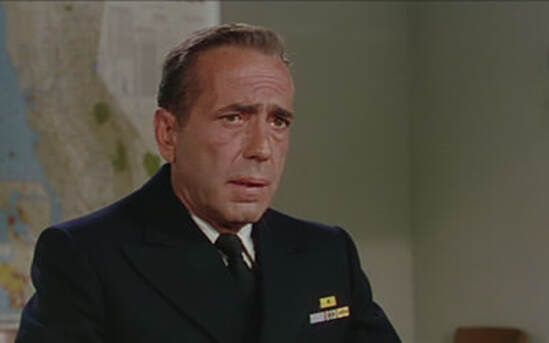
At the trial, Keefer lies. He says that he never felt Captain Queeg was mentally unstable, and that he was very surprised when he heard that Queeg had been relieved of command. While Greenwald cross-examines him strongly, Queeg begins to behave strangely in court — especially when he keeps rolling two metal balls in his hand, which is a sign of his unstable mental condition. Because of this, Maryk is found not guilty.
After Maryk is found not guilty, the officers of the Caine hold a party. At the party, Maryk treats Keefer coldly. Later, Greenwald, who is drunk, arrives and scolds all the officers. He says that they never respected Captain Queeg’s long years of service and did not support him when he asked for help. Instead, they mocked him and treated him like a fool.
Even if the captain was wrong, supporting a mutiny is never justified, because military discipline is built on trust and obedience. Queeg was an experienced naval officer. Removing him and taking control into their own hands was an act of “mutiny,” meaning rebellion against the captain.
He tells the officers of the Caine that they failed Captain Queeg. He says that while they were busy with their own ambitions, writing stories, studying law, or enjoying college sports, Queeg and men like him were out protecting the country. Queeg was not a bad man, just a tired and overworked one who needed support. But instead of helping him, the officers mocked him, made songs about him, and abandoned him when he asked for loyalty.
Greenwald reveals that Queeg once came to them seeking help, but they turned him away. If they had supported him then, the mutiny might never have happened. He says the officers, not Queeg, put the ship in danger. He admits he destroyed Queeg on the witness stand even though he felt guilty about it.
Then Greenwald exposes Keefer as the true villain, the man who planted the idea of mutiny, twisted facts, stayed safe during the trial, and let others take the blame. Greenwald says Keefer lacked even a fraction of Queeg’s courage. He toasts Keefer sarcastically, calling him the one who should have been on trial.
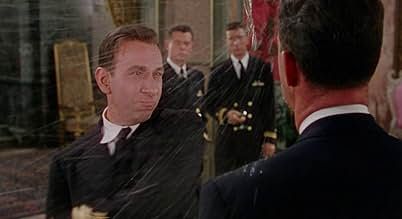
Greenwald explains that Queeg was suffering from “battle fatigue” (stress and exhaustion from war) because of his earlier fighting in the Atlantic. Because of this, he became unsure and confused during the typhoon. Greenwald then says that Keefer is the real cause of the mutiny, because he planted the idea in Maryk’s mind. Greenwald throws a glass of champagne (“yellow wine”) in Keefer’s face.
All the other officers walk out, leaving Keefer alone in the room.
Humphrey Bogart delivers a powerful performance as Captain Philip Queeg. The hints of suspicion, fear, and tension on his face make the character unforgettable. “In the Navy, you can’t assume such a bad thing.” this line becomes Captain Queeg’s catchphrase. He first uses it when he scolds Burt Gorton for not giving him a complete report about the difficulty of recovering the target after the towline is cut.
The insecurity in his eyes, the small steel balls nervously rolling in his hands, and his gradual breakdown under pressure are all etched in the viewer’s memory. Bogart does not portray Queeg as a villain but as a tragic, troubled man. Through this role, he proves that he is not only capable of playing tough detectives or gangsters, but can also portray characters with deep psychological complexity.
Before the film was released, Humphrey Bogart appeared on the cover of Time magazine (June 7, 1954), which gave the movie a big boost. The article praised Bogart’s acting as Captain Queeg, saying he showed Queeg as a strict and angry officer who slowly reveals his inner fear and mental struggle. In the courtroom scene, Bogart makes Queeg’s breakdown powerful and memorable, especially when Queeg suddenly realizes he is defeated and falls silent.
José Ferrer – Lt. Barney Greenwald (Defense Attorney) delivers one of the film’s strongest speeches in this scene. Greenwald tells honestly says the officers that they failed Captain Queeg. He tells the officers that Queeg deserved respect because he had served bravely for years and was suffering from battle stress. He calls Keefer the true cause of the mutiny and then throws champagne in Keefer’s face. Ferrer’s acting is sharp, emotional, and morally forceful. He shows anger, disappointment, and sadness all at once, making the scene one of the film’s most dramatic moments.
Van Johnson – Lt. Steve Maryk is the officer who took command from Queeg during the typhoon. In the champagne scene, Maryk is present, and he gives Keefer a cold look because he feels betrayed. Johnson plays Maryk with honesty and seriousness, he is a man who believed he was doing the right thing but later realizes he was influenced by Keefer. His quiet anger in this scene adds to the tension.
Fred MacMurray – Lt. Tom Keefer (Communications Officer) is the one who first suggested that Queeg might be mentally unfit. In the champagne scene, Keefer is exposed as a coward when Greenwald calls him the real cause of the mutiny and throws champagne in his face. He shows Keefer as intelligent but weak, clever with words but afraid to take responsibility. When the champagne hits him and everyone walks away, his shocked and guilty expression shows the collapse of his character.
The film was released on June 24, 1954, by Columbia Pictures. It was very successful and became the second highest-earning movie in the U.S. that year.
At the 27th Academy Awards, it was nominated for Best Picture, Best Actor (Humphrey Bogart), Best Supporting Actor (Tom Tully), Best Screenplay, Best Film Editing, Best Music Score (Max Steiner), and Best Sound Recording. It was also nominated at the British Academy Film Awards for Best Film and for Best Foreign Actor (José Ferrer). Director Edward Dmytryk received a nomination from the Directors Guild of America for Outstanding Directorial Achievement. The New York Film Critics Circle nominated him for Best Director and nominated Bogart again for Best Actor. At the Venice International Film Festival, Dmytryk was nominated for the Golden Lion.
📸 Photo courtesy: Google. ✍️ Excerpts: Google.
 Writer Sunita