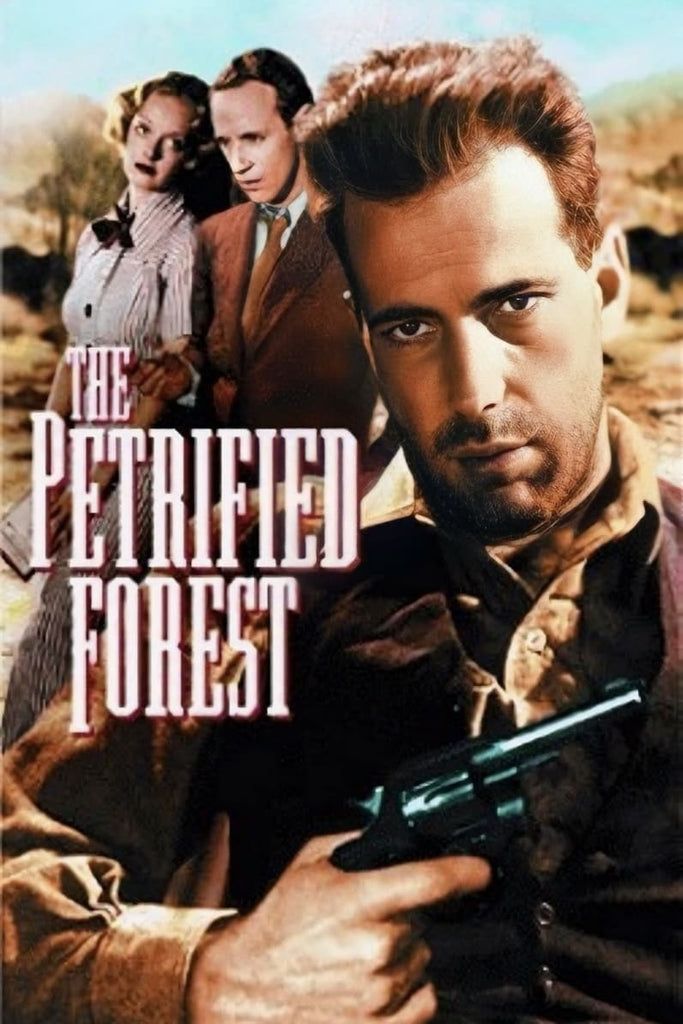
The Petrified Forest is a 1936 American crime drama movie directed by Archie Mayo. It is based on a 1934 stage play written by Robert E. Sherwood. The movie stars Leslie Howard, Bette Davis, and Humphrey Bogart. The script was written by Delmer Daves and Charles Kenyon. Later, the story was also performed on radio and TV. The film takes place in Petrified Forest National Park in Arizona.
During the Great Depression, Alan Squier, a British writer who has failed in life, is now a sad and penniless wanderer. He walks into a small roadside diner in the lonely town of Black Mesa, Arizona, near the Petrified Forest.
The diner is run by Jason Maple, his daughter Gabrielle, and Jason’s talkative father Gramp. Gramp loves telling anyone who will listen about his old adventures in the Wild West, including stories about famous outlaws like Billy the Kid.
Gabrielle’s mother was a French woman who married Jason during World War I. She loved him when he was a young, handsome American soldier. But after the war, she found him to be a “dull, defeated man,” so she left him and went back to France when Gabrielle was still a baby. She now sends Gabrielle poems, and Gabrielle dreams of going to Bourges, the place where her parents first met, so she can become an artist.
Alan then shares his own story, he wrote one novel, then spent eight years in France living with his publisher’s wife while trying to write a second book. Gabrielle immediately feels attracted to him.
Gabrielle shows Alan her paintings—it is the first time she has ever shown them to anyone. She also reads him a poem she loves by François Villon.
Boze Hertzlinger, a strong young man who works at the diner and has tried many times to win Gabrielle’s love, becomes jealous of Alan. Seeing the tension, Alan decides to leave immediately.
He gets a free ride from rich tourists, Mr. and Mrs. Chisholm. But only a few minutes later, they run into Duke Mantee, a famous gangster who is running from the police. Duke’s car has broken down, so he and his gang take the Chisholms’ car and drive to the diner. Duke has planned to meet his girlfriend, Doris, there before escaping to Mexico.
Soon, Alan, the Chisholms, and their chauffeur all return to the diner as well.
Alan does not seem worried about being a hostage. Instead, he talks to Duke in an energetic, friendly way and even raises a toast to him, calling him “the last great believer in true individualism.”
Boze suddenly grabs a rifle and manages to aim it at Duke. But when Boze gets distracted for a moment, Duke quickly pulls out his gun and shoots Boze in the hand, taking control again.
Duke then finds out that Doris has been caught by the police and has told them about their meeting place. Soon, police and federal agents surround the diner.
Duke gets ready to escape and says he will take Mr. and Mrs. Chisholm with him as hostages.
Moved by Boze’s brave act, Alan suddenly follows a strong impulse. While Gabrielle is in the back room wrapping Boze’s injured hand, Alan takes out his life insurance policy and changes it so that Gabrielle will receive the money after his death.
Alan then asks Duke to kill him. He tells Duke, “It won’t make any difference to you… they can only hang you once.” Alan wants Gabrielle to use the insurance money to go to France and follow her dreams.
Duke agrees and shoots Alan, especially after Alan stops him from escaping with the hostages. Duke then leaves the diner but is captured by the police soon after.
Alan dies in Gabrielle’s arms, comforted by the thought that she will escape the empty life around her and finally have the chance to follow her dream of becoming an artist in France.
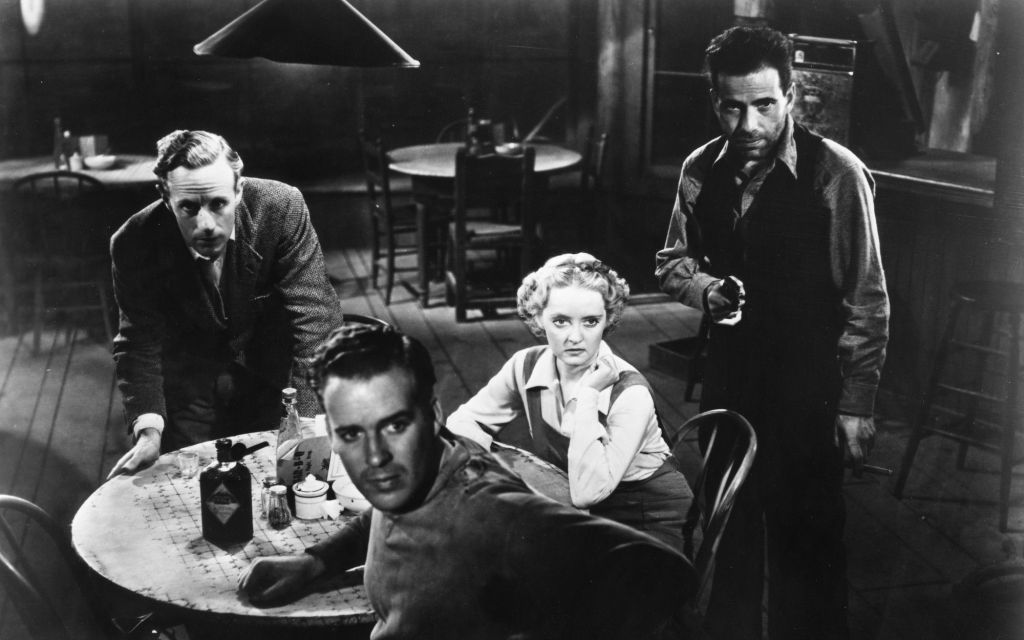
Humphrey Bogart’s delivery of the line, “And the first time any one of you makes a wrong move I’m gonna kill the whole lot of you,” shows why his performance as Duke Mantee became famous.
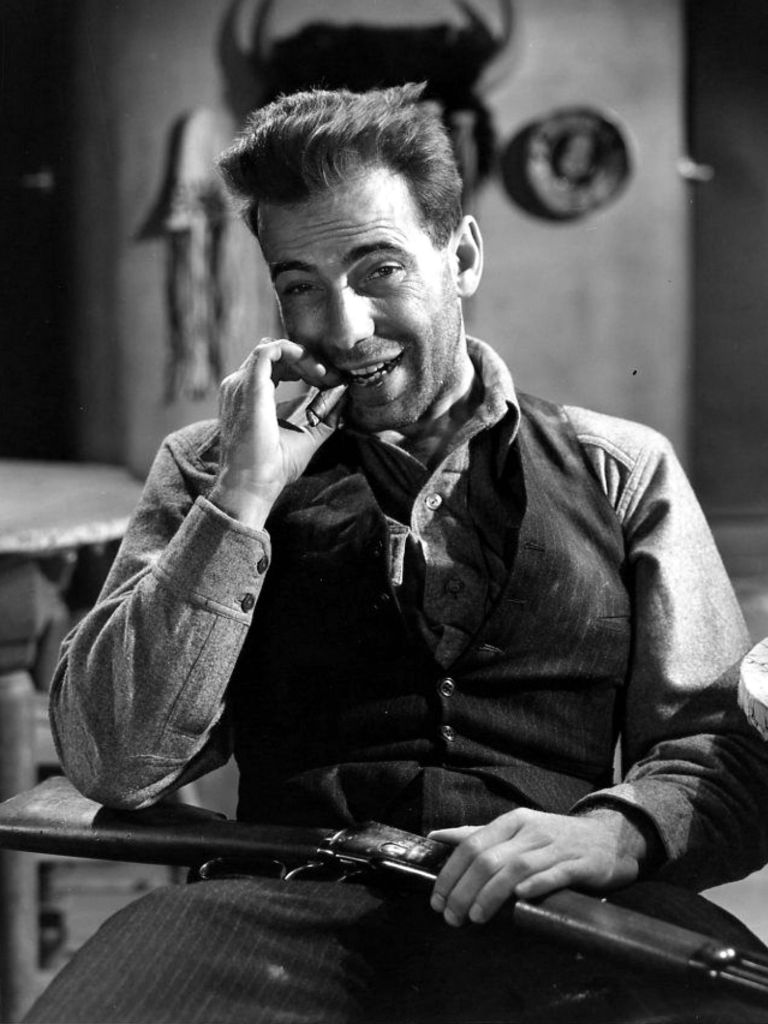
In The Petrified Forest, Humphrey Bogart’s performance is defined by quiet intensity, controlled menace, and subtle emotional depth. As Duke Mantee, he avoids melodrama, using a calm, steady voice and sharp, focused gestures to create a constant sense of danger. Bogart presents Mantee not merely as a ruthless criminal, but as a hunted, exhausted, and desperate man shaped by the pressures of the Great Depression, making the character feel strikingly real.
His rigid posture, quick reactions, and watchful eyes suggest a man living purely on instinct, while beneath the hard exterior Bogart hints at a tragic loneliness. Duke seems fully aware that his fate is inevitable, and has already accepted it. This blend of menace and vulnerability heightens the tension in every scene and makes the character unforgettable.
As Variety noted in January 1936, the film remains faithful to its stage origins, with Leslie Howard and Bogart reprising their theatrical roles. Howard’s disillusioned writer and Bogart’s fugitive gangster represent two failed dreams: one seeking meaning through words, the other asserting existence through violence.
Duke Mantee proved to be a turning point in Bogart’s career. It marked the beginning of his iconic hard-boiled screen persona—morally ambiguous, wounded, yet deeply human—and planted the seeds for his later roles in High Sierra, The Maltese Falcon, and Casablanca. The Petrified Forest thus stands not just as a crime drama, but as the birth of the Humphrey Bogart legend.
Photo courtesy Google. Excerpts taken from Google.
 Writer Sunita