
“To Have and Have Not” (1944) is an American film set against a backdrop of romance and war. Directed by Howard Hawks, the film is based on Ernest Hemingway’s 1937 novel of the same name. It is also notable for bringing Humphrey Bogart and Lauren Bacall together on screen for the very first time.
The film is set on the island of Martinique during World War II, at a time when the island is under the control of Vichy France. The story revolves around a fisherman who falls in love with an American drifter girl. Their relationship becomes entangled in the growing tension between the French Resistance and Vichy authorities.
In the summer of 1940, after the fall of France, Harry Morgan, an American, operates a sport-fishing boat named Queen Conch at Fort-de-France on Martinique. The island is under the tight control of Vichy France, which remains loyal to Nazi Germany.

To make a living, Harry takes tourists out on sea-fishing trips in his boat. His companion is Eddie, a drunk but honest friend who was once a skilled sailor but has now ruined himself with alcohol. Despite Eddie’s shortcomings, Harry looks after him with genuine affection.
Meanwhile, there is an atmosphere of unrest on the island of Martinique. Many of the locals secretly support Free France and are standing up against the Vichy government.
Harry’s new customer, Johnson, owes him $825 for a fishing trip. But Johnson admits that he doesn’t have the money with him and promises to pay the next day when the bank opens.
At the hotel (where Harry himself is staying), the hotel owner Gérard, known to English speakers as “Frenchy,” approaches Harry. He asks Harry to help the French Resistance by bringing in a few people to the island. However, Harry refuses, saying he wants nothing to do with politics.

That evening, in the hotel bar, Harry notices Marie “Slim” Browning. She is a young, beautiful, and fearless American girl who has just arrived from Rio. She does various odd jobs to survive. To escape the unwanted trouble caused by the drunken and irresponsible Johnson, she joins pianist Cricket and his band and performs a lively rendition of “Am I Blue.”
Harry realizes that Slim has secretly lifted Johnson’s wallet. He follows her to her room and forces her to return it. Inside the wallet, they find $1,400 in travelers’ checks and an airline ticket for the next morning—before the bank opens.
Harry returns the wallet to Johnson but immediately insists that he sign the checks and pay him. Just then, a gunfight breaks out between the police and the Resistance in front of the hotel. The chaos spills into the bar, and Johnson is accidentally shot and killed in the crossfire.
The police arrest Harry, Slim, and Frenchy for questioning. They also confiscate Johnson’s wallet, Harry’s passport, and his money, especially because Harry argues with them.
After returning to the hotel, Gérard offers Harry a job. Since Harry now has no money, Gérard asks him to secretly bring Paul de Bursac and his wife Hélène, members of the Resistance, from a nearby island to Martinique. Harry reluctantly accepts the task.
Meanwhile, the relationship between Harry and Slim grows closer. Slim realizes that Harry has begun to care for her. But her happiness is shattered when Harry uses most of the money he earns from the job to buy her a plane ticket back to America.
Harry sets out to bring the de Bursac couple, but his boat is spotted by a Navy patrol, which opens fire on them. Paul de Bursac is wounded in the attack. Even so, Harry manages to evade the patrol and safely deliver them to a waiting boat.
When Harry returns to the hotel, he is surprised to find that Slim has not gone back to America; she has chosen to stay, deciding she cannot walk away from him. The de Bursac couple is hidden in the hotel cellar, and at Frenchy’s request, Harry removes the bullet from Paul’s shoulder.
Harry then learns that the couple has come to Martinique in order to help a prisoner escape from Devil’s Island, so he can join the Free French movement. Paul de Bursac asks Harry to assist in this mission, but Harry politely refuses.
The police return to the hotel once again. They tell Harry that they had recognized his boat the previous night. They have also taken Eddie into custody. This time, however, they keep Eddie away from alcohol so that he will reveal everything he knows about the smuggling operation.
.jpg)
The police catch Harry in his hotel room, but he turns the situation around. He kills one of the officers and holds Captain Renard at gunpoint. Harry forces him to issue orders to release Eddie and to sign the permits they need to access the harbor.
After this, Harry, Eddie, and Slim head toward the boat Queen Conch. Their plan is to join Frenchy and the de Bursac couple in rescuing the prisoner from Devil’s Island.
Howard Hawks decided to adapt Ernest Hemingway’s novel, even though the original book was not very strong. Hawks changed the story, shifted the setting from Cuba to Martinique, and focused more on romance and adventure than on politics.
He cast Lauren Bacall in her first major role and highlighted her remarkable on-screen chemistry with Humphrey Bogart, which became one of the film’s biggest attractions. Hawks also used jazz music throughout the film, emphasizing themes of freedom and resistance.
Because of Howard Hawks’ directing style, the actors were allowed to perform naturally, giving the film its unique charm. Hawks adapted a novel and turned it into a celebrated work of cinema, and this film also marked the beginning of the famous Bogart–Bacall pairing.
Humphrey Bogart plays Harry Morgan, a weary, world-wise fishing boat captain in Martinique. At first, Harry only wants to earn a living and stay away from politics. But as the story progresses, he is drawn into helping the French Resistance. Bogart’s performance shows Harry as a calm, brave man who doesn’t rely much on luck. At the same time, he is caring—especially toward his alcoholic friend Eddie and toward Slim. While romance blossoms between Harry and Slim, Harry slowly changes from a man who thinks only of his own benefit into a hero willing to take risks for what’s right. His cool, firm style, sharp dialogue, and quiet strength make the character feel completely real.

In the film, a bullet is lodged in Paul de Bursac’s body. Saving him is crucial because his survival is essential for the French Resistance mission. Bogart hides him in his room. The police and Gestapo agents are nearby, which already makes the situation dangerous. On top of that, the responsibility of removing the bullet falls on Bogart. There is no rush, panic, or fear on his face. He calmly gathers the necessary items, assesses the situation, and examines Paul before beginning the procedure. This is Bogart’s signature “cool under pressure” look. While removing the bullet, he holds Paul’s hand as he writhes in pain, yet he performs the job with precision. In his eyes, you can see the determination—“I have to do this.”
Bogart says, “If he regains consciousness while I’m examining the wound, pour some of this liquid onto a bit of cotton and let him smell it—but don’t open the can until I tell you. Take out four pieces from it. George, bring the lamp a little closer so I can see clearly. Slim, hold this for a moment. Stay calm. Now open the can and let him smell it. George, hold his head down—and quickly. Bring the lantern lower. Frenchy, give me the bowl here, and push that smoke away or we’ll pass out too. Here—your bullet. I told you it was already spent; it didn’t have enough force left to break the bone. All right, forget that now; you finish bandaging him.”
Inside the room, the dim glow of the lantern flickers, the search is going on outside, and inside we see Bogart working with complete calm. This contrast heightens the tension of the scene. Bogart’s voice is low, deep, and fully in control of the situation. Bacall’s character is there helping him. The chemistry between Bogart and Bacall becomes evident here, few words, but immense emotion. In his behavior, you see the mark of a “romantic yet tough hero” — a man who may care about profit, but will also stand up against injustice when it matters.
Bogart never tries to show that he is the hero; after a while, the audience realizes it on their own. This man is calm, patient, with a hardness in him but also a gentle center. There is no melodrama, he says everything through his eyes. This is his true style of silent courage.
.jpg)
“Anybody get a match” With the very first line of her very first film, Lauren Bacall seemed to strike a spark on screen, and with it, an immortal screen partnership with Humphrey Bogart was born. Bogart plays a world-weary gunrunner who has no intention of getting involved with the Free French movement. But when Bacall, a mysterious young woman, steps up to him asking for a light, something in him begins to change.
Lauren Bacall began her career as Marie “Slim” Browning, a sharp, bold, and independent young woman. Her confident performance, deep voice, and razor-edged dialogue gave her character a blend of mystery and irresistible allure.

“You don’t take my shoes off… don’t bring me breakfast… don’t have to fix me a nice bed. I don’t want anything from you,” Bogart says quietly.
The way he says it carries a controlled irritation and a hidden pleasure at the same time. He doesn’t answer Bacall’s teasing directly; he speaks in a low, slow, perfectly measured voice.
This is truly an unforgettable, immortal cinematic moment, because in it, emotions speak far louder than the dialogue itself.

“What should I do then, Steve?” she asks, looking straight into his eyes.
“No matter what you say… I can’t be angry with you.”
He studies her for a moment and says, “You wanted to do something for me, didn’t you?” Bogart asks her to walk once around him. She circles him slowly.
“Find anything?” he asks with a soft smile.
He doesn’t move his head, only his eyes follow her as she walks around him. Bacall’s lingering nearness leaves him a little startled and a little pleased at the same time. He enjoys her words, her confidence, her playful boldness, but he doesn’t reveal everything openly. That’s why he gives that mischievous, quietly restrained smile.
This natural, unspoken, faint smile is not just a smile, it’s a vivid reflection of his character. That slight lift at the corner of his lips, with its mischievous glint, is a perfect blend of confidence, mystery, and control. In his exchanges with Lauren Bacall, this subtle smile creates a unique magic. He understands every nuance of what she’s saying, and his reply is often just a glance, nothing more, nothing less.
His smile is never broad or obvious; instead, it’s restrained, precise, and infused with a quiet assurance that says, “I can handle whatever comes.” It carries a hint of danger, a touch of charm, and a deep self-assurance that makes his screen presence even more compelling. This smile speaks louder than words, dangerous yet alluring, calm yet powerful. And because of that, Bogart’s understated smile gives the entire film a special, bittersweet romantic energy..
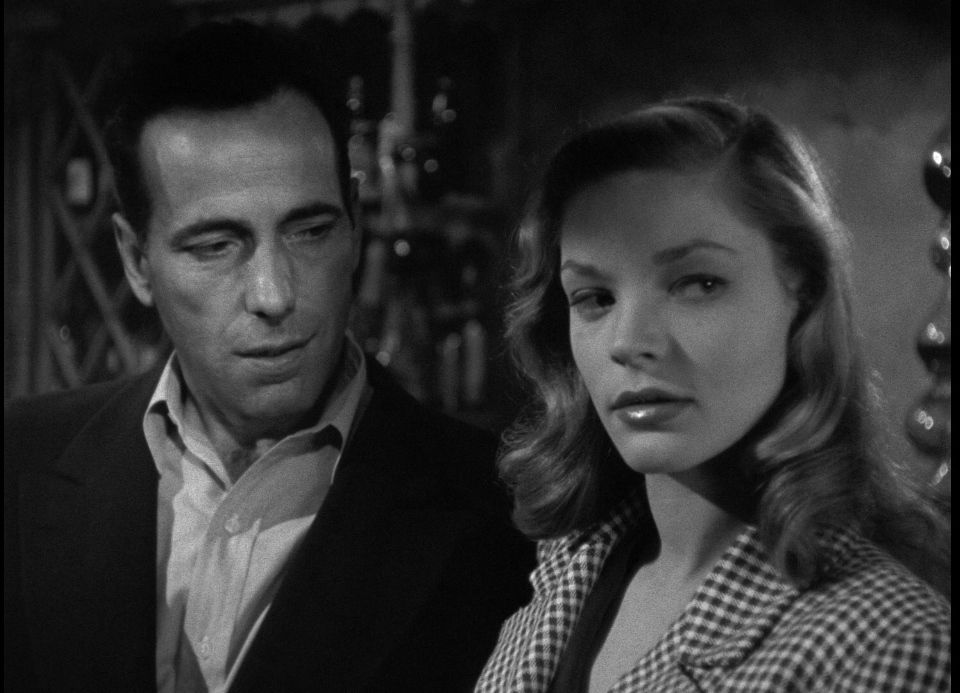
From Bogart’s eyes, it is as if he’s saying: “I know exactly what you’re trying to do. You put your hand in mine… and then smile and say ‘hello.’ And in that very moment, my whole being starts to tremble. My heart beats so hard that anyone could see what I’m feeling. And yet, I can’t say a single word. You think you know me well… but you don’t. I like you. But I will never be the one to admit it first.”
The Bogart–Bacall chemistry is considered one of the most magnetic and natural pairings in all of Hollywood. Bogart’s calm, serious, quietly intense personality combined with Bacall’s youthful, confident, and radiant presence creates an instant spark on screen. Their exchanges are filled with playfulness, challenge, and a mysterious attraction. Bacall’s bold tone and Bogart’s restrained, knowing smile give every encounter a delicious tension and anticipation.
Their eye acting is even more powerful, their silent looks speak louder than their lines. And importantly, Bacall never shrinks in front of Bogart; she stands on equal footing, and Bogart respects her confidence. This equality, respect, and natural pull between them shines brightly on screen.
The real love that blossomed between them during filming shows in every gesture, every glance. Their chemistry never feels performed, it feels lived, real, and deeply felt.

When Lauren Bacall asks Humphrey Bogart, “You know how to whistle, don’t you, Steve? You just put your lips together and blow,” the words become unforgettable. It is considered one of the greatest lines ever spoken by a woman on screen. Bacall delivers it with a confidence that is both seductive and effortlessly stylish. In that moment, she proves she is not just a stunning beauty but the perfect match for Bogart, on screen and in real life.
Those words serve as the perfect introduction to everything that defines Bacall’s performance. In her very first film, she speaks the line with a calm assurance and a playful boldness that announce her uniqueness. That single line becomes the symbol of her entire style, an iconic moment that marks the birth of a new star.
In the hotel bar, the role of the pianist Cricket is played by singer–songwriter Hoagy Carmichael. In the film, Cricket and Slim (Bacall) perform “How Little We Know” and “Am I Blue?”, while the band plays “Hong Kong Blues” and “The Rhumba Jumps.” At the end of the film, Bacall does a quick, playful shimmy to the lively rhythm of “How Little We Know.”
Bacall’s original theme song, “Baltimore Oriole,” was used only as background music because her voice was still untrained at the time. The film uses very little background scoring overall; the main music was composed by Franz Waxman, with a few short cues contributed by William Lava.
According to Paul Schrader, To Have and Have Not is a noir film from the first “wartime” film-noir period. In this film, good and likable characters are addressed by nicknames, Steve, Slim, Eddie, Frenchy, Cricket—which makes them feel closer and more familiar to the audience. In contrast, the bad or corrupt characters are addressed by their surnames, such as Johnson, which gives them a colder, more distant feel.
Critic Robin Wood notes that Bogart’s character Morgan reflects both Bogart’s own screen persona and Howard Hawks’s ideal hero. He lives by his own rules, looks out for his own interests, yet is never selfish. He does the right thing because he feels responsible for his people. Bogart’s character also conveys a powerful idea: “A single act does not define who you are, unless you let it.”
The film premiered in New York City on October 11, 1944. Audiences enjoyed it, even though the critical response was mixed. Many praised Lauren Bacall’s debut and the remarkable chemistry between Bogart and Bacall.
The film was a box-office success and ranked among the top 10 highest-grossing films of 1944.
At the National Board of Review Awards, Humphrey Bogart won the Best Actor award.
📸 Photo courtesy: Google. ✍️ Excerpts: Google.
 Writer Sunita