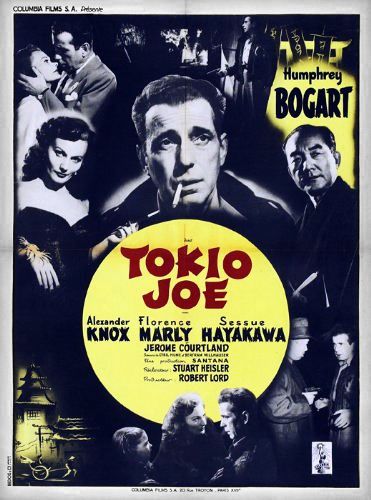
Tokyo Joe is a 1949 American film noir crime drama directed by Stuart Heisler and starring Humphrey Bogart, Alexander Knox, and Florence Marly. The film marked the first of two collaborations between Heisler and Bogart.
The film takes place against the contemporary backdrop of that time. Produced by Bogart’s own company, Santana Productions, it is considered one of the first films to comment on the period of American occupation in post-war Japan.
Made at the height of Humphrey Bogart’s fame, Tokyo Joe gives a rare look at life in Tokyo during the American Occupation. Bogart plays Joe Barrett, a former lieutenant colonel who used to run a nightclub in Tokyo before World War II. He was married to a beautiful European singer named Trina (played by Florence Marly). For reasons only he knows, Joe left his wife and Japan just before the attack on Pearl Harbor, and because of the war, he could not return until many years later.
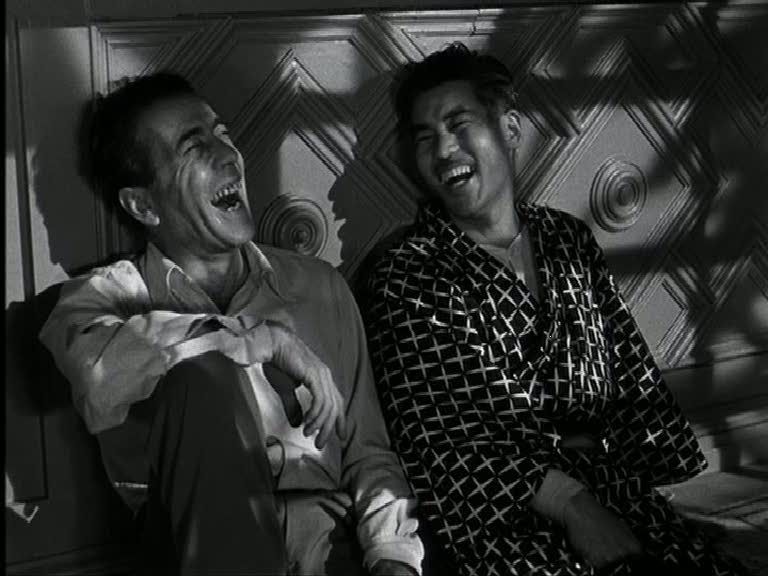
The film begins with Joe Barrett returning to Japan. Before the war, he used to run a bar called Tokyo Joe’s. Although Joe has served in the American military, he still gets caught in the red tape of the occupation authorities. After serving in the Air Force during World War II, former Colonel Joe Barrett comes back to Tokyo to see whether anything is left of his pre-war bar and gambling joint, Tokyo Joe’s. To his surprise, the place is still standing—almost unchanged—and his old friend Ito is still running it.
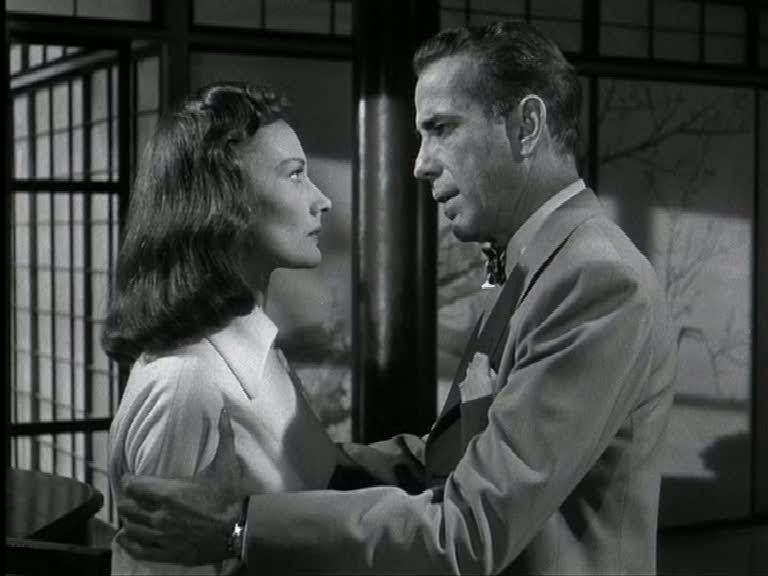
Ito tells him that his wife Trina, whose death had been reported to him during the war, is actually alive. Joe is stunned. Filled with sudden hope, he goes to meet her. Seeing Trina again awakens old feelings in Joe, but she is now living a completely different life. She tells him that she has divorced him and is now married to Mark Landis, a lawyer working for the American occupation forces in Japan.
To remain in Japan after his 60-day visitor’s permit expires, Joe plans to start an airline freight franchise, but he needs financial support. Through Ito, Joe meets Baron Kimura, the former head of the Japanese secret police.
Kimura offers to finance a small airline business that will supposedly transport frozen frog legs for export to North and South America. Joe suspects that Kimura intends to use the airline as a front for smuggling penicillin, saccharin, and pearls.
When the U.S. Army delays granting Joe permission to open his business, Kimura pressures him by revealing documents from the Japanese secret police files. These files show that Trina had broadcast propaganda for the Japanese during the war—a treasonable act since she was a naturalized American citizen and married to an American.
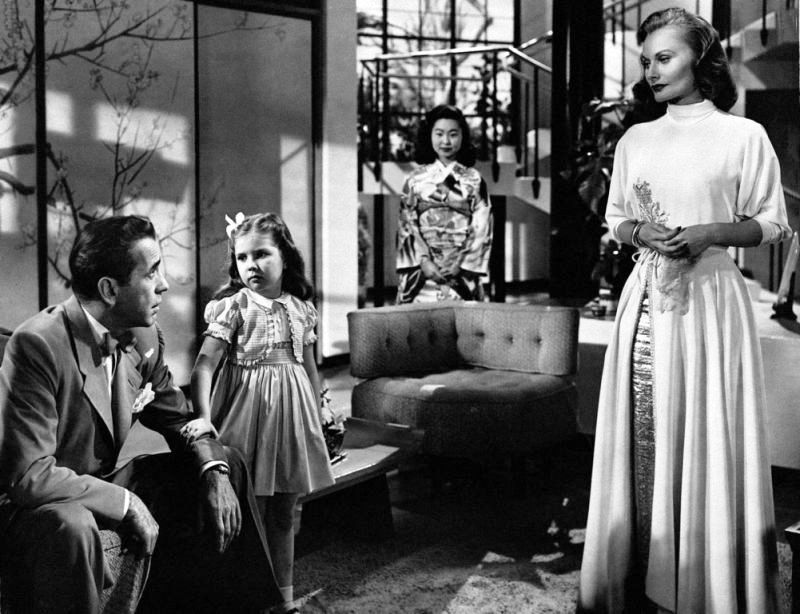
When Joe shows Trina the evidence, she tells him she made those radio broadcasts only to save her newborn baby. While she was in the Oyama prison camp, the Japanese officers took her child away, and she feared for the baby’s life.
She then tells Joe that when he left her, she was pregnant, and Anya is actually his daughter. Joe is shocked again. Anya comes in—small and innocent. Bogart’s Joe looks at her with curiosity, guilt, joy, and the pain of lost years. He gently talks to her. The old love for Trina and the new bond with Anya start pulling Joe back into his past.
This makes Joe want to back out of the airline deal, but Kimura threatens him and says he must finish it. To protect Trina, Joe finally agrees to Kimura’s terms and even convinces Mark Landis to help start the airline business before Joe’s visitor permit expires.
Later, Joe learns from American military officers that Kimura’s real plan is very dangerous. Kimura wants to secretly bring fugitive war criminals into Japan—former top officers of the Japanese Army and the leader of the Black Dragon Society. These men want to start a secret anti-American movement.
The American authorities decide they will arrest these men the moment they land at Haneda Airfield.
But Kimura finds out Joe has spoken to the Americans. Before Joe flies to Korea, Kimura tells him that Anya has been kidnapped. She will be released only if Joe brings the Japanese fugitives into Japan on time.
Joe picks up the men and tries to land at the airfield chosen by the American Army. But the Japanese fugitives pull out guns, hijack the plane, and force Joe to land at another airstrip in Okuma.
However, the U.S. Army is already prepared. They have every airstrip on Honshu island guarded, so they catch the Japanese criminals before they can escape.
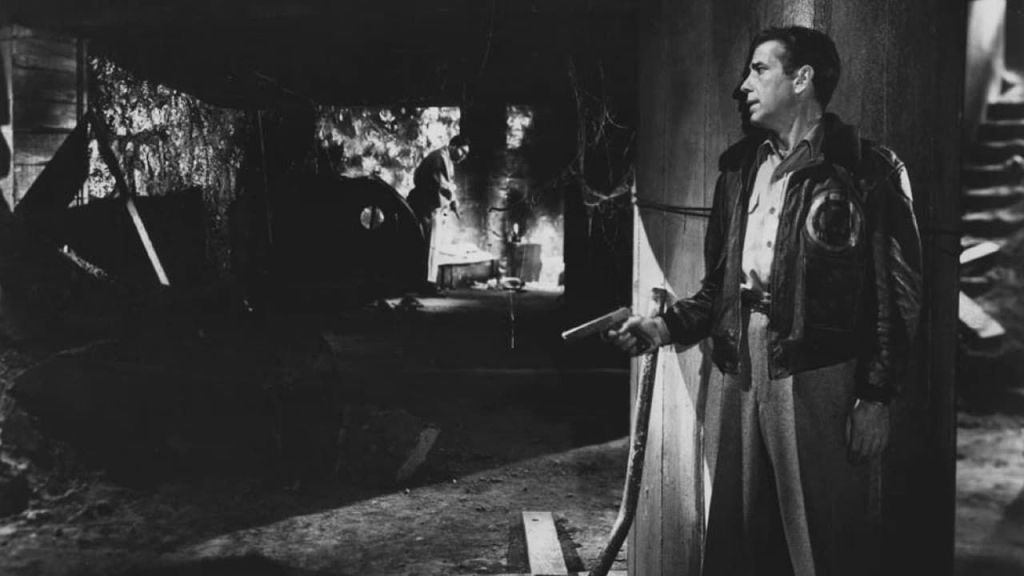
Back at the bar, the badly wounded Ito tells Joe that Anya is being held in the basement of the old hotel next door. Joe goes into the dark basement and finds Anya. But while carrying her to safety, Kimura shoots him.
American soldiers arrive just in time and kill Kimura.

Trina arrives, and Anya runs from Joe straight into her arms. Joe watches both of them happily, even though he is in pain. He risked his life to save the little girl. But when he sees Anya safe in her mother’s embrace, a look of fatherly love and responsibility appears on his face.
Joe softly asks Trina if she will come back to him, and Trina, with tears in her eyes, says she has already returned. Joe smiles gently and tells her not to cry, saying the best is still ahead and that he has many things he wanted to tell her but never did. He says that plans don’t always work out, but this time he will be fine—for her and for the child. He then looks at Anya and asks what she is looking at. When she answers, “You,” Joe smiles softly and says he will see her a little later. Trina holds his hand and whispers that she will see him a little later too.
The film received a good response from audiences because postwar Japan was a topic that frequently appeared in newspaper headlines at the time and was something people found intriguing.
One important theme of the film is the “rehabilitation” of the Japanese people. Although it includes some Yellow Peril stereotypes, such as Baron Kimura or Trina’s maid who turns out to be a spy, the film also presents positive Japanese characters like Ito and “Kamikaze.”
Another interesting aspect of the film is Baron Kimura’s plan, a “Communist-controlled” conspiracy aimed at creating riots and chaos. This clearly reflects the early signs of the Cold War.
Humphrey Bogart himself never went to Tokyo, so for some scenes the film crew had to use American military personnel as body doubles by dressing them in Bogie’s famous trench coat. Second-unit director Arthur Black, cameraman Joseph Biroc, and Emil Oster Jr. shot nearly 40,000 feet of background footage in Tokyo and surrounding areas. This included locations such as Mount Fuji, Haneda Airport, and a few other places.
The most important aspect of this shoot was that—after the war—this was the very first American company to receive permission to film in Japan.
Casting Japanese superstar Sessue Hayakawa in Tokyo Joe was considered a major event. Playing the role of Baron Kimura, this was Hayakawa’s first American film since the 1920s, and Bogart personally requested him to join the film. This movie is regarded as a rare opportunity to see Humphrey Bogart and one of Japan’s greatest actors of all time, Sessue Hayakawa, together on screen.
The chemistry between Joe and Trina is the heart of Tokyo Joe. It is not a happy, romantic chemistry, but a blend of memories, pain, guilt, and unfinished love. When they meet, there is a shock between them. Bogart’s eyes seem to say, “Why did you leave me?” and Trina’s eyes seem to answer, “I didn’t leave you—circumstances forced me to.”
In Tokyo Joe, Humphrey Bogart acts with quiet strength and controlled emotion. He plays a man who carries the pain of war, lost love, and guilt, but still tries to stay calm and confident on the outside.
Bogart’s eyes show most of his feelings, surprise, sadness, longing, and unfinished love, especially when he looks at Trina. His face looks steady, but you can clearly feel the emotions inside him. He plays Joe Barrett as a “tired hero,” a man who has suffered a lot but still fights for the people he cares about. His acting gives the film deep emotion and makes Joe’s struggle very real.
This was a heart-touching and emotional dialogue scene from the film.
Joe is shaken to the core when he discovers that the little girl is actually his daughter. A moment earlier, he had harshly said, “What do I care about your child?” But when he sees the old photograph and learns her age, the truth hits him—the child was born when Trina was alone during the war, carrying his baby while he had already left.
This realization breaks him from inside. He suddenly understands how unfair he has been, how much pain she faced, and how blindly he judged her.
And then, the shock deepens when the little girl, his daughter, walks in, innocent and unaware. She smiles at him, talks to him, corrects him sweetly, “I’m not a baby… my name is Anna,” and proudly shows him her photo.
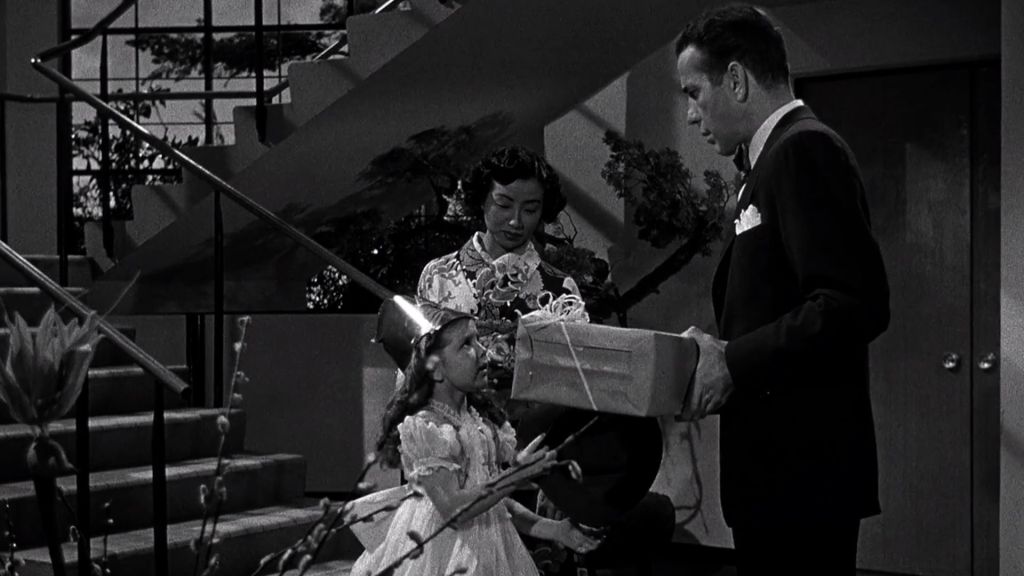
Joe, still trembling from the truth, tries to smile back.
Then she asks with pure innocence: “My birthday is coming… will you come to my party?”
For Joe, this is overwhelming. Just minutes ago, he didn’t even know he had a daughter, and now that same daughter is inviting him into her little world, trusting him completely.
It’s a moment of guilt, tenderness, shock, and unexpected love all at once,
a father meeting his child for the very first time.
Tokyo Joe shows that you cannot run away from your past; to move forward, you must face your old mistakes, lost relationships, and painful memories. The film also highlights how important responsibility, love, and courage are when it comes to protecting the people you care about.
It is a story of love, guilt, the uncertainty of the post-war world, and one man’s struggle for redemption, a journey where the hero must confront his own past and learn to stand up again for the sake of those he loves.
📸 फोटो सौजन्य: Google. ✍️ उतारे: Google.
 Writer Sunita