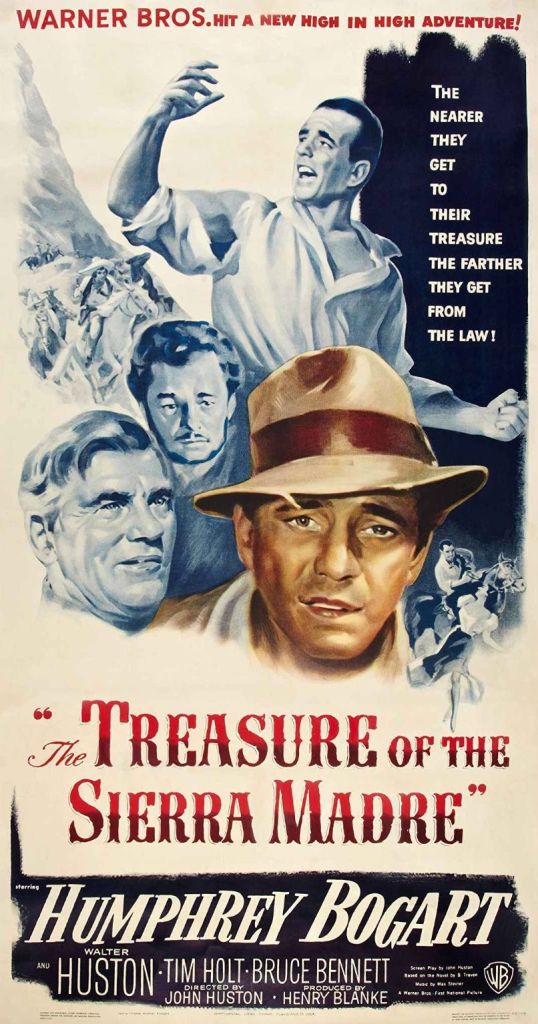
The Treasure of the Sierra Madre is a 1948 American film directed by John Huston and starring Humphrey Bogart, Walter Huston, Tim Holt, and Bruce Bennett. It is based on a 1927 novel by B. Traven.
The story is about two poor men who team up with an old gold prospector to search for gold in the mountains of Mexico.
In 1925, in Tampico, Mexico, two poor American drifters, Fred C. Dobbs and Bob Curtin, are hired by a contractor named Pat McCormick to help build oil derricks. They work hard for $8 a day, but when the job ends, McCormick disappears without paying them.
With almost no money left, Dobbs and Curtin stay in a cheap lodging house, where they meet Howard, an old prospector who loves to talk. Howard tells them stories about hunting for gold and warns them about the dangers and greed that come with it.
Later, Dobbs and Curtin see McCormick again in a bar. After a fight, they force him to give them the wages he owes. Soon after, Dobbs wins a small lottery prize. Using this money, the three men, Dobbs, Curtin, and Howard, buy supplies and head into the mountains of Mexico to search for gold.
This begins their dangerous adventure in The Treasure of the Sierra Madre, where the promise of gold slowly tests their friendship and their trust in one another.
After leaving Tampico by train, Dobbs, Curtin, and Howard are attacked by a group of bandits led by a man called Gold Hat. The three men help fight off the attackers and continue their journey north of Durango.
They enter the wild and remote Sierra Madre mountains. Here, Howard proves to be the toughest and most experienced among them. After days of difficult travel and hard work, Howard discovers gold in a spot the others had overlooked.
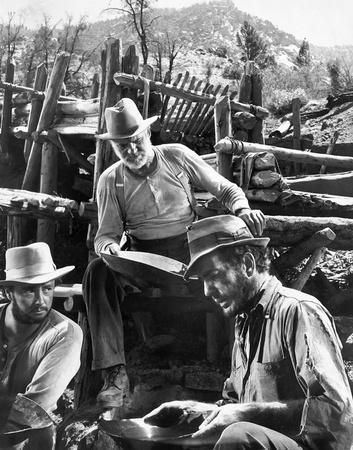
The three men begin mining under very harsh conditions and slowly collect a large amount of gold. But as their fortune grows, Dobbs becomes more suspicious and distrustful of Curtin and Howard. To avoid arguments later, the men decide to divide the gold immediately each day and hide their individual shares.
On a trip to Durango to buy supplies, Curtin is noticed by a curious Texan named Cody, who quietly follows him back to the camp. When Cody confronts the three men, they lie about their work, but he immediately guesses the truth. Cody boldly asks to join them and says he will only claim a share of any gold they find in the future. The three prospectors privately discuss the situation and, fearing exposure, vote to kill him.
But before they can act, Gold Hat and his bandits arrive, pretending to be government federales. A tense standoff leads to a gunfight in which Cody is killed. Soon after, real federales appear, chase Gold Hat’s gang away, and save the prospectors. Searching Cody’s belongings, the men find a loving letter from his wife, showing that he only wanted to earn money for his family. Howard and Curtin decide to give part of their future gold to Cody’s family, but Dobbs refuses.
Later, the local villagers take Howard with them to treat a seriously ill child. After the boy recovers, the villagers insist that Howard return to their village so they can honor him. Howard leaves his belongings with Dobbs and Curtin and tells them he will meet them later.
While Howard is away, Dobbs and Curtin continue to argue constantly. One night, Dobbs—now completely consumed by greed—shoots Curtin and steals his share of the gold. But Curtin survives and hides in the darkness.
When Dobbs discovers that Curtin has disappeared, he panics and flees with all the gold he has. But at a water hole, he is attacked and killed by Gold Hat and his bandits. The bandits think the dust in the gold bags is just sand, so they dump it on the ground and take only the burros and supplies. A strong wind begins to blow, scattering all the gold across the desert.
Gold Hat’s gang is soon captured and punished by the federales, thanks to the marks and clues recognized by the village boys.
At last, Howard and Curtin return to Durango in a fierce storm. When they reach the place where Dobbs was killed, they find only empty bags. The wind has blown all the gold away into the desert. Their long and dangerous journey ends in failure, but they gain a bitter yet valuable life lesson.
When they realize this cruel irony, both men begin to laugh. In the end, Howard decides to stay in the village with honor, and Curtin chooses to return to America to help Cody’s widow.
The story ends on a note of humility and realization, showing how greed can destroy, but acceptance can bring peace.
John Huston not only directed The Treasure of the Sierra Madre (1948), but also wrote the screenplay. Huston’s role as director was to bring out both the gritty realism and the moral depth of the story, showing how greed and desperation can destroy men. He used a documentary-like style, shooting many scenes on location in Mexico, which was rare for Hollywood at the time. This gave the film a natural, rugged look that matched its theme of survival and human weakness.
As a director, Huston focused on, Character realism, showing human flaws honestly. Moral conflict, how gold turns friends into enemies. Visual storytelling, using Mexico’s harsh landscapes to reflect inner turmoil.
Humphrey Bogart had become Warner Bros.’ biggest star. Before shooting began, Bogart jokingly told a film critic outside a New York nightclub, “Wait till you see me in my next picture. I play the worst man you ever saw.”
Humphrey Bogart delivers one of the most intense and powerful performances of his career. As Fred C. Dobbs, he begins as a poor but hopeful drifter and slowly transforms into a paranoid, greedy, and desperate man. Bogart shows Dobbs’s inner struggle and moral downfall with great realism, his eyes, voice, and expressions reveal how greed destroys his humanity. This role was very different from Bogart’s usual heroic image. Here, he plays an anti-hero, showing the dark side of human nature. Critics often praise this as one of Bogart’s finest performances, proving his depth as an actor.
Director John Huston’s father, Walter Huston, plays Howard, the wise old prospector. His performance is full of energy, humor, and wisdom. He perfectly captures Howard’s experience and common sense, balancing the greed and foolishness of the younger men. His lively manner of speaking, laughter, and gestures make the character very real and memorable.
John Huston later said that his father’s acting in The Treasure of the Sierra Madre was the finest he had ever directed. Even Bogart humorously remarked, “One Huston is bad enough, but two are murder.”
Tim Holt plays Bob Curtin, the most decent and loyal member of the trio. His acting is natural and sincere, showing Curtin as a man who values friendship and fairness more than gold. He serves as the moral center of the story, balancing Dobbs’s greed and Howard’s wisdom. Holt’s performance gives the film emotional stability and compassion.
The cinematography of The Treasure of the Sierra Madre by Ted D. McCord gives the film its striking realism and depth. McCord captures the harsh beauty of the Mexican landscape, using natural light and strong contrasts to emphasize the loneliness, greed, and desperation of the characters. His camera work brings out the dusty atmosphere of the Sierra Madre mountains, making the audience feel the intense heat and struggle of the gold hunt.
The film’s pacing and rhythm were skillfully shaped by Owen Marks’s editing, which keeps the story tight and engaging. Marks blends scenes of quiet tension with bursts of action, maintaining a steady flow that holds the viewer’s attention throughout.
Complementing the visuals is Max Steiner’s powerful musical score, which enhances the emotional impact of every scene. His music shifts beautifully between adventure and tragedy, reflecting both the grandeur of the mountains and the growing madness of the men. Together, McCord’s cinematography, Marks’s editing, and Steiner’s music create a visually stunning and emotionally rich cinematic experience.
This film was one of the first Hollywood movies to be filmed outside the United States, with many scenes shot in Mexico and some back in the U.S.
The Treasure of the Sierra Madre was distributed by Warner Bros. and first premiered in Los Angeles on January 14, 1948. The film was both a critical and commercial success. It won three Academy Awards, Best Director and Best Screenplay for John Huston, and Best Supporting Actor for Walter Huston. This was the first time in history that a father and son both won Oscars for the same film.
The movie also received the BAFTA Award for Best Film and the Golden Globe Award for Best Picture.
The film works as both an adventure story and a moral lesson. It has many memorable scenes, including a thrilling shootout with Mexican bandits. It also shows the beauty and danger of chasing wealth. The ending is ironic and bittersweet, reminding viewers that greed often leads to loss.
The Treasure of the Sierra Madre is widely regarded as one of Hollywood’s greatest films. Critics like James Agee, Pauline Kael, Roger Ebert, and Leonard Maltin praised it for its powerful storytelling, deep themes, and exceptional performances, especially by Humphrey Bogart and Walter Huston.
The Treasure of the Sierra Madre is a timeless classic that perfectly captures its era and remains one of the most important adventure films in Hollywood history.
In 1990, the Library of Congress added it to the United States National Film Registry, recognizing it as “culturally, historically, or aesthetically significant.”
Photos courtesy Google. Excerpts taken from Google.
 Writer Sunita