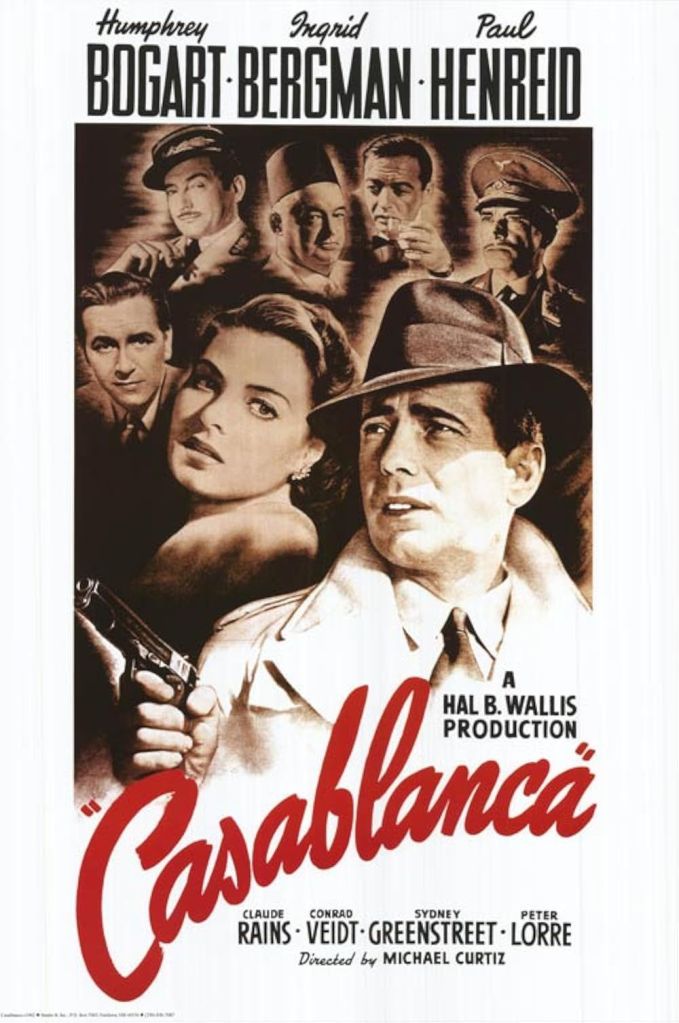
Casablanca is a 1942 American romantic drama film directed by Michael Curtiz. The film stars Humphrey Bogart, Ingrid Bergman, and Paul Henreid in the lead roles. The story is set in French Morocco during World War II, where American expatriate Rick (Bogart) runs his café. Rick finds himself in a major dilemma: whether to be with his former lover Ilsa (Bergman) or to help her husband Laszlo (Henreid), a leader of the Czechoslovak resistance movement, escape from the Nazis and continue their fight.
The film’s screenplay is based on the unproduced play Everybody Comes to Rick’s by Murray Burnett and Joan Alison. Claude Rains, Conrad Veidt, Sidney Greenstreet, Peter Lorre, and Dooley Wilson play supporting roles, adding depth, conflict, and emotional resonance to the story.
In December 1941, American expatriate Rick Blaine runs “Rick’s Café Américain,” a nightclub and casino in Casablanca. The café attracts French and Nazi German officers, refugees hoping to travel to America, and opportunists trying to exploit them. On the surface, Rick appears neutral, but in reality, he had previously supplied arms to Ethiopia and fought on the Republican side during the Spanish Civil War.
A small-time criminal, Ugarte, proudly tells Rick about the “letters of transit” he obtained by killing two German couriers. These letters allow their holders to travel freely to Nazi-occupied Europe and neutral Portugal. Ugarte plans to sell the letters at Rick’s club and convinces Rick to keep them for him. However, before he can make the transaction, Ugarte is arrested by the local police under the orders of Captain Louis Renault, the corrupt police chief. Ugarte dies, secretly leaving the letters in Rick’s possession.
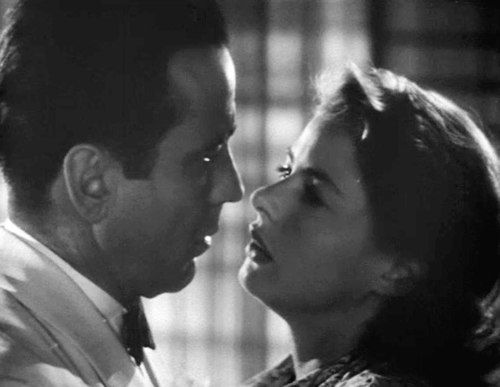
The reason behind Rick’s bitter demeanor is his former lover, Ilsa Lund. She arrives at his café with her husband, Victor Laszlo. Laszlo is a leader of the Czechoslovak resistance movement and needs the letters of transit to travel. A flashback reveals that in Paris, Ilsa had been in love with Rick, but she discovers that Laszlo is still alive. Unable to tell Rick, she leaves abruptly, which leaves Rick heartbroken and hardens his personality.
Seeing Rick’s friend and the house pianist Sam, Ilsa asks him to play “As Time Goes By.” Rick becomes angry because Sam had ignored his previous instructions and played the song, and he is stunned when he sees Ilsa. Laszlo and Ilsa need the letters, but meanwhile, German Major Strasser arrives in Casablanca and tries to stop them.
When Laszlo questions the situation, Rick’s friendly business rival and underworld figure Signor Ferrari tells him that he suspects Rick possesses the letters. That night, Laszlo returns to Rick’s café, attempting to purchase the letters. Rick refuses to sell them and says that if Laszlo wants to know the reason, he should ask his wife. At that moment, a group of German officers begins singing “Die Wacht am Rhein,” led by Strasser. Laszlo instructs the house band to play “La Marseillaise,” and Rick permits it. The patriotic song stirs the audience, everyone joins in, and the German voices are drowned out.
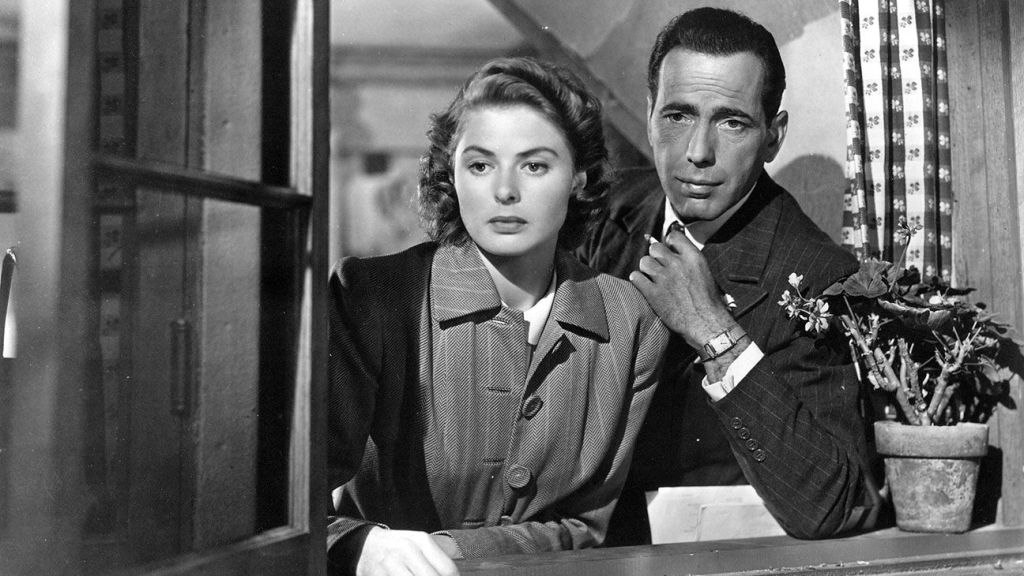
Afterwards, Strasser orders Renault to close the café, citing a minor pretext.Later, in Rick’s empty café, Ilsa confronts him. When Rick refuses to give her the letters, she threatens him with a gun. However, she soon confesses that she still loves him. She explains that when she and Rick met and fell in love in Paris in 1940, she believed her husband Laszlo had died while trying to escape from a concentration camp. But when she discovered that Laszlo was alive and hiding near Paris, she left without telling Rick to take care of her ailing husband.
This revelation softens Rick’s bitterness. He becomes willing to help and tells Ilsa that if she stays with him, Laszlo will leave Casablanca. At that moment, Laszlo unexpectedly arrives, having narrowly escaped a police raid. Rick instructs the waiter, Carl, to help Ilsa get out safely. Aware of Rick’s love for Ilsa, Laszlo tries to persuade him to use the letters to ensure her safe passage.
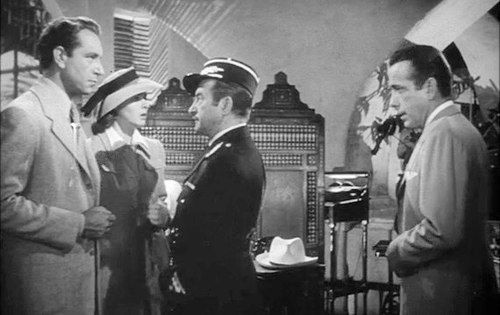
When the police arrest Laszlo on false charges, Rick persuades Renault to release him and promises that he will frame Laszlo for a more serious crime: possession of the letters. To allay Renault’s suspicions, Rick explains that he and Ilsa will use the letters to travel to America. But when Renault tries to arrest Laszlo as planned, Rick points a gun at him and forces him to help the couple escape.
Humphrey Bogart’s portrayal of Rick in Casablanca is revealed through a series of key moments that chart his journey from cynicism to sacrifice. First seen playing chess alone in his café, Bogart establishes Rick as cool, detached, and calculating, a man hiding his emotions behind clipped dialogue and a tough exterior. Yet glimpses of his compassion emerge, as in the scene with the young Bulgarian couple when he quietly rigs the roulette table to save the woman from compromising herself, his tiny smile betraying the heart beneath his stoicism. When Ilsa enters the café with Victor Laszlo, Bogart conveys Rick’s inner turmoil with just a flicker in his eyes and a tense jaw, and the flashback to Paris allows him to show another side—boyish, relaxed, and deeply in love, then utterly shattered when abandoned at the train station. Later, drunk and bitter, his famous line “Of all the gin joints…” is delivered with sharp rawness, the anger laced with heartbreak. In his conversations with Laszlo, Bogart’s calm pauses and steady voice reveal growing respect, showing Rick’s realization that the larger fight against fascism matters more than personal desire.
This transformation culminates in the airport finale, where Rick makes the hardest choice of his life. Ilsa pleads with him, desperate not to lose him again, but Rick gently reminds her, “We’ll always have Paris.” He tells her that if she doesn’t leave with Victor, she will regret it someday, and admits that while he is not good at being noble, he knows their love would eventually turn bitter or even end in tragedy under Nazi rule. With quiet strength, he sacrifices his happiness, sending Ilsa onto the plane with Laszlo and sealing it with the tender farewell, “Here’s looking at you, kid.” Ilsa leaves heartbroken but understanding, while Rick stays behind, trading personal love for duty and honor. After shooting Strasser, he walks into the night with Renault, his relaxed, hopeful line—“Louis, I think this is the beginning of a beautiful friendship”—signaling a new purpose and a loyal ally. Through understated gestures, subtle expressions, and measured dialogue, Bogart creates a performance that balances toughness with vulnerability, making Rick’s evolution unforgettable and the film’s ending both bittersweet and noble.
Casablanca is not just a classic film; it almost feels like an American myth, which has earned it a special place in popular culture. The performances of Humphrey Bogart, Ingrid Bergman, and Claude Rains made the film globally popular and even gave it “cult” status among college students. Ingrid Bergman became a Hollywood star through this film.
The real strength of Casablanca lies in Humphrey Bogart’s portrayal of Rick—a character hardened by experience yet capable of love, an antihero with depth. His restrained and introspective acting, combined with the intrigue, chaos, and tension of Casablanca city, creates a lasting emotional impact on the audience. Iconic lines such as “Here’s looking at you, kid” and “Play it, Sam” have become part of American cultural memory.
Critics praised the film. Time magazine described it simply as “delicious.” Director Michael Curtiz focused more on the rhythm of the camera and lighting design than on the confusion of dialogue, which contributed to the film’s success.
These expressionistic elements together produce a deep emotional effect that remains powerful even decades later. Despite a dramatic story, minimal special effects, and studio-based shooting, Casablanca remains a shining example of emotionally compelling cinema.
Many of the film’s famous lines developed gradually. The final line, “Louis, I think this is the beginning of a beautiful friendship,” was added after filming. Likewise, Bogart’s famous line “Here’s looking at you, kid” was not in the script; he improvised it on set.
Although several writers worked on the screenplay, it remained coherent and strong. Critic Roger Ebert noted, “With so many writers, the screenplay is surprisingly beautiful and consistent.” Filming began on May 25, 1942, primarily on studio sets, with only a few exterior shots. Producer Hal Wallis was praised for his attention to small details, while Curtiz emphasized storytelling through visuals. Cinematographer Arthur Edeson focused on Bergman’s beauty, using soft lighting and catchlights. Shadows and dark lighting enhanced emotional depth, drawing from film noir and German expressionism.
The music was composed by Max Steiner, using “As Time Goes By” and “La Marseillaise” as leitmotifs. Dooley Wilson, who played Sam, was dubbed for the piano scenes. In the iconic “anthem duel” scene, Laszlo sings La Marseillaise, overpowering the Nazis’ song. Originally, the Horst-Wessel-Lied was considered, but copyright issues required the change. The film combined visuals, music, and careful direction to create a lasting impact.
At release, the film received excellent reviews for its story, performances, dialogue, and emotional resonance.
Casablanca is not merely a romance or a war story; it is a remarkable blend of character, moral conflict, and psychological complexity, making it a timeless artistic and cultural gem of Hollywood’s Golden Age.
The film won numerous awards and nominations. At the 1944 Academy Awards, it won Best Picture and Best Director (Michael Curtiz), while earning nominations for Best Actor (Humphrey Bogart) and Best Supporting Actor (Claude Rains). It won for Best Screenplay and received nominations for Cinematography, Editing, and Music. At the National Board of Review Awards, it ranked sixth among the Top Ten Films, and Curtiz won Best Director. The film was also selected for preservation in the U.S. National Film Registry. Other nominations included the New York Film Critics Circle Awards and Saturn Awards (for the DVD release).
At the Oscars, when Bogart emerged from a car with his wife, the audience erupted in enthusiasm, and police had to protect him as the crowd cheered, shouting “Good luck” and “Here’s looking at you, kid.”
Photo courtesy Google. Excerpts taken from Google.
 Writer Sunita