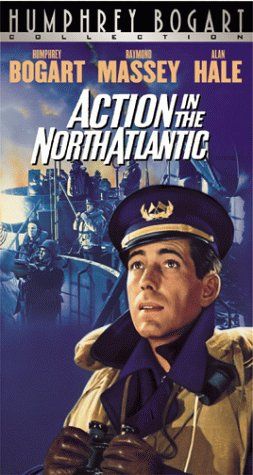
Action in the North Atlantic is a 1943 American war film released by Warner Bros. Pictures. The film was produced by Jerry Wald and directed by Lloyd Bacon, with a screenplay adapted by John Howard Lawson from a story by Guy Gilpatric. Set during the Second World War, it stars Humphrey Bogart and Raymond Massey as officers in the American Merchant Marine.
The story begins with a German U-boat attacking and sinking an American oil tanker. The surviving crewmen drift at sea on a wooden raft for eleven days before being rescued. Having come face to face with death, they nevertheless return to service. Their next assignment takes them across the dangerous North Atlantic, under constant threat from German submarines, to deliver vital war supplies to the Soviet port of Murmansk. It is an inspiring account of the courage, endurance, and sacrifice of the Merchant Marine.
Like many Hollywood war films made during the early period of America’s involvement in World War II, the film was intended to arouse patriotism and unite the public in support of the war effort. It pays tribute to the often-overlooked heroes of the Merchant Marine, who risked their lives during the Battle of the Atlantic to ensure that life-sustaining supplies reached the Allied forces.
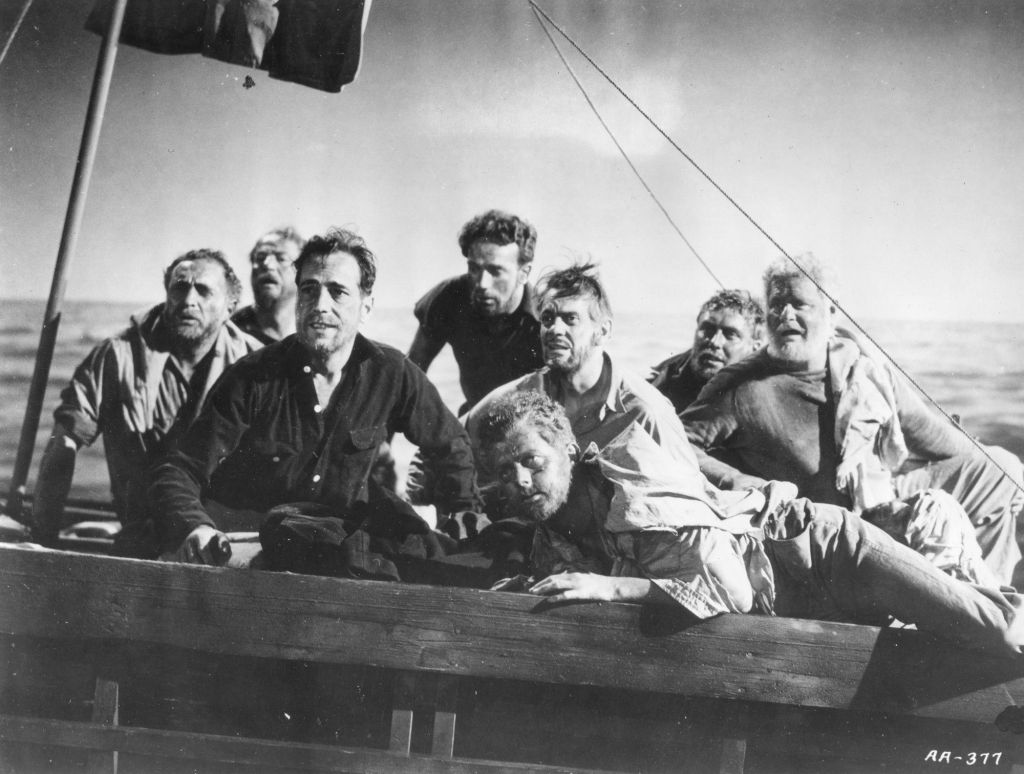
The American oil tanker S.S. Northern Star, under the command of Captain Steve Jarvis, is sunk by a German U-boat in the North Atlantic. Jarvis, along with First Officer Joe Rossi and other crew members, escape in a lifeboat; however, the same U-boat that sank their ship rams the lifeboat as well, causing it to sink. Ultimately, a few survivors drift for eleven days on a wooden life raft before being rescued.
After spending a short time ashore, Steve spends time with his wife Sarah, while Joe meets singer Pearl O’Neill and marries her. At a seamen’s union hall, the surviving crew of the Northern Star wait for new assignments. Soon, they are assigned to a brand-new Liberty ship, the S.S. Seawitch, once again commanded by Captain Jarvis, with Rossi serving again as First Officer.
Equipped with anti-aircraft guns and dual-purpose weapons under the supervision of trained naval gunners, the Seawitch sails with a convoy carrying vital supplies to the Soviet port of Murmansk. The convoy is scattered by attacks from German U-boat wolf packs. Through skillful evasive maneuvers, the Seawitch hides along the edge of the Arctic ice and succeeds in eluding the pursuing U-boat.
Unable to completely shake off its pursuer, the Seawitch engages in a tense cat-and-mouse game, maintaining total silence to mislead the enemy and prevent it from tracking the ship. When the U-boat finally withdraws, the Seawitch fires up its boilers and resumes its course toward Murmansk. However, the German Luftwaffe is summoned to destroy the ship. German maritime patrol aircraft locate the Seawitch and attack with bombs and machine-gun fire. During the assault, Captain Jarvis is wounded and eight crewmen are killed. First Officer Rossi then assumes command of the ship.
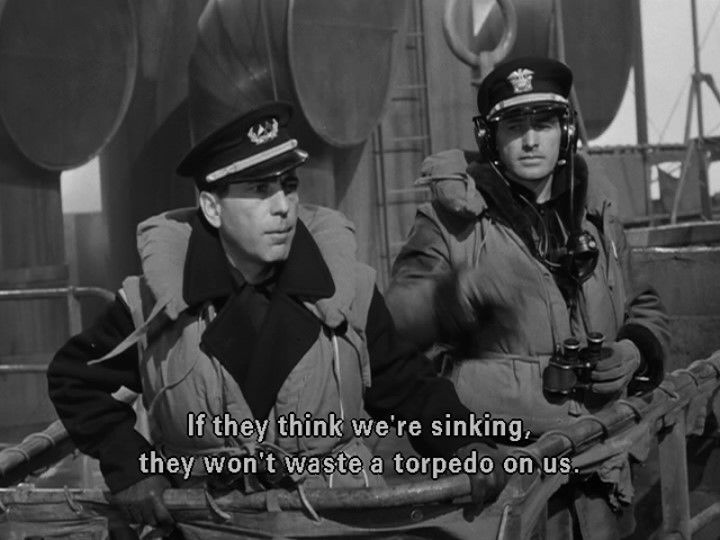
The same U-boat returns and attempts once again to sink the Liberty ship. The submarine fires a torpedo, but Rossi deceives the U-boat’s captain by creating smoke, setting fires on deck, and ordering a “abandon ship” signal. Believing the cargo ship to be crippled, the U-boat surfaces to finish it off with its deck gun. At that moment, the Seawitch suddenly rams the submarine, sinking it.
The Seawitch then resumes its voyage to Murmansk. There, a formation of Soviet fighter aircraft salutes the ship. On the Russian dock, a gathered crowd—remarkably including women dockworkers, to the Americans’ surprise—gives the vessel an enthusiastic welcome.
The film ends with an excerpt from a speech by U.S. President Franklin Delano Roosevelt, in which he pays tribute to the courage of the American Merchant Marine and acknowledges their invaluable contribution to the war effort:
“From the freedom-loving peoples of the United Nations, let there be everlasting gratitude to our merchant seamen who serve upon all the oceans.”
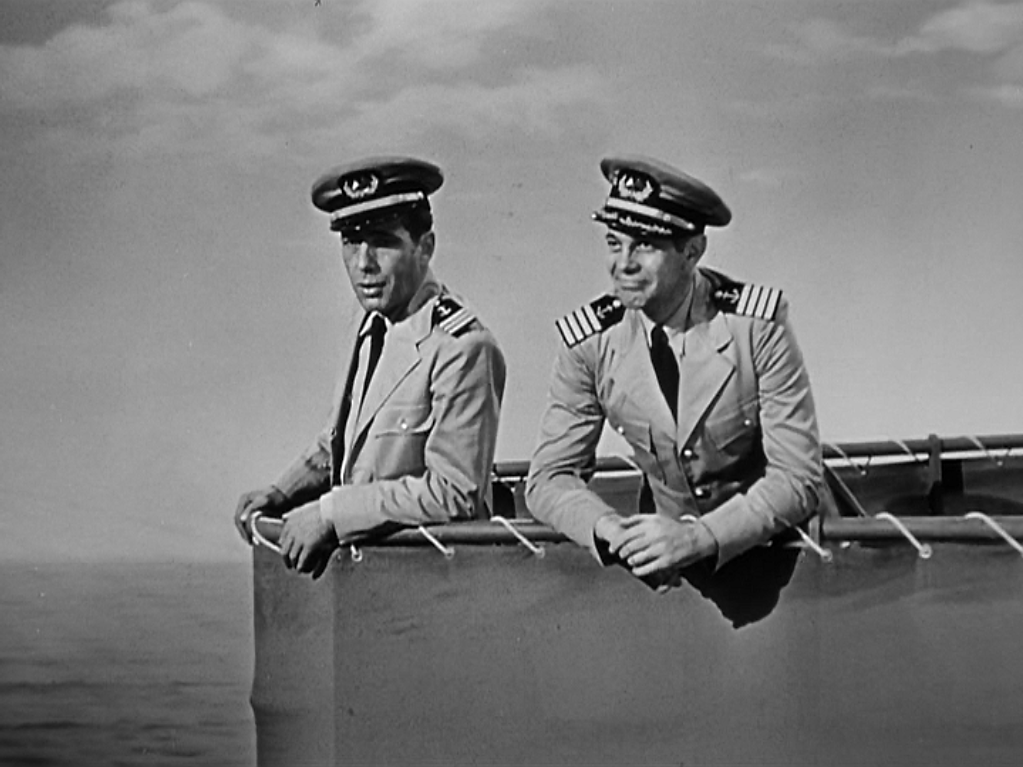
Raymond Massey recounts an amusing incident in his autobiography: during the filming, he and Bogart had been drinking a little and were watching stuntmen jump from a burning ship. While betting on who was braver, they ended up taking the leap themselves!
Because of wartime restrictions, filming at sea was not possible, so the entire movie was shot inside Warner Bros. studios. Ship sets, scenes of burning and sinking vessels, and aerial attacks were created using scale models and actual wartime footage.
The film features an extraordinary amount of model-ship action per foot of film. Since shooting on real ships was impossible, extensive use of miniatures was made to depict the contribution of the Merchant Navy during World War II. These models, filmed against the backdrop of Santa Barbara Harbor, were built at a 1/12 scale, with around 450 miniatures used in total. Supervised by Jack Cosgrove, the model work feels remarkably grand and dynamic, with constantly moving ships, frames crowded with vessels, and explosions enhanced through optical printing.
At the New York premiere of Action in the North Atlantic, dozens of Merchant Marines and hundreds of U.S. sailors presented Jack Warner with the Merchant Marine Victory Flag. Shipbuilding industrialist Henry J. Kaiser found the film so inspiring that he suggested it be shown to all of his employees.
In The New York Times, Bosley Crowther praised the film, calling it “exciting and informative,” and offered special appreciation for the strong performances of Raymond Massey and Humphrey Bogart. Within just two weeks of its release, prints of the film were sent to Merchant Marine schools. The War Shipping Administration recognized the film as useful for training purposes, and Warner Bros. donated official prints to the United States Merchant Marine Academy and several other training centers.
Action in the North Atlantic received an Academy Award nomination for Best Writing (Original Motion Picture Story) for Guy Gilpatric.
After the film’s release, The Pittsburgh Courier reported that Humphrey Bogart had tried to ensure that Action in the North Atlantic included a role for a Black Merchant Marine captain, but his efforts were unsuccessful. On the matter, Bogart was quoted as saying:
“Whether on the stage or in any area of American life, a man’s skin color should have nothing to do with his rights, because this land is founded on the self-evident truth that all men are born equal.”

In this review published in The New York Times on May 22, 1943, Action in the North Atlantic is given special praise. According to critic Bosley Crowther, the film rightly honors the brave sailors of the Merchant Marine, a service that had remained largely overlooked compared to other branches of the armed forces. Informative as well as thrilling, the film powerfully portrays the courage, loyalty, and sacrifice of the seamen who deliver vital supplies to the very front lines of war.
Crowther notes that the opening sequence depicting the sinking of the tanker is highly realistic and chilling. The conversations among the sailors in the union hall convey a strong sense of authenticity. While some of the later battle scenes feel somewhat overdramatic, the strong performances of the cast keep the film engaging.
Raymond Massey and Humphrey Bogart deliver forceful and convincing performances as the captain and the first officer, respectively, and the contributions of the supporting cast are also noteworthy. Overall, the film is seen as an important work that raises the flag for the Merchant Marine, clearly showing that “these seamen are truly passing through storms and conditions akin to hell,” as The New York Times concluded.

While paying tribute to the eight fallen sailors, Bogart says: “I am the resurrection and the life, says the Lord. He who believes in me, though he may die, yet shall he live. We brought nothing into this world, and we shall take nothing out of it. The Lord gives, and the Lord takes away. This is the word of God. But today I too wish to say a few words. These eight men were just like us—our friends, men with whom we ate, slept, and fought. We have only been a little more fortunate than they were. They were just like us—our friends. Their absence will always be felt. We will not forget them. They were all gun crewmen, and today we bid them farewell with honor. It is sad that their loved ones are not here; it might have eased their burden. It is painful that they died. They were not allowed to live out their lives or finish what they had begun. But such is war. Today we bid them farewell with dignity and calm.”
In this scene, Bogart’s performance is restrained and deeply introspective. There is no melodrama—his quiet voice, slightly lowered gaze, and carefully paced pauses convey grief, guilt, and acceptance. This stillness and sincerity give the moment a profound emotional impact.
From a technical standpoint, the film is meticulously structured and powerfully executed. Wartime restrictions made on-location shooting impossible, so the filmmakers relied on studio sets, stock wartime footage, and remarkably effective miniature models to create gripping sequences. The confrontations between Jarvis’s crew and the lurking U-boat generate intense suspense. Notably, the German sailors’ dialogue is presented without subtitles—the visual context alone conveys the necessary meaning.
With a large ensemble cast, the film does employ familiar character types, yet it never feels formulaic. All performances are restrained and effective, avoiding exaggeration. The film was made to boost public confidence during wartime, so deep character development was not its primary aim. Even so, the work of Alan Hale Sr., Julie Bishop, Ruth Gordon, Sam Levene, and others is precise and impactful.
Overall, the film stands as a compelling, entertaining, and skillfully crafted war movie, distinguished by its own clear and thought-provoking political edge.
📸 Photo courtesy: Google. ✍️ Sources: Google.
 Writer Sunita