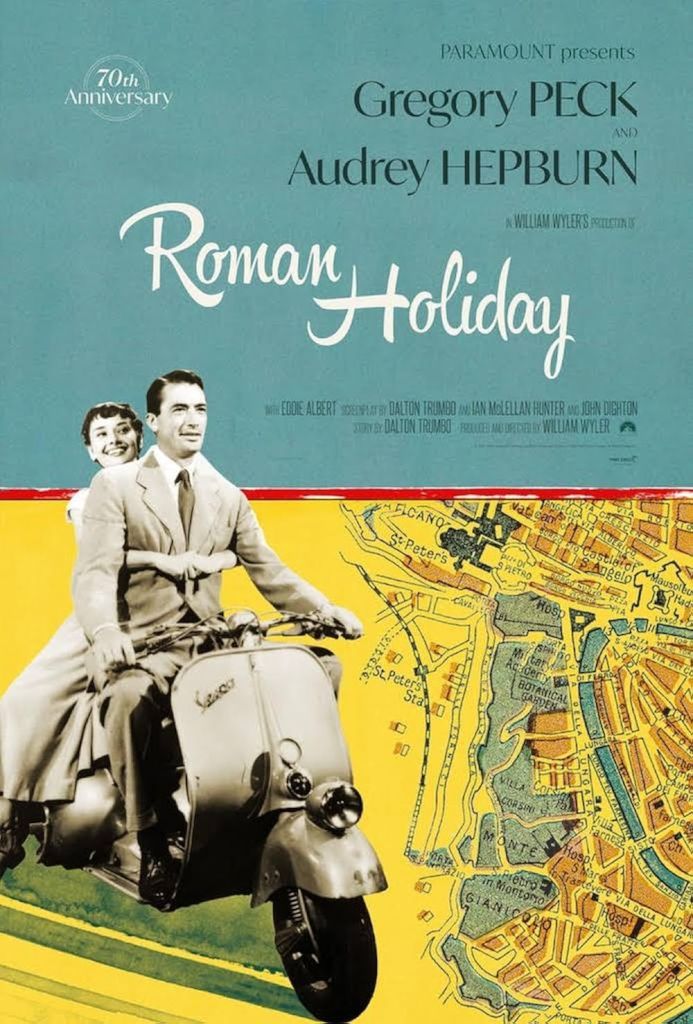
Roman Holiday (1953) is an American romantic comedy film directed and produced by William Wyler. The screenplay was written by Dalton Trumbo and John Dighton. The film stars Audrey Hepburn as a young princess who slips away to explore the city of Rome on her own terms, and Gregory Peck as an American journalist.
At the beginning of the film, Crown Princess Ann (Audrey Hepburn) is on an official tour of various European capitals and arrives in Rome. Young, beautiful, and impeccably royal in her bearing, Ann’s days are relentlessly packed with exhausting official engagements, one after another. Overwhelmed by the rigid protocol and constant formality, she finally expresses her frustration. The royal physician gives her an injection and remarks, “The best remedy I know is to do exactly what you want for a while.” Following this advice, Ann secretly slips out of the embassy to experience real, ordinary life in Rome.
Joe Bradley (Gregory Peck), an American expatriate journalist living in Rome, is a carefree man who spends much of his time playing poker and borrowing money from his American friends. Late one night, as he leaves a poker game, he encounters Ann, who is fast asleep on a park bench under the influence of the medication. Joe casually assumes that she is drunk.
Feeling it would be wrong to leave a helpless young woman alone in such a condition, he takes her back to his apartment so that she can rest and recover. Unaware that she is a princess and assuming she is merely intoxicated, Joe soon finds himself amused by her behavior. To him, this seemingly reckless woman acts as though receiving attention and service from everyone around her is her natural right.
The next morning, Bradley wakes up and realizes that he has overslept and missed his planned assignment. He has failed to attend the official press conference organized for Princess Ann. In a hurry, he rushes to the office of his English-language newspaper and falsely claims to editor Hennessy that he was present at the press conference. However, the lie is quickly exposed. Hennessy shows him a news report stating that the press conference was canceled due to the princess’s “sudden illness.”
At that moment, Bradley sees a photograph of Princess Ann and suddenly realizes that the woman who had been sleeping in his apartment was none other than Princess Ann herself. Instantly, he senses a once-in-a-lifetime opportunity. To regain his editor’s trust, he promises to secure an exclusive interview with the princess. Hennessy agrees to pay $5,000 for such an interview and even places a $500 bet that Joe will fail to obtain it.
When Bradley returns to his apartment, Ann has already left. Wanting to explore the city on her own, she goes out alone, and Bradley secretly follows her. In an effort to free herself from social constraints, Ann visits a salon and has her long hair cut into a short, “cool” new style, completely transforming her appearance and making her unrecognizable.
Bradley then deliberately runs into her “by accident,” and the two begin talking at a café, where he introduces himself not as a journalist but as a successful businessman. Soon, his photographer friend Irving Radovich arrives. Irving grows suspicious, but Bradley signals him with gestures to stay quiet so that this carefree time with Ann can continue without revealing the truth. Eventually, Bradley convinces Irving that secretly photographing the princess could bring them significant financial gain.
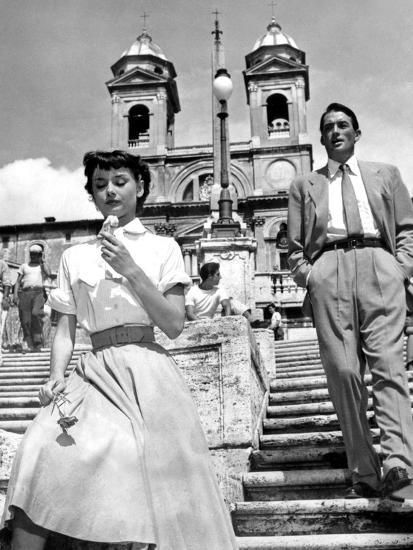
Joe takes Ann—who introduces herself as “Anya”—on a tour of Rome: wandering through open markets, buying shoes, meeting near the Spanish Steps, and enjoying relaxed moments at street cafés. Meanwhile, Irving secretly takes photographs with a tiny camera hidden in his cigarette lighter. Ann claims she has run away from school. As they visit famous monuments, navigate bustling streets, and ride around on a scooter, Ann’s spontaneous joy shines through. Gradually, Bradley’s pursuit of a journalistic “scoop” fades into the background, and during this journey of freedom, the two unknowingly fall in love.
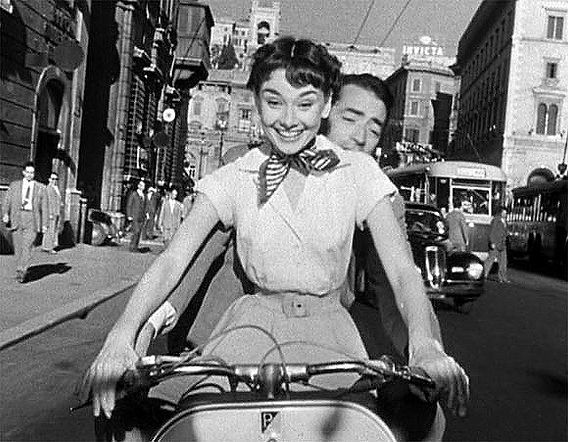
Ann drives a Vespa scooter, causing chaos in Roman traffic, and the two are arrested—but they are released after showing fake press credentials.
Joe then takes Ann to the Mouth of Truth (Bocca della Verità) and tells her the legend that liars have their hands bitten off if they place them inside the stone mouth. After a moment’s hesitation, Ann puts her hand in. Then Joe mischievously pretends that his hand has been severed, frightening her.
At the barber’s invitation, they attend a dance on a riverboat. There, agents from Ann’s country try to take her back by force, but Ann sides with Joe and Irving, fights back, and even smashes a guitar over one pursuer’s head. In the ensuing chaos, Joe falls into the river and Ann jumps in after him. They swim to safety and, shivering on the riverbank, embrace each other.
Back at Joe’s apartment, as their wet clothes dry, a radio broadcast reports that people in Ann’s country are deeply worried about her illness. The next day, Ann and Joe exchange uneasy glances in the apartment. Joe says, “I need to tell you something,” but Ann stops him: “No… please don’t say anything.” The call of duty draws her back to her royal responsibilities, and she prepares to accept them.
They embrace one last time. Ann asks Joe to walk her as far as a corner near the embassy. There, they share another embrace, and with tears in her eyes, Ann bids Joe farewell.
Meanwhile, Joe tells his editor, Hennessy, that he did not get the big story; Hennessy does not believe him. However, Joe makes it clear to his friend Irving that he cannot stop him from selling the photographs.
After returning, the princess speaks firmly to those who remind her of her duties:
“If I were not fully aware of my duty to my family and my country, I would not have returned tonight… in fact, I might never have returned at all.”
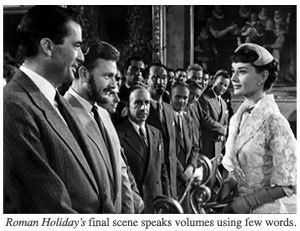
At the royal press conference the following day, they face each other again in their rightful roles, she as the princess, and he as the journalist. All earlier misunderstandings and false identities come to an end. In the final moments, they can only look at each other from a distance, with quiet restraint and a gentle ache. At the conference, Ann expresses her belief that relations between nations, like relationships between people, are built on trust, and Joe assures her that this belief is not misplaced.
When a reporter asks which of the cities she visited she liked the most, she initially says it is difficult to answer, but then declares firmly, “Rome. By all means, Rome.”
While other photographers take pictures with their large press cameras, Irving pretends to use his cigarette lighter. Ann exchanges brief words with each journalist, and finally, Irving presents her with the photographs he took as souvenirs of Rome.
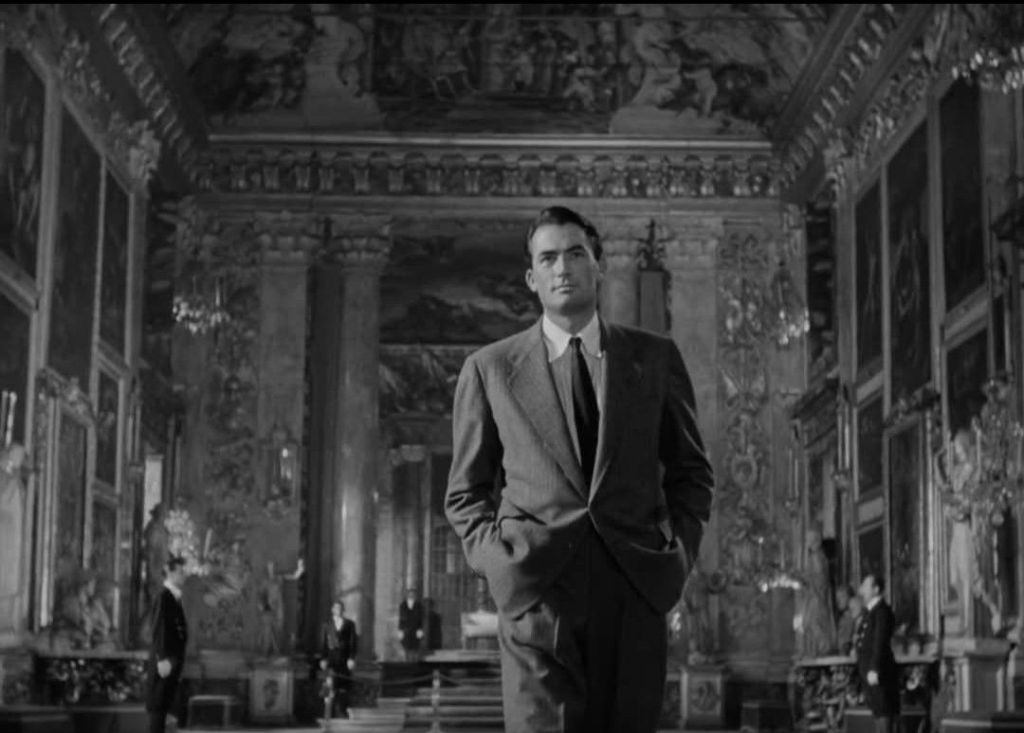
After everyone leaves, Joe lingers for a few moments and then quietly, slowly walks out of the room.
Director William Wyler wanted an actress very different from the curvaceous, glamorous Italian stars of the time, someone he described as almost “anti-Italian.” In his view, Audrey Hepburn was perfectly suited to the role. According to a statement attributed to Wyler, he described her by saying that she lacked the showy appeal of conventional beauty: no flamboyant costumes, no voluptuous figure, no glittering glamour. She seemed entirely different, as if she belonged to another world. And it was precisely this difference, he believed, that would make her a star who ruled the hearts of audiences. This very sense of uniqueness later became the reason for Audrey Hepburn’s enduring popularity.
In Roman Holiday, William Wyler presents the love story without excessive drama, in a simple, natural, and realistic style. Rome is not merely a backdrop but becomes a living, breathing part of the narrative. From the newcomer Audrey Hepburn, he draws a restrained and subtle performance, while giving Gregory Peck’s acting a sense of stability and sincerity. Known primarily for serious films, both Wyler and Peck proved equally successful in this romantic comedy. Meaningful close-ups and an emphasis on quiet emotional moments lend the film its gentle poignancy. Princess Ann’s journey through Rome ultimately becomes a journey toward freedom, simplicity, and the true joy of life.
The role of Princess Ann, portrayed by Audrey Hepburn, proved to be the turning point of her career. At the beginning, she appears as a disciplined, exhausted princess weighed down by duty. However, during her single day of freedom in Rome, her childlike curiosity, joy, playfulness, and tenderness gradually emerge. Hepburn’s performance is remarkably natural, delicate, and sincere. Without relying on grand gestures, she conveys emotional depth through her expressive eyes, gentle smile, and quiet dialogue. In the final act, her portrayal of a woman who sacrifices personal love in favor of duty is handled with such restraint that the audience becomes emotionally invested in her choice.
Gregory Peck plays Joe Bradley, an American journalist who initially seems opportunistic, eager for a big story. Gradually, however, he reveals himself to be sensitive, honest, and responsible. Peck’s performance is understated, controlled, and highly believable. He moves effortlessly between humor, romance, and moral conflict. His decision not to exploit Princess Ann even after discovering her true identity highlights the ethical maturity of his character.
The chemistry between Hepburn and Peck feels entirely natural. Their relationship is expressed more through silences, exchanged glances, and subtle emotional shifts than through dialogue. This is precisely why the love story in Roman Holiday feels sweet, poignant, and timeless.
The film opened the 14th Venice International Film Festival on August 20, 1953. It was released at Radio City Music Hall in New York on August 27, 1953, and earned $165,000 in its very first week.
Upon its release, the film received outstanding critical acclaim. Milton Luban of The Hollywood Reporter described it as a “charming, amusing, and often laugh-out-loud funny film,” praising its sharp dialogue, intelligent humor, and the beautiful integration of Roman locations into the narrative. The New York Times called Roman Holiday “natural, tender, and thoroughly delightful,” noting that it offers audiences “good-natured, heart-lifting laughter.” Critic A. H. Weiler wrote in 1953 that although the story may seem somewhat fanciful and artificial, the film is warm, humorous, and emotionally touching, ultimately leaving viewers with an uplifting, fairy-tale-like experience.
Roman Holiday received widespread recognition at major international award ceremonies. At the Academy Awards, it earned multiple nominations, including Best Picture and Best Director (William Wyler). Audrey Hepburn won the Oscar for Best Actress, Dalton Trumbo received the Academy Award for Best Story, and Edith Head won for Best Costume Design (Black-and-White). Hepburn also won the Golden Globe Award for Best Actress and received the BAFTA Award for Best British Actress. The film was honored by the Writers Guild of America for Best Written American Comedy. In addition, it earned nominations from the New York Film Critics Circle and the Venice Film Festival, was included in the National Board of Review’s Top Ten Films, and was later selected for preservation in the U.S. National Film Registry—collectively affirming its artistic and historical significance.
In 1999, the Library of Congress selected Roman Holiday for inclusion in the United States National Film Registry, recognizing it as “culturally, historically, and aesthetically significant.”
Even today, Roman Holiday is celebrated as one of the most romantic films in cinema history.
📸 Photo Courtesy: Google ✍️ Excerpts: Google
 Writer Sunita