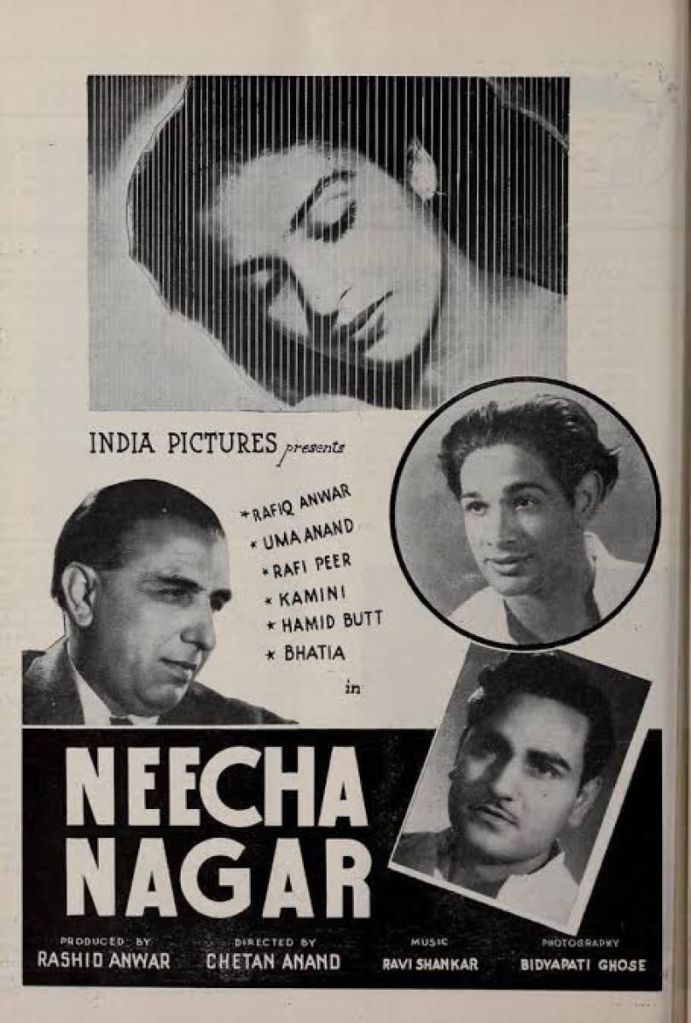
Neecha Nagar (1946) is a Hindi-language Indian film directed by Chetan Anand, with a screenplay written by Khwaja Ahmad Abbas and Hayatullah Ansari. The film was produced by Rashid Anwar and A. Halim. It is regarded as one of the pioneering works of social realism in Indian cinema.
The film stars Uma Anand (Chetan Anand’s wife) in the lead role, alongside Rafiq Anwar, Kamini Kaushal, Murad, Rafi Peer, Hamid Butt, and Zohra Sehgal. Neecha Nagar is an Indianized Hindi adaptation of Russian writer Maxim Gorky’s 1902 play The Lower Depths, re-imagined to suit Indian social conditions.
Through an expressionist approach, the film portrays the deep divide between the rich and the poor in society.
The title Neecha Nagar (literally meaning “the lower town”) refers to a settlement located in a valley. The residents of Neecha Nagar are predominantly very poor. Although their lives are not always marked by absolute starvation, they remain far removed from wealth and privilege. The film opens with a joyful song-and-dance sequence celebrating the arrival of spring. On the surface, this scene conveys vitality, life, and collective happiness. People sing and dance, the mood is cheerful, and the sequence highlights the innocence, unity, and unawareness of the people of Neecha Nagar regarding the hardships that lie ahead.
Rupa and her lover Sagar live in Neecha Nagar. Rupa’s brother Balraj is an honest and respected young man who enjoys the trust of the community. His wife, played by Zohra Sehgal, is also an important presence in the settlement.
Above Neecha Nagar, in a luxurious mansion, lives Sarkar, a wealthy and powerful man. Although there is mutual love between his daughter Maya and Balraj, Balraj keeps his distance because of the stark social divide between them. Driven by greed, Sarkar desires even greater wealth. His plan is to acquire the valuable land of Neecha Nagar and drain the surrounding marshland in order to undertake new construction, regardless of the suffering it will cause to the people living below.
Sarkar is not merely a wealthy man; he is someone who recognizes no moral limits when it comes to profit. Neecha Nagar, located on valuable land, and the neighboring marshland stand in the way of his financial ambitions. To drain the marsh, he devises a scheme to divert the flow of a drainage channel directly toward Neecha Nagar. This plan would dry up the marsh while simultaneously destroying Neecha Nagar—allowing Sarkar to gain on both fronts and ultimately seize the land for construction.
At this point, the narrative gathers momentum. Balraj, Rupa, and Yakub Chacha learn of the plan to redirect the drainage channel toward Neecha Nagar. Recognizing the devastating consequences, they approach Sarkar with a delegation to protest. Sarkar, however, refuses to reconsider. He deceptively refers to the drain as a “canal,” presenting it as a symbol of progress and false prosperity. Since the municipality is under his control, his decision remains unchanged.
After this encounter, Sagar does not fall into despair; instead, he becomes strangely enthusiastic. Considering himself modern and different, Sagar is emotionally and mentally detached from Neecha Nagar. Sarkar quickly recognizes this opportunity and invites Sagar for a private meeting. Offering him a monthly salary of 300 rupees and assigning him the task of maintaining the so-called “canal,” Sarkar successfully turns Sagar into his ally.
Having won Sagar over, Sarkar begins to project an image of benevolence. To pacify resistance from Neecha Nagar, he announces the opening of a hospital, promising free medical treatment for the residents.
In response, Balraj, Yakub Chacha, and Rupa oppose Sarkar’s schemes by establishing their own service center and urging people to stay away from Sarkar’s hospital. However, the struggle proves difficult. When Balraj falls ill, Rupa’s sister-in-law insists on taking her daughter—Rupa’s niece—to Sarkar’s hospital, revealing how desperation and survival can undermine resistance even among those who oppose exploitation.
With the water supply of Neecha Nagar cut off, the people are left completely helpless. The strength of Neecha Nagar lies in its simple yet powerful narrative: a direct, unembellished confrontation between poor, defenseless people and the ruthless oppression of the wealthy and powerful.
Although the film includes songs and dance sequences, they are meaningful and reinforce the message of standing up against injustice. The romantic subplots are restrained rather than dominant. The love story between Rupa and Sagar ends in betrayal, while the relationship between Balraj and Maya becomes a source of inner and social conflict. Maya wishes to oppose her father’s actions but lacks the courage to do so, whereas Balraj finds himself trapped between two opposing worlds.
Ultimately, Neecha Nagar arrives at a harsh truth: life in the settlement is slowly drained away through the canal, and Sarkar’s victory becomes inevitable.
Chetan Anand’s debut film bears a strong influence of IPTA’s socialist ideology and is regarded as one of the earliest socialist films in Hindi cinema. The film’s sharp edge comes from its powerful direction, symbolic cinematography, and the character of “Sarkar,” who functions as a metaphor for oppressive power. The disturbing yet meaningful visuals depicting the inhuman conditions of Neecha Nagar deepen the film’s impact.
The climactic sequence set during the municipal meeting, along with the effective use of close-ups, heightens the film’s intensity. Chetan Anand’s direction, Khwaja Ahmad Abbas’s precise and restrained screenplay, and the solid narrative foundation provided by Hayatullah Ansari together give the film its strength. Pandit Ravi Shankar’s evocative music, the revolutionary songs, and Rafi Peer’s performance, imbued with the arrogance of power—make Neecha Nagar a deeply compelling work.
The film’s music was composed by Pandit Ravi Shankar, with lyrics written by Mamman Anand and Vishwamitra Adil.
Neecha Nagar became the first Indian film to receive international recognition at the Cannes Film Festival. At the very first Cannes Film Festival held in 1946, the film won the Grand Prix du Festival International du Film (Best Film), sharing the honor with 11 other films out of the 18 films that participated.
To this day, Neecha Nagar remains the only Indian film to have won the top Cannes award (later known as the Palme d’Or). Remarkably, despite receiving such a prestigious international honor, the film was never released theatrically in India.
However, in the 1980s, Neecha Nagar was finally shown to Indian audiences when it was telecast on India’s national television channel, Doordarshan.
📸 Photo Courtesy: Google ✍️ Excerpts: Google
 Writer Sunita