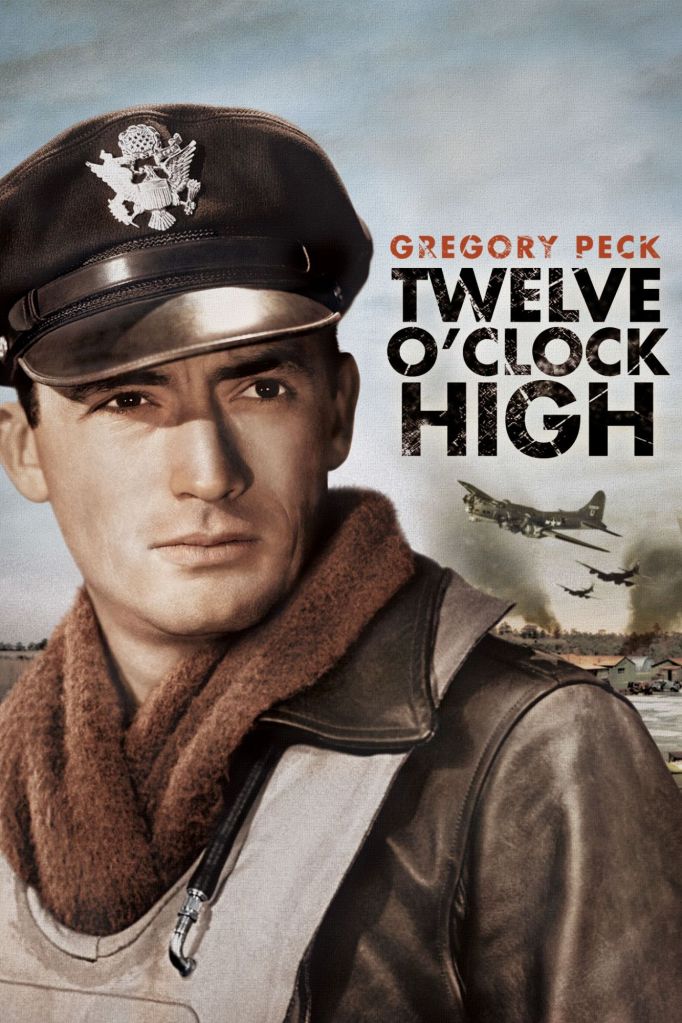
Twelve O’Clock High is a 1949 American war film directed by Henry King. The film is based on the novel of the same name by Sy Bartlett and Beirne Lay Jr. Gregory Peck plays the lead role of Brigadier General Frank Savage, while Hugh Marlowe, Gary Merrill, Millard Mitchell, and Dean Jagger appear in supporting roles.
In 1949, former United States Army Air Forces officer Harvey Stovall notices a familiar Toby Jug in an English antique shop. On inquiry, he learns that the jug came from Archbury, where Stovall had served during World War II. Convinced that it is the same jug from the officers’ club at the airfield, he buys it and travels to the now-derelict airfield, where he becomes absorbed in memories of his wartime experiences.
In a flashback, the story shifts to 1942. The 918th Bomb Group stationed at Archbury has earned a reputation as a “hard luck group.” After a disastrous mission, the group commander, Colonel Keith Davenport, appears exhausted and demoralized. His defeated attitude gradually spreads among the senior officers, including his Air Executive, Lieutenant Colonel Ben Gately.

The very next day, the group is ordered to fly another mission at a dangerously low altitude. Disturbed by this, Davenport voices his concerns to his friend Brigadier General Frank Savage, who serves as Assistant Chief of Staff for Operations at VIII Bomber Command. Reluctantly, Savage shares his doubts with Major General Pritchard, the commanding general of VIII Bomber Command, suggesting that Davenport has become too emotionally close to his men and may no longer be fit for command.
That night, Pritchard and Savage visit the group headquarters to investigate the causes of the heavy losses suffered on the mission. When Davenport refuses to discipline the failed navigator, Lieutenant Zimmerman, Pritchard becomes convinced that Savage’s assessment is correct. He immediately relieves Davenport of command and appoints Frank Savage as the new group commander.
In order to restore the group’s shattered morale and discipline, Savage deliberately adopts a harsh—almost ruthless—style of leadership. His public reprimand and demotion of Gately is not merely a disciplinary action, but a clear message to the entire group: emotional closeness and self-pity have no place in war. Forcing Gately to fly every mission and deliberately assigning him inexperienced crews is part of Savage’s psychological strategy; he knows that confidence cannot return without confronting fear. The name “Leper Colony” painted on Gately’s aircraft, though seemingly humiliating, becomes a visual symbol of the group’s defeated mindset.
Against this backdrop, the blunt, fearless, and practical Major Cobb impresses Savage. Cobb’s appointment as Air Executive represents the next step in Savage’s leadership vision: he wants not obedient subordinates, but colleagues capable of independent judgment and willing to face danger.
The series of training missions initiated by Savage are not meant solely for technical preparation; they are an effort to rebuild the group’s sense of self-worth. However, when contrasted with Davenport’s gentle, humane leadership, Savage’s severity appears cruel to the pilots. As a result, all of them submit transfer requests—a crucial turning point in the film, as it exposes the fundamental conflict between leadership and popularity.
At this moment of crisis, Savage’s order to Major Stovall to halt the processing of the transfer requests reveals his foresight. He understands that only time will allow him to rebuild the group’s fighting spirit. Twelve O’Clock High makes it clear that wartime leadership is sometimes founded on firmness rather than sympathy, and that such firmness is born not of personal cruelty, but of the burden of responsibility.
Due to adverse weather, many bomber groups are ordered to abort their missions. Savage ignores these orders, and the 918th Bomb Group becomes the only unit to successfully bomb its target. Savage later claims that he did not hear the recall order because of radio failure, and even persuades the furious Pritchard to recommend the group for a Distinguished Unit Citation. This episode highlights the moral ambiguity in Savage’s leadership: he breaks the rules, but does so to achieve the objective and to restore the group’s confidence.
At this stage, Savage appoints Medal of Honor recipient Lieutenant Jesse Bishop as his “eyes and ears” among the airmen. This decision signals a shift in his leadership style—he is no longer merely an officer who issues orders, but a leader who seeks to understand the psychological state of the men at the grassroots level.
When the Inspector General arrives to investigate the transfer requests, Savage prepares himself to be relieved of command or even court-martialed. However, at Bishop’s initiative, all the airmen withdraw their requests. This becomes a decisive emotional turning point in the film, as the group finally begins to understand Savage’s strict discipline. Thereafter, Savage’s own outlook changes: he grows more humane and emotionally connected to his men. During this period, Gately earns Savage’s respect through extraordinary courage and leadership, transforming their earlier hostility into a mature mutual respect.
As the bombing missions push deeper into Germany, the air war grows increasingly brutal. Operations become longer and more perilous, and many of Savage’s finest airmen are killed or shot down. Pritchard once again advises Savage to return to an administrative position at VIII Bomber Command, but Savage believes that the 918th still depends on his presence. Reluctantly, Pritchard allows him to remain in command.
After a particularly savage attack on a ball-bearing plant, the group receives orders to strike the same target again. This time, Savage is completely broken—physically and psychologically—and is unable even to climb into his B-17. Gately takes his place, assuming the role of lead pilot and strike commander for the mission. As the group flies out, Savage slips into a catatonic state. This moment becomes the film’s most powerful statement, laying bare the true cost of leadership in war.
Only when the group returns safely to Archbury does Savage regain consciousness, falling into a calm, restorative sleep, as if his duty has finally been fulfilled.
The narrative then shifts to 1949. Stovall rides away from Archbury on his bicycle, and Twelve O’Clock High concludes as a meditation on memory, sacrifice, and the invisible wounds of leadership. The film ultimately emphasizes not the triumphs of war, but its human cost—elevating it beyond a conventional war film into a profound study of leadership and psychology.
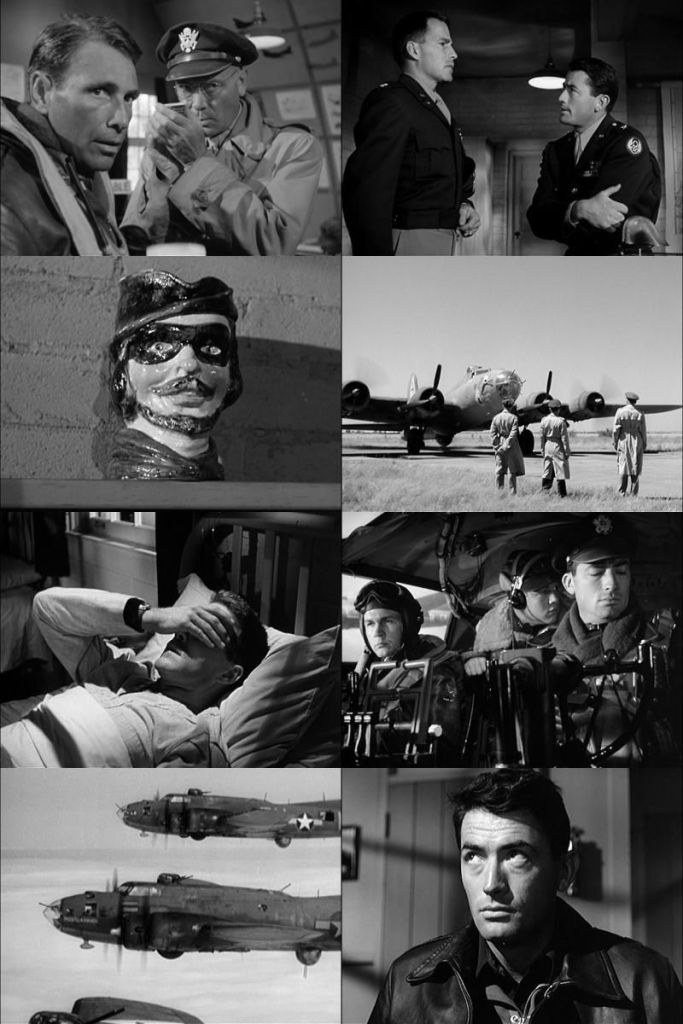
This film is not merely a war drama set against the backdrop of the Second World War; it is a profound study of leadership, responsibility, and psychological exhaustion. Rather than celebrating victory in battle, it illuminates the human cost behind that victory.
Gregory Peck’s portrayal of Brigadier General Frank Savage stands at the very center of Twelve O’Clock High. While remaining within the framework of a war film, it gives priority to the moral dilemmas of leadership and its psychological consequences. Through a flashback structure, the narrative moves from memories in 1949 back to the war years of 1942, emphasizing how the scars of war persist long after the fighting has ended.
Savage’s uncompromising style of command is set in sharp contrast to Davenport’s gentler approach. Gately’s demotion and the assignment of perilous missions initially appear cruel, but the film gradually makes clear that these actions stem from a deep sense of responsibility. The incident in which Savage disregards orders and proceeds with the bombing mission becomes a symbol of moral ambiguity—Twelve O’Clock High offers no easy answers about right and wrong.
Gately’s journey from a resentful subordinate to a courageous leader, and the mutual respect that develops between Savage and Gately, forms one of the film’s most compelling arcs.
The most powerful moment in the film is Savage’s complete breakdown. The relentless pressure, constant loss of life, and burden of decision-making wear him down physically and psychologically. His inability to board the B-17 and his descent into a catatonic state serve as a stark commentary on the myth of wartime heroism—reminding us that even leaders are ultimately human.
By refusing to glorify war, the film presents it instead as a severe psychological trial. Leadership, it argues, is not about popularity, but about the willingness to make harsh decisions and to personally bear their consequences. It is this perspective that gives Twelve O’Clock High its enduring relevance, compelling audiences even today to reflect on leadership, responsibility, and human limitations.
Henry King’s direction gives Twelve O’Clock High a restrained and realistic tone. Rather than glorifying wartime heroism, he emphasizes discipline, responsibility, and psychological strain, offering a subtle and layered portrayal of Savage’s inner journey. Although the aerial combat sequences are thrilling, they primarily underline the exhaustion and relentless repetition of war.
Leon Shamroy’s cinematography powerfully conveys wartime tension through high-contrast lighting and realistic aerial imagery. The blending of actual wartime footage with studio-shot scenes lends the film a semi-documentary texture, enhancing its sense of authenticity.
Barbara McLean’s editing maintains a careful balance between the excitement of combat and the quieter, simmering tension on the base. The alternation between fast-paced and slower sequences makes the mounting danger and mental fatigue vividly palpable.
The film received four Academy Award nominations, winning two Oscars—Dean Jagger won Best Supporting Actor, and Thomas T. Moulton received the award for Best Sound Recording.
In 1998, Twelve O’Clock High was selected for preservation in the United States National Film Registry. The Library of Congress recognized the film as “culturally, historically, or aesthetically significant.”
📸 Photo courtesy: Google. ✍️ Sources: Google.
 Writer Sunita