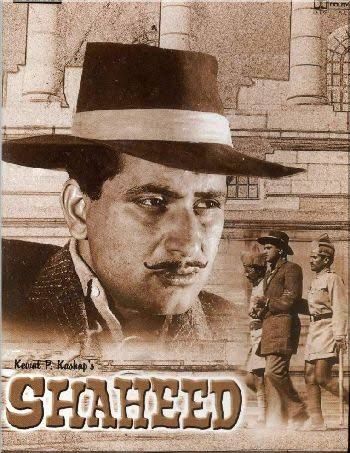
Shaheed (1965) is a biographical film based on the inspirational life of one of India’s greatest patriots, Sardar Bhagat Singh. The film was directed by S. Ram Sharma and produced by Kewal Kashyap. It stars Manoj Kumar, Kamini Kaushal, and Pran in the lead roles, with Iftekhar, Nirupa Roy, Prem Chopra, Madan Puri, and Anwar Hussain appearing in supporting roles. The film narrates the life and sacrifice of the Indian freedom fighter Bhagat Singh.
Shaheed is regarded as the first film in Manoj Kumar’s series of patriotic films, a genre with which he later became strongly identified.
The story begins in British India in 1911. Sardar Kishan Singh and his family, including his young son Bhagat, are deeply disturbed when Kishan Singh’s brother Ajit Singh is arrested for inciting the public against British rule. After rumors spread that Ajit Singh has escaped from prison, he mysteriously disappears and is never seen again. This incident leaves a profound and lasting impression on young Bhagat Singh’s mind.
As he grows older, Bhagat Singh joins the freedom struggle under the leadership of Chandrashekhar Azad. In 1928, during a protest march against the Simon Commission, veteran leader Lala Lajpat Rai is brutally beaten by the police in a lathi charge. He later succumbs to his injuries. Enraged by this injustice, Bhagat Singh, Chandrashekhar Azad, Rajguru, Sukhdev, and Jaigopal decide to take revenge.
On 17 December, as he exits the local police station, Assistant Superintendent of Police J. P. Saunders is shot dead. Following the assassination, to evade arrest by the CID and police, Bhagat Singh and his companions decide to flee Lahore. Bhagat Singh disguises himself as an Anglo-Indian gentleman, and along with Azad and Rajguru, successfully escapes from the city.
Four months later, Bhagat Singh and Batukeshwar Dutt throw bombs in the Central Legislative Assembly in Delhi as an act of protest. The bombs are deliberately non-lethal and intended as a symbolic challenge to British authority. Following this act, Bhagat Singh, Sukhdev, and other revolutionaries are arrested, put on trial, and imprisoned.
They are lodged in Lahore Central Jail, where they are subjected to constant torture and brutal treatment by prison guards. Witnessing the inhumane treatment of Indian prisoners, Bhagat Singh and his comrades launch a hunger strike. During this protest, Jatindranath Das dies, creating immense public outrage and pressure on the government. Eventually, the authorities are forced to promise improved treatment of Indian prisoners.
Meanwhile, the trial in the Saunders murder case continues. In court, Bhagat Singh and his comrades deliver powerful speeches, fiercely criticizing British imperialism.
At the same time, Chandrashekhar Azad and Bhagwati Charan Vohra attempt to rescue the imprisoned revolutionaries, but the plan fails. During this attempt, Bhagwati Charan Vohra loses his life.
Subsequently, in an encounter with the British police at Alfred Park, Chandrashekhar Azad, who had sworn never to be captured alive, sacrifices his life by shooting himself.
After the conclusion of the trial, Bhagat Singh, Rajguru, and Sukhdev were sentenced to death on 7 October 1930. Fearing widespread public outrage, the British government secretly carried out the executions a day earlier than the announced date, and on 23 March 1931, Bhagat Singh and Rajguru were hanged. Just before their execution, they raised the resounding slogan: “Inquilab Zindabad!”
In 2017, Manoj Kumar revealed that he had spent four years researching the role of Bhagat Singh. He explained: “I visited newspaper offices and read every old book, magazine, and newspaper I could find related to freedom fighters. While shooting my films in Madras (now Chennai), after the day’s work I would go to the Hindu Library and study the books there.”
In addition to this, he also met Bhagat Singh’s lawyers and several freedom fighters of that era, which helped him gain a deeper understanding of the personality he was portraying and enabled him to perform the role with greater authenticity.
In his portrayal of Sardar Bhagat Singh, Manoj Kumar captures not just the external likeness but also the inner patriotism, intellectual sharpness, and readiness for sacrifice that defined the revolutionary. Through a calm and restrained performance, he highlights Bhagat Singh’s dual identity as both a thinker and a revolutionary. His meticulous preparation lends the role a sense of sincerity and inspiration.
Prem Chopra, portraying a character aligned with British authority, embodies oppression, self-interest, and moral decay. His cold, calculating, and ruthless performance sharply underscores the internal conflicts of the freedom struggle and creates a necessary dramatic contrast within the narrative.
Anant Purushottam Marathe, in a supporting role, portrays an ordinary yet deeply committed companion within the revolutionary movement. His performance is simple, realistic, and emotionally grounded, effectively highlighting the spirit of collective sacrifice and unity that defined the struggle.
Taken together, the performances of these three actors elevate Shaheed beyond a mere biographical film, transforming it into a powerful document of freedom, sacrifice, and patriotism.
The music of Shaheed was composed by Prem Dhawan, who also wrote most of the lyrics. However, the immortal song “Sarfaroshi Ki Tamanna” was penned by Bismil Azimabadi. The film’s songs do more than evoke emotion; they forcefully articulate the ideals of freedom, sacrifice, and revolution.
“Ae Watan, Ae Watan, Humko Teri Kasam” is a quiet yet resolute oath taken to the motherland, expressing an unshakable commitment to sacrifice everything for the nation’s honor.
“Pagdi Sambhaal Jatta” stands as a symbol of pride and identity, delivering a rousing call to remain vigilant against injustice and to safeguard one’s self-respect.
“Watan Pe Marne Wale Zinda Rahega Tera Naam” glorifies the immortality of martyrs, affirming that sacrifices made for the nation live on forever in history.
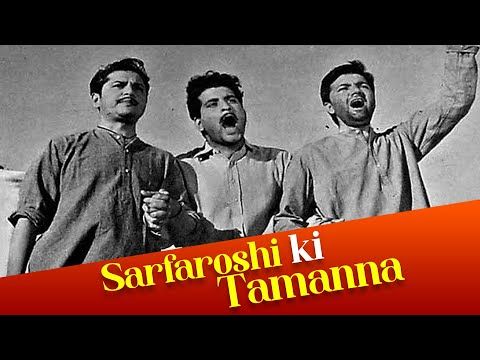
“Sarfaroshi Ki Tamanna” embodies the unwavering resolve to lay down one’s life for freedom. It proclaims a principled and ideological struggle against injustice, free from fear of death—serving as a reflection of Bhagat Singh’s revolutionary philosophy.
“O Mera Rang De Basanti Chola” transforms sacrifice into an expression of pride and sanctity. The saffron hue becomes a symbol of renunciation, courage, and spiritual calm, portraying martyrdom not as sorrow, but as a sacred milestone in the journey toward freedom.
Shaheed was released on 1 January 1965 and proved to be a box-office success. It emerged as the eleventh highest-grossing film of the year and was officially declared a “Hit” by Box Office India.
At the 13th National Film Awards, Shaheed received the following prestigious honors: Best Hindi Feature Film, Nargis Dutt Award for Best Feature Film on National Integration, Best Screenplay (awarded to B. K. Dutt and Deen Dayal Sharma)
The film was also screened retrospectively on 15 August 2016 at the Independence Day Film Festival. This special screening was jointly organized by the Directorate of Film Festivals and the Ministry of Defence, in commemoration of India’s 69th Independence Day.
📸 Photo courtesy: Google ✍️ Excerpts: Google
 Writer Sunita