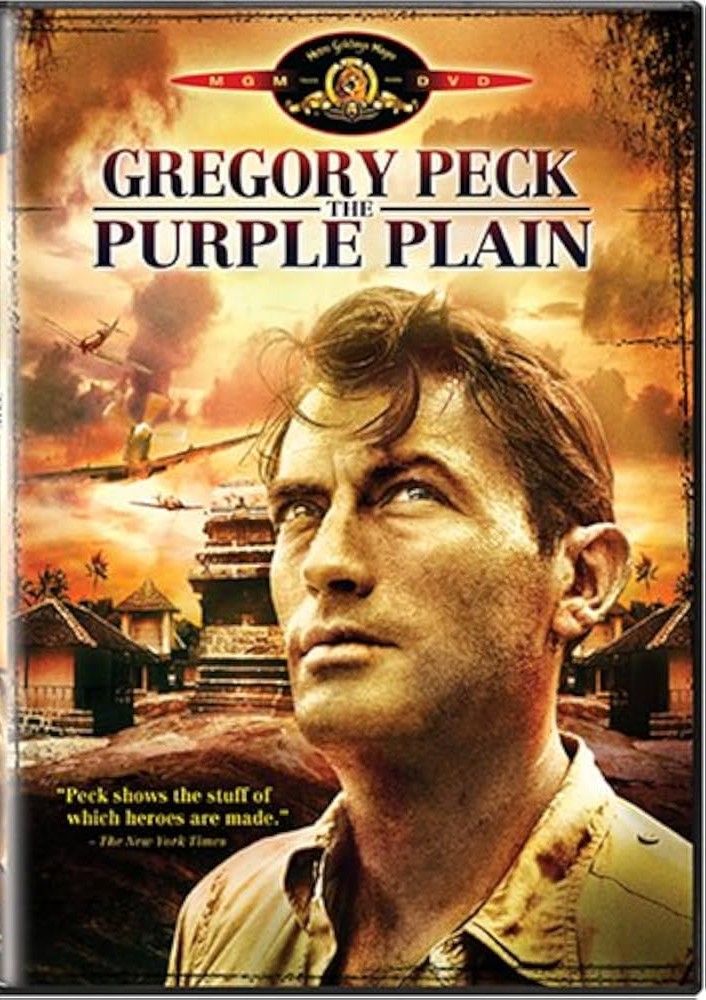
The Purple Plain is a 1954 British war film directed by Robert Parrish. The film stars Gregory Peck as a Royal Canadian Air Force pilot serving with the Royal Air Force during the Burma campaign in the final stages of World War II. Traumatized by the death of his wife in a German bombing raid on London, he struggles with deep emotional despair. The film also features notable performances by Win Min Than, Maurice Denham, and Lyndon Brook in important supporting roles.
Bill Forrester is a Canadian-born, Battle of Britain–hardened pilot now serving with the Royal Air Force in Burma, flying the two-seat de Havilland Mosquito fighter-bomber. When we first meet him, he breaks formation to attack Japanese anti-aircraft guns; the reckless maneuver results in his navigator being wounded.
The year is 1945. While much of the world senses that the Second World War is nearing its end, Forrester—caught in the slow, grinding Burma campaign—seems indifferent to that reality. He insists on flying by day and is plagued by horrific nightmares at night, jolting awake from imagined air raids. The trauma of losing his newly married wife in the London Blitz eats away at him, and his grief gradually turns into a pattern of self-destructive recklessness.
Alarmed by this dangerous behavior, his commanding officer grows increasingly concerned, aware that Forrester is endangering not only his own life but also those of his flight crews. Other pilots begin to avoid flying with him. The commander attempts to ground him, but doing so requires the approval of the base flight surgeon—marking the point at which Forrester’s private torment becomes an official and unavoidable crisis.
“He’s completely gone mad,” the British around him say. Through flashbacks it becomes clear that he has never recovered from losing his wife during the Blitz, when London was subjected to devastating air raids. Forrester himself admits, “I didn’t want to live. I thought dying in the war would be easy—but it never happened. I wanted to die, and instead I kept getting medals.”
Bernard Lee—later famous as ‘M’ in the James Bond series—plays the squadron doctor, tasked with carrying out Forrester’s so-called “medical examination,” which feels more like a deeply human conversation than a clinical assessment. Forrester’s non-flying tent-mate (Maurice Denham) believes that it is the absence of anything to look forward to—no hope, no personal ties—that has driven him to such recklessness.
The doctor feels that taking Forrester along to a Christian mission working with Burmese refugees might help him rediscover a sense of purpose. Although Bill is highly decorated and regarded as the squadron’s finest pilot, the doctor reluctantly agrees to evaluate him and encourages him to visit a nearby village.
There, amid people displaced by the Japanese invasion—the innocent victims of war who nevertheless endure despite their wounds and constant fear of renewed air attacks—Forrester meets Anya, a young Burmese woman (Win Min Than). In simple yet profound words, she explains the human need to keep moving forward after loss: “Here, we bury the dead in the earth, not in our hearts.”
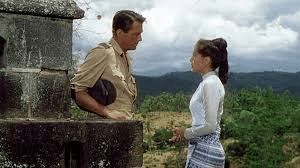
A friendship gradually develops between them, and during their regular meetings Bill opens up about the pain of his wife’s death and his desire to die in the war. Through Anya’s quiet companionship and support, he slowly begins to heal. Trapped in grief, guilt, and self-destructive impulses, the pilot starts once more to look at life with hope and optimism, discovering that even amid the devastation of war, human connection still has the power to sustain and redeem.
He sets out on what is supposed to be a routine “milk run” mission—intended to give a new navigator (Lyndon Brook) some flying experience and to deliver his tent-mate, Flight Lieutenant Blore, to a new posting. Forrester is granted permission to fly this one final sortie. Along with his new navigator Carrington, he takes responsibility for transporting Blore—who is traveling in the Mosquito’s bomb bay—to Meiktila.
During the flight, however, an engine catches fire, forcing them to make an emergency landing in a remote, arid region under Japanese control. The purplish hues of the soil and surrounding hills give the film its title, The Purple Plain. In the crash landing, Carrington is badly injured; his leg is severely burned, leaving him unable to walk. With no equipment, very little water, and no sign of friendly forces, the situation is dire. In these desperate circumstances, Forrester decides that their best chance of survival is to attempt a roughly thirty-mile trek to the nearest river, where they might find water and hope for rescue.
Blore, however, disagrees. He believes they should stay with the aircraft and wait for rescue, arguing that search parties will surely be looking for them. Forrester counters that the chances of being spotted from the air are extremely slim.
They fashion a makeshift stretcher out of bamboo for Carrington and begin their journey toward the river, traveling by night and resting during the day. In these harsh conditions, Forrester’s will to survive emerges as the strongest force holding them together.
During the arduous trek, Blore slips and falls down a rocky slope, breaking his collarbone and rendering him unable to carry the stretcher or offer much help. Their water supply is nearly exhausted. Faced with this crisis, Forrester decides that Blore should go on alone to find water, while he stays behind with Carrington.
Blore resists the decision and insists on turning back toward the crashed aircraft. Forrester suggests they rest for a while and decide what to do after waking. When Forrester awakens the next morning, he realizes that Blore has gone—but has left behind the metal water canteen with a small amount of water in it. Forrester places the canteen beside Carrington and sets out to look for Blore.
Before he can reach him, Blore takes his own life. Forrester later finds Blore’s wallet, containing a photograph of his family—his wife and two children. The discovery profoundly shakes him. In the end, he returns to Carrington, carrying the weight of this loss with him.
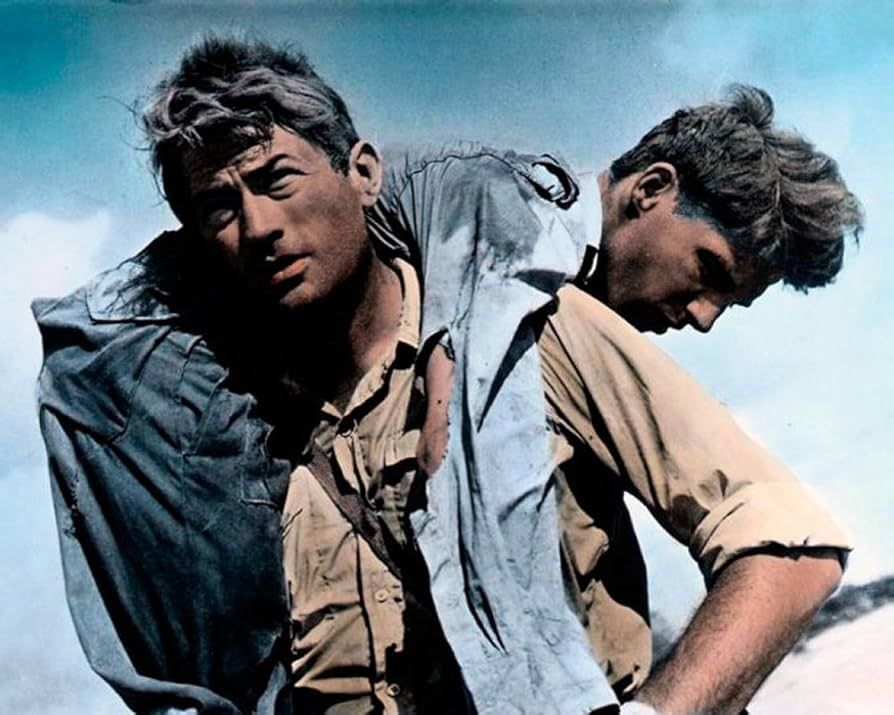
Forrester carries Carrington on his back and continues onward. Eventually, exhausted and severely dehydrated, he collapses onto the desert ground. In that state, Carrington urges him to go on alone, explaining that their only remaining hope is for Forrester to reach the river and bring back water.
With immense effort, Forrester resumes the journey by himself. While climbing a hill, he becomes completely drained of strength and falls face-first to the ground, unable to go any farther. At that moment, he hears the sound of water. On the other side of the hill lies a river.
Summoning his last reserves of energy, he reaches the river and then manages to return with water for Carrington. Soon afterward, both men are rescued. Despite surviving the ordeal, Forrester is left extremely weak. Back at the base, the doctor visits him and, after a brief examination, agrees to take him by jeep to see Anya.
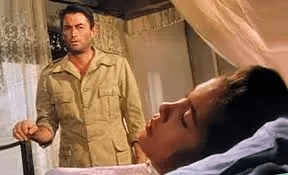
Forrester finds Anya fast asleep on her cot. Without waking her, he lies down beside her and almost instantly falls into a deep, peaceful sleep.
The Purple Plain is regarded as a largely historically accurate film, notable for its strong production values and careful attention to detail. Its portrayal of the local Burmese people is handled with respect and sensitivity.
The film is based on H. E. Bates’s 1947 novel The Purple Plain, which drew on the author’s own experiences while serving with the RAF during World War II. The novel was first published in serialized form in The Saturday Evening Post in 1947. The screenplay was written by Eric Ambler, in consultation with Bates himself.
Robert Parrish’s direction is spare and unfussy, making effective use of Ceylon’s natural beauty and real combat aircraft. Geoffrey Unsworth’s cinematography is especially striking. Filming took place in Ceylon (present-day Sri Lanka), notably at Sigiriya.
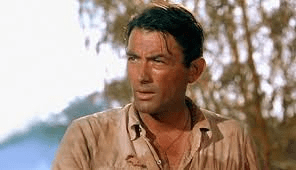
Gregory Peck’s true strength as an actor lies in emotions that speak without words. Rather than expressing feelings directly, he suppresses them, stores them, and reveals them gradually—so the calm on his face is never emptiness, but a surface charged with inner conflict.
He never plays “unthinking” roles, because his characters are always reflective and conscious. Even when dialogue is minimal, his eyes, pauses, and body language convey a mind that is constantly at work. As a result, even when his characters are trapped within their own limitations, they remain understandable and deeply human to the audience.
Peck’s restraint is not a lack of emotion; it is controlled emotion. His performances do not aim to project “heroism” as much as moral weight. He does not tell us that a character is great; instead, he allows us to experience why the character is troubled, why he is conflicted, and yet why he remains honorable. This is the true meaning and lasting power of Peck’s acting.
Critic Bosley Crowther wrote of Peck’s performance that “the intensity of Peck’s suffering is powerfully conveyed to the audience… through stark and sustained scenes.” In recent years, this film has come to be regarded as one of Peck’s most acclaimed works. Critic David Thomson has described his performance as outstanding. According to Craig Butler of AllMovie, “Peck is astonishing—delivering a layered, intense yet subtle performance that deserves major awards.”
At the very least, The Purple Plain has stood the test of time—a solid genre film that presents the psychological and human cost of war with far greater maturity than many World War II films of its era, while remaining firmly grounded within its genre.
The film was also a box-office success. In 1954, it ranked as the 11th most popular film in Britain. According to Kinematograph Weekly, it was listed as a “money maker” at the British box office for that year.
The Purple Plain received recognition at the 8th British Academy Film Awards (BAFTA), where it was nominated for Best British Film of 1954. Actor Maurice Denham also earned a nomination for Best Actor in a Leading Role for his performance as Blore.
📸 Photo courtesy: Google ✍️ Sources: Google
 Writer Sunita