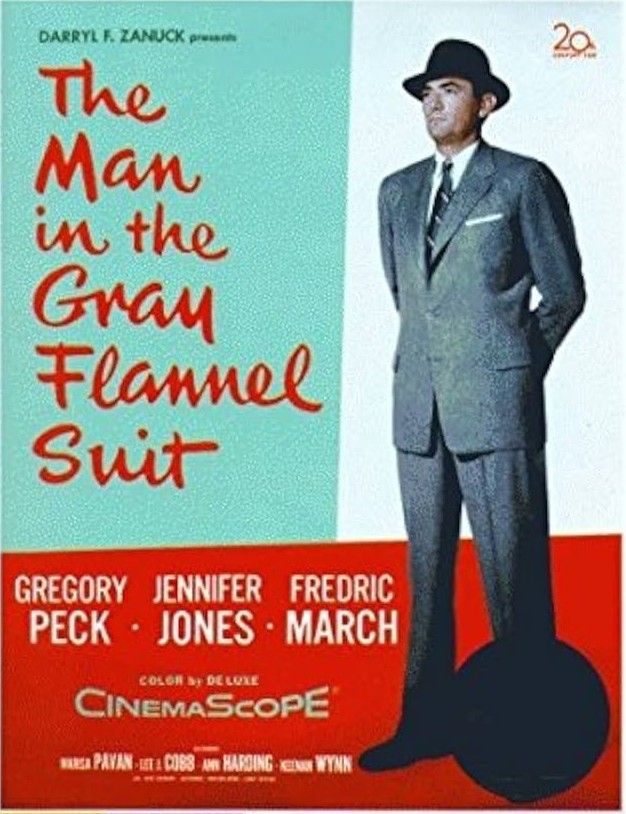
The Man in the Gray Flannel Suit (1956) is an American drama film starring Gregory Peck and Jennifer Jones, with supporting performances by Fredric March, Lee J. Cobb, Keenan Wynn, and Marisa Pavan.
The film is based on Sloan Wilson’s 1955 novel of the same name and was written and directed by Nunnally Johnson.
It tells the story of a former soldier who struggles with ethical dilemmas while trying to earn enough to properly support his wife and children. After the war, he takes on a high-pressure job to meet the ambitions of his wife and the growing needs of his family. Throughout this journey, he must balance career demands, personal integrity, and family values. At the same time, the painful memories and psychological scars from his wartime experiences continue to cast a shadow over his present life.
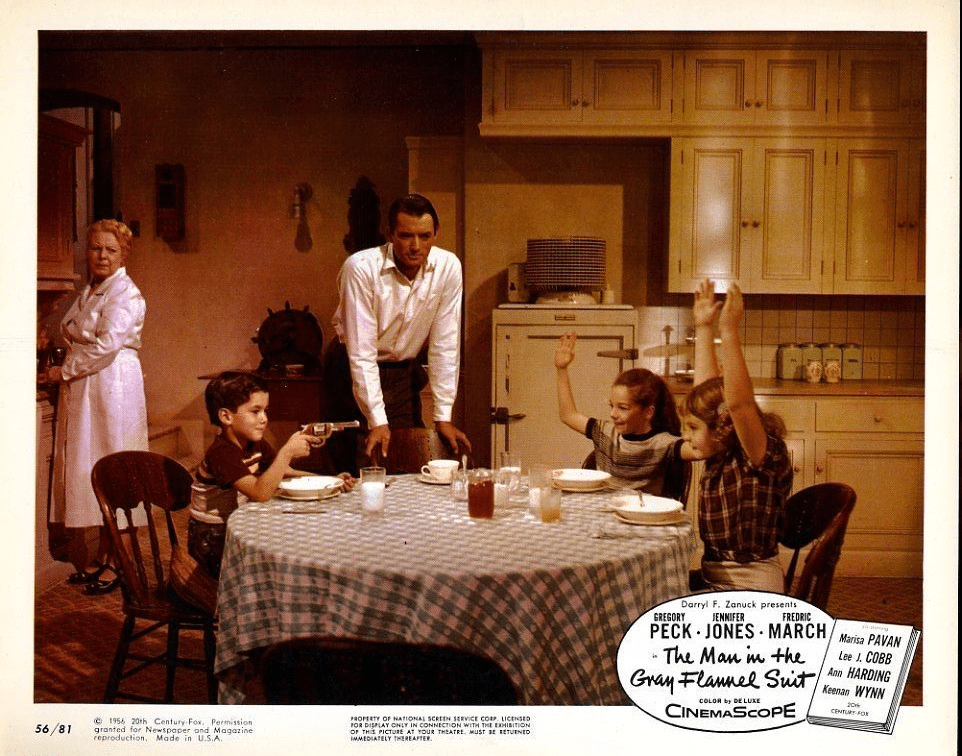
Ten years after the end of World War II, Tom Rath (Gregory Peck) is living in suburban Connecticut with his wife Betsy (Jennifer Jones) and their three children. He struggles to support his family and meet his wife’s ambitions on the modest salary he earns as a writer for a nonprofit organization in Manhattan.
Tom is also haunted by the psychological effects of his wartime experiences. He frequently suffers from disturbing flashbacks to his service in the European and Pacific theaters, including memories of killing men in combat—accidentally causing the death of his best friend—and a brief romantic affair with a young Italian woman named Maria (Marisa Pavan) while he was involved with Betsy.
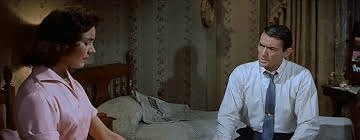
Tom expects to inherit a substantial fortune from his recently deceased grandmother, but discovers that the estate has been nearly depleted, leaving behind only a large, unsellable property. As a result, Betsy pressures him to seek a higher-paying job.
On the advice of a fellow commuter on his daily train ride, Tom applies for a public relations position at the United Broadcasting Company (UBC), a television network. During the interview, when asked to write his autobiography, he frankly states that he wants the job, believes he can grow into the role, and is willing to answer any relevant questions directly.
His straightforwardness impresses the company’s founding president, Ralph Hopkins (Fredric March). Hopkins seeks Tom’s help in launching a national mental health campaign that is close to his heart. Though powerful and highly respected, Hopkins has sacrificed his family life for his career—he is estranged from his wife and troubled by his rebellious daughter, who elopes with an unsuitable man.
Tom’s honesty and character remind Hopkins of his own son, who was killed in the war, creating a special bond between them.
Initially, Tom works under Bill Ogden (Henry Daniell), a slick, micromanaging office politician. Ogden rejects Tom’s draft of an important speech Hopkins plans to deliver for the campaign and replaces it with a bland, superficial version filled with empty platitudes. Although Tom knows the campaign idea originated with Hopkins, he considers going along with Ogden under pressure. Encouraged by Betsy, however, he presents his original ideas directly to Hopkins.
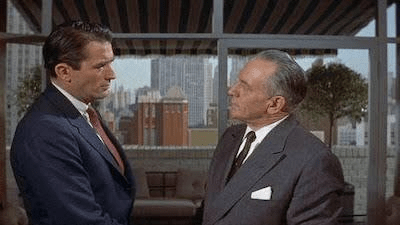
Hopkins is surprised and impressed by Tom’s candid and incisive approach. However, their meeting is abruptly disrupted by the news that Hopkins’ daughter has eloped, shifting the tone of the moment.
Deeply shaken by the incident, Hopkins opens up to Tom. He reveals that his son had refused an officer’s commission during World War II, choosing instead to serve as an enlisted man, and was killed in action. Regretting that he neglected his family, Hopkins advises Tom not to make the same mistake.
Meanwhile, Betsy abruptly sells their modest suburban home and moves the family into Tom’s late grandmother’s large mansion, which she sarcastically calls “Dragonwyck.” Complications arise when the grandmother’s longtime caretaker, Edward (Joseph Sweeney), claims that the estate was willed to him. Judge Bernstein (Lee J. Cobb) intervenes and presents evidence that Edward forged the will and inflated his bills, draining the estate’s wealth. In the end, the Rath family successfully retains ownership of the house.
At his new job, Tom encounters the elevator operator, Caesar (Keenan Wynn), who had been his sergeant during the war in Italy. Caesar tells him that his wife is the cousin of Tom’s former Italian lover, Maria, and that Maria and her son by Tom are living in severe hardship in war-torn Italy and desperately need financial support.
Tom has kept his past relationship and possible child a secret from Betsy. However, prompted by her advice that evening to “always tell the truth,” he confesses everything. Furious and hurt, Betsy drives off recklessly in the family car.
The next morning, Tom receives a call from the South Bay police informing him that Betsy has been found after running out of gas. At the same time, Hopkins asks Tom to accompany him to California to support the new campaign. Tom politely declines, saying he simply wants to “work nine to five and spend the rest of the time with my family.” Hopkins accepts his decision respectfully, though with some regret.

Tom brings Betsy back home, and the two reconcile. They then visit Judge Bernstein to arrange financial support for Tom’s son in Italy through a third party. In the end, they leave together, embracing each other, a sign of a new beginning.
In the 1950s, mental health was considered a bold subject, and this film portrays PTSD with great sensitivity. The “gray flannel suit” is not merely clothing but a symbol of stable yet monotonous American middle-class life. Tom Rath appears successful and polished in his attractive suit, yet internally he is troubled by workplace stress and haunting flashbacks from the war. In contrast to the intensity of his past experiences, the dullness of his present life becomes even more pronounced.
On the other hand, Hopkins’ luxurious attire symbolizes not only his success but also the personal sacrifices he has made for it. The story highlights post–World War II American middle-class suburban life and the concept of the “ideal” family. Tom hopes for a peaceful, contented life, but Betsy feels confined in the limited role of a housewife and sees such a life as a kind of “graveyard.” Through costume, style, and situation, the film effectively reinforces its social message.
Perhaps Betsy is waiting for ideas like those later expressed in The Feminine Mystique to give direction to her restlessness. The children’s innocent conversations also hint at the condition of women’s lives in that era—when one girl falls ill and another asks, “Is she dying?”, it subtly reflects a fear of a dull, predetermined future.
Little Pete, dressed in a soldier’s uniform, evokes his father’s heroic past, while the children eagerly watching a television Western ask, “Who dies next?”—at the very moment Tom is overwhelmed by violent memories of the war.
The war flashbacks weave together themes of death and creation. In Italy, Tom falls in love with Maria, but they part after she tells him she is pregnant. This secret later becomes Tom’s central moral conflict and leads to the decisive moment when he confesses the truth to his wife.
The film’s score, composed by Bernard Herrmann, creates a somber and haunting atmosphere. When Tom looks up at an airplane crossing the New York skyline, the music shifts abruptly, carrying us back into a wartime flashback. Some scenes feature powerful orchestration, while others use deliberate silence—for instance, in the crucial moment when Tom refuses to accept that a soldier killed by an accidental hand grenade is truly dead, there is no background music at all.
In The New York Times, Bosley Crowther described it as “a mature, fascinating and often tender and touching film.”
Harrison’s Reports called it “one of the most absorbing pictures of the year” and especially praised the performances.
The Monthly Film Bulletin wrote that, as a sociological portrayal of contemporary American middle-class life, the film is compelling and intriguing.
Like the novel on which it was based, the film became hugely popular with audiences.
It was also screened at the 1956 Cannes Film Festival.
📸 Photo courtesy: Google ✍️ Sources: Google
 Writer Sunita