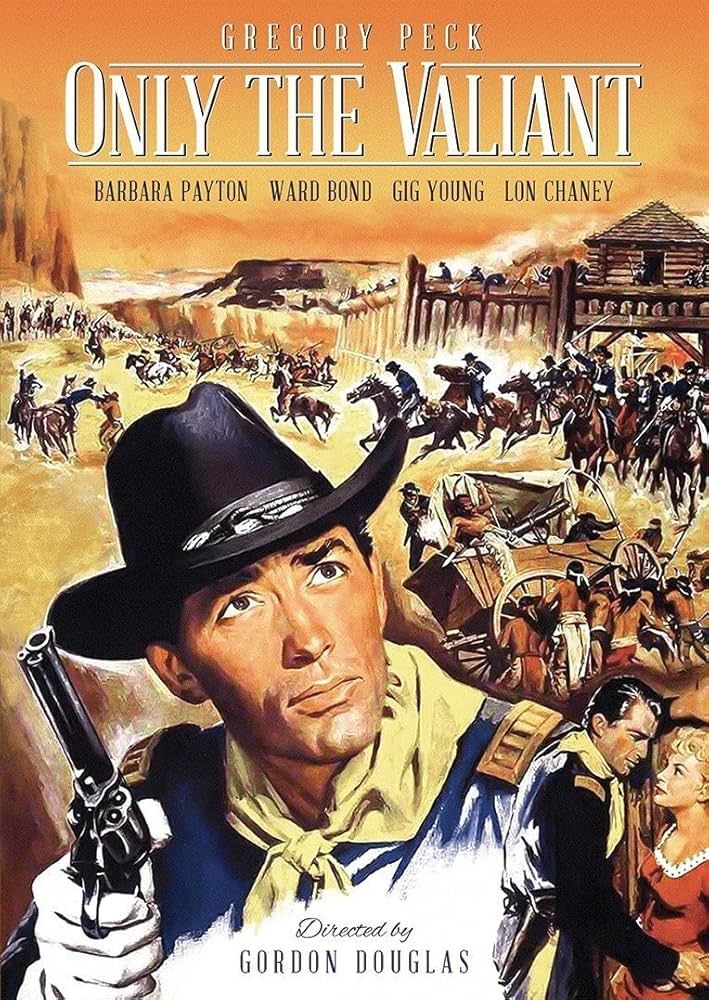
Only the Valiant (also known as Fort Invincible) is a 1951 American Western produced by William Cagney and directed by Gordon Douglas. The film stars Gregory Peck, Barbara Payton, and Ward Bond.
The screenplay by Edmund H. North and Harry Brown is based on the 1943 novel of the same name by Charles Marquis Warren.
The story centers around a remote mountain pass frequently used by the Apaches for raids. To block them, the U.S. Cavalry built Fort Invincible—but the fort is suddenly destroyed in a fierce attack. Despite heavy losses, Captain Richard “Dick” Lance (Gregory Peck) manages to capture the Apache chief Tucsos alive.
The local scout, Joe Harmony, warns that Tucsos is revered like a god by his people, and keeping him alive will provoke even more violent attacks. He urges that Tucsos be killed immediately. However, the disciplined and duty-bound Lance refuses to execute a prisoner and instead decides to take him to Fort Winston. Tension rises among the soldiers, who fear retaliation, while the Colonel worries about the fort’s weakened condition. Lance’s strict, uncompromising nature—and the strain in his personal relationships—become increasingly evident.
When ordered to move Tucsos to Fort Grant for safety, Lance prepares for the dangerous mission. Many soldiers distrust him, especially Sergeant Ben Murdock, whose applications for a commission Lance had previously rejected. At Fort Winston, Lance is warmly welcomed by his friend Lieutenant Bill Holloway and Cathy Eversham. Cathy loves Lance, but Bill also has feelings for her, creating a subtle love triangle.
Colonel Drumm decides Tucsos must be transferred, but instead of sending Lance, he assigns Bill to lead the mission. Lance does not reveal that this was the Colonel’s decision, leading Cathy to believe that jealousy motivated him to send Bill into danger. Under this cloud of misunderstanding and emotional tension, Bill departs with the prisoner.
Bill’s unit falls into an Apache ambush. He is captured alive, and days later his mutilated body is returned—a clear warning of revenge. Only Trooper Kebussyan survives to tell the tale, angrily blaming Lance. Suspicion and division spread within the fort. Some see Lance as harsh and unfeeling; others still trust his leadership. Cathy, too, blames him for Bill’s death.
Scout Joe Harmony warns that the Apaches are preparing for a major assault, possibly before reinforcements—400 men—can arrive. Lance proposes a bold plan: take a small group of six or seven men back to the ruined Fort Invincible and hold the narrow pass for a few days until help arrives. Reluctantly, Colonel Drumm agrees, allowing Lance to choose his own men.
Instead of selecting the best soldiers, Lance deliberately chooses disgruntled and flawed men—Corporal Gilchrist, Kebussyan, Sergeant Murdock, Onstott, Rutledge, the fearful young trumpeter Saxton, and the ailing Lieutenant Winters. Many believe he has chosen those who resent him. Yet Lance remains calm, determined to prove that duty outweighs personal bitterness.
Cathy rejects him completely, but Lance focuses only on the mission. Upon reaching Fort Invincible, they discover the water supply destroyed—the Apaches have already prepared the battlefield. With low morale inside and the enemy outside, Lance enforces strict discipline: rationing water, preparing ammunition, organizing defenses. The narrow pass gives them a strategic advantage, as only a few attackers can approach at a time. Still, thirst, fear, and mistrust threaten to break them before the enemy does.
In Only the Valiant, Murdock continues to make sarcastic remarks about his long-denied commission, while some of the men show open resentment and indiscipline. Yet Captain Lance keeps them united by assigning each man a clear responsibility. He prepares dynamite charges in the narrow pass and places Gilchrist in charge of detonating them. The ailing Lieutenant Winters is sent back, as Lance insists on taking final responsibility himself.
When the Apaches lay siege, the situation becomes desperate—water and ammunition run low, and tensions within the group intensify. Despite this, Lance remains calm and courageous. Risking his own life, he repairs the explosives and successfully blows up the pass, temporarily halting the enemy. In this moment, his leadership, discipline, and self-sacrifice are truly proven.
Back at Fort Invincible, the strain reaches a breaking point. Thirst, alcohol, mistrust, and personal grudges weaken the men’s morale. Kebussyan even attacks Lance, and in the ensuing gunfire, Lance is wounded. At the same time, Joe Harmony brings shocking news: the expected relief force is not 400 men, but only 31. Their hope of rescue grows faint, and survival now depends entirely on their courage and endurance.
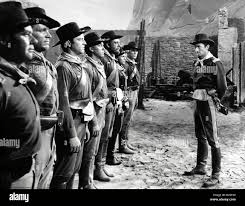
Though wounded, Lance accepts the harsh reality and openly confronts his men about their weaknesses—Murdock’s bitterness, Onstott’s tendency to desert, Rutledge’s vengeful pride, Kebussyan’s rage, Saxton’s fear, and Gilchrist’s drinking. He listens to their accusations without protest and even dismisses the detail, giving them the choice to walk away. Yet it is precisely his honesty, courage, and willingness to face both blame and danger that slowly brings the men together, uniting them at last as soldiers rather than divided individuals.
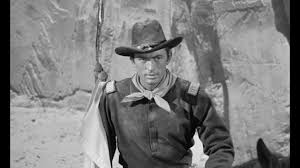
With water nearly gone and the Apaches tightening their siege, Lance devises one final gamble—he carries a white flag and pretends to negotiate with Tucsos. In reality, it is a ruse: Gilchrist has hidden dynamite, ready to be ignited with the spark of a cigar for one last, decisive explosion.
Tucsos confidently declares that only 31 relief soldiers are coming and that the men inside the fort are dying of thirst. Lance calls his bluff and deliberately stalls for time, knowing that every second matters. Saying “Wait,” he prepares to execute his final move.
Under a fierce Apache assault, the detail is nearly wiped out—ammunition runs low and several men are wounded. But at the crucial moment, the devastating firepower of a Gatling gun turns the tide and repels the attack. The pass is held. Though seriously injured, Lance stands firm. Even those who doubted and resented him now acknowledge his courage. In the end, duty, leadership, and sacrifice prevail.
Though it follows the traditional framework of a Western, the film stands out for its strong character development and the gripping tension of its final half-hour—keeping the audience in suspense over whether Tucsos is telling the truth, whether help will arrive in time, and whether Lance can save his men.
In a contemporary review in The New York Times, critic Thomas M. Pryor wrote that as an action film, Only the Valiant does not lack excitement, since the conflict extends beyond just Indians and soldiers—it also unfolds within the ranks of the men themselves.
He further observed that Gregory Peck’s commanding screen presence and his ability to make even a somewhat artificial character seem believable prevent the simplicity of the plot from becoming too obvious to the audience. Likewise, director Gordon Douglas deserves credit for effectively creating and sustaining an atmosphere of danger throughout the film.
The title Only the Valiant applies especially to Captain Richard Lance. Here, “valiant” does not merely mean bravery on the battlefield; it signifies a man who remains faithful to duty despite personal humiliation, misunderstanding, hatred, and isolation. Lance faces accusations of jealousy, the resentment of his men, and the loss of trust from the woman he loves—yet he never abandons discipline, responsibility, or moral principle.
Even if watched solely for Gregory Peck, the film proves satisfying. Peck portrays Captain Lance with quiet restraint, authority, and emotional control. Though initially burdened by suspicion and hostility, his character ultimately redeems himself through courage, leadership, and moral strength. The story may be conventional, but Peck’s powerful performance gives the film weight and emotional depth.
📸 Photo courtesy: Google ✍️ Sources: Google
 Writer Sunita