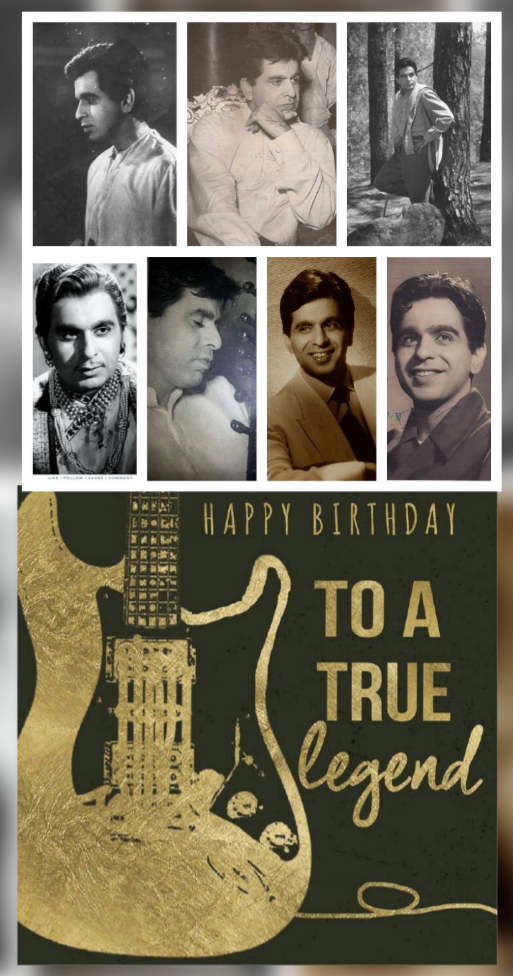
Mohammed Yusuf Khan, better known by his stage name Dilip Kumar, was an Indian Actor and film producer who worked in Hindi Cinema. In a career spanning over six decades Kumar worked in over 65 films in a variety of roles.
He was spotted by a leading actress of those years Devika Rani who also the wife of Himanshu Rai (The founder of Bombay Talkies) and helped his entry into the Bollywood Film Industry. She also gave him the screen name of Dilip Kumar.
He debuted as an actor in the film “Jwar Bhata” (1944). produced by Bombay Talkies. In 1947 film Jugnu he starred alongside Noor Jehan. His next major hits were the 1948 films Shaheed and Mela. Both Jugnu and Shaheed were the highest grossing Hindi films of their respective year of release. In 1949 he starred alongside Raj Kapoor and Nargis in Mehboob Khan’s Andaz. At the time of its release, Andaz was the highest grossing Indian film ever, until its record was broken by Raj Kapoor’s Barsaat that same year. Shabnam was another box office hit that was also released in 1949.
Kumar went on to have success in the 1950s playing leading roles in several box office hits such as Jogan, Babul, Deedar, Tarana, Daag, Amar, Uran Khatola, Insaniyat in which he co-starred with Dev Anand, Devdas, Naya Daur, Yahudi, Madhumati and Paigham. Several of these films established his screen image as the “Tragedy King”.
Mehboob Khan’s big-budget 1952 musical film Aan featured him in one of his first lighter roles and marked his first film to be shot in technicolor. Aan was the first Indian film to have a wide release across Europe with a lavish premiere in London. He had further success with lighter roles as a thief in the comedy Azaad and Royal Prince in the musical Kohinoor.
In 1960, Kumar portrayed Prince Salim in K. Asif’s big budget epic historical film Mughal-e-Azam. Mughal-e-Azam was the highest grossing Indian film. The film was originally shot in black and white, with only two songs and the climax scenes shot in colour. After 44 years its original release, it was fully colourised and theatrically re-released in 2004 and once again a box office success.
In 1961, Kumar worte, produced and starred in Ganga Jamuna . The film received the National Film Award for second best feature film in hindi, the Paul Revere Silver Bowl at the Bostan Internationl Film Festival.
Over his career, Kumar received eight Filmfare Awards for best actor (with 19 total nominations) and a Filmfare Lifetime Achievement Award in 1993. He received Dadasaheb Phalke Award in 1994. The Government of Pakistan conferred Kumar with the Nishan-e-Imtiaz, the highest civilian award in Pakistan, in 1998.
Kumar is widely considered one of the greatest and most influential actors in the history of Indian Cinema. Kumar was pioneer of method acting, predating Hollywood method actor such as “Marlon Brando”. He inspired many great Indian Cinema actors. Kumar, who pioneered his own form of method acting without any acting school experience, was described as “the ultimate method actor” by noted filmmaker Satyajit Ray, despite not having worked him.
Kumar was popularly referred to as “Abhinay Samrat” by the Audience. Kumar was voted the “Greatest Indian Actor of all time” in a Rediff Readers poll in 2011. He holds the Guinness World Record for having the most awards by an Indian actor. He was honored by the World Book of Records on his 97th birthday for his “matchless contribution to Indian Cinema and promoting social cources.”
Photos courtesy Google. Excerpts taken from Google.

