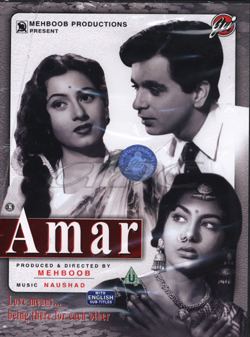
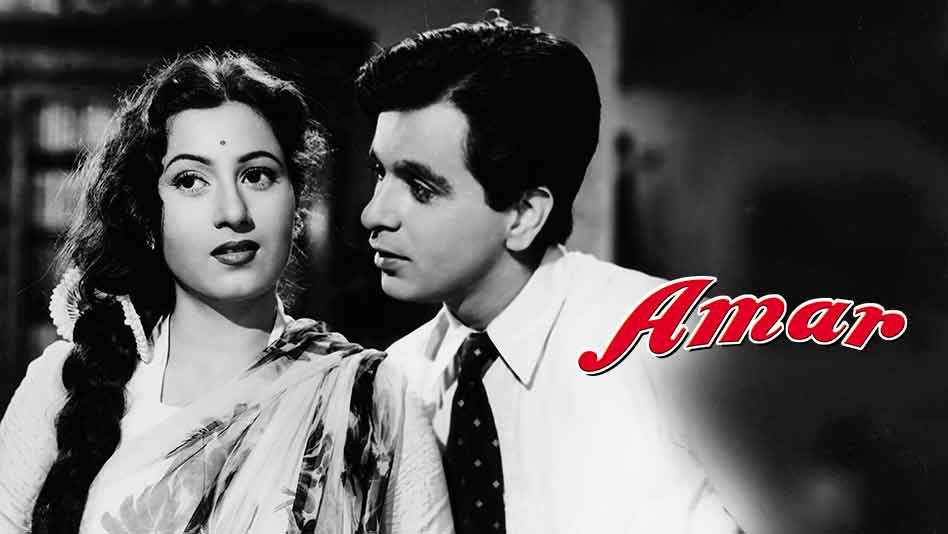
Amar ( ”Immortal”) is a 1954 Indian Hindi language romantic dram film produced and directed by Mehboob Khan.
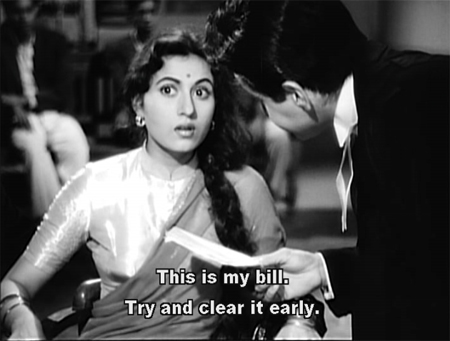
The film is about Amarnath (Dilip Kumar), a noted criminal lawyer who is opposed to any moral transgression in public life. One day, he meets Soniya (Nimmi), a milkwoman. Amar’s father wants him to get married and sends him Anju’s (Madhubala) photograph. Anju has graduated from a foreign University and believes in justice and aiding the poor. Both she and Amar take a liking to each other and they are soon engaged. In love with a scholarly activist Anjoo (Madhubala), Amar’s life is torn apart when his milkmaid Sonia, who too pines for Amar, enters his house on a stormy night while trying to escape an infatuated criminal Sankat (Jayant). Sonia’s blooming youth and fragility ignite lust in Amar and he inflicts himself upon her. Though raped by her idol, Sonia seals her mouth about the crime until an accident reveals her carrying a child. Despite remonstrations by many to reveal the name of the offender, Sonia remains silent and is protected by Anjoo from the rabble rousers.
Meanwhile, Amar struggles with his conscience but cannot disclose the truth until one day, Sankat attacks Amar and the ensuing struggle leads to Sankat’s death. Though Sonia is accused of murder as she is found next to the body, she takes the blame so as to protect Amar from harm. But her sacrifice moves Amar to blurt out the truth and he seeks Sonia’s pardon by taking her as his life partner.
“Amar” was one of the rare flops of Mehboob’s career, yet many still admire the film for its well designed sets, wonderful sound effects and delicate photography done under his talented eye. The black and white canvas lent the story a quiet dignity, appropriate to the ethical tussle between truth and desire, moral turpitude and justice. Faredoon Irani’s photography is worth a study for its lighting, especially an outstanding underwater scene of the heroine trying to escape from the villain. Similarly, the shot taken by Mehboob of thunderstorm, rape and temple precincts is enhanced by brilliant lighting and movement of the camera. It’s a worthy lesson to learn how the rape is never shown but metaphorically conveyed through facial expressions.
The narrative of the movie attempts to force the audience to sympathize with a man who rapes a village girl but is remorseful about it. Throughout the film, Amar complains about how guilty he feels and tries to justify it, calling her his barbaadi.
It is interesting to note the portrayal of both women characters who have been presented as the epitome of selflessness and sacrifice. Heroines were always represented as chaste, submissive, modest and self-sacrificing and were stereotyped as either the virtuous all-giving mother or the long-suffering wife or lover. In this film, one character sacrifices her love while the other is ready to sacrifice her life. Both sacrifices are performed in order to save the ‘virtue’ of the man they love.
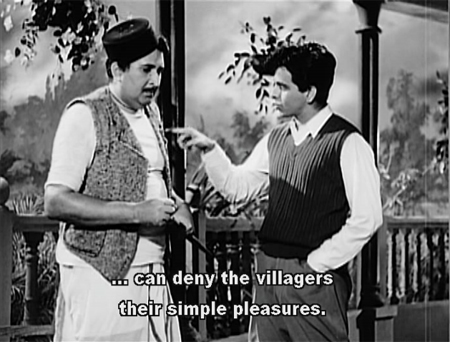
In the film, Dilip Kumar plays the titular Amar, who is introduced as a well-respected lawyer. He is shown as a charming man who thinks on his feet and mesmerises Madhubala’s Anju in an instant. The director makes you believe that he is the definition of a ‘good guy’, until that stormy night. The village belle Sonia, is introduced as an innocent Disney princess-like woman, who talks to her many pets and respects Amar, for his kind nature and how he appears to be helping the needy.
The night of the local fair, where Nimmi dances with abandon, she finds herself being chased by a local goon. She runs for her life, hides in the bushes, swims across the lake and lands up at Amar’s house so she can ask the ‘nice man’ for refuge but what happens instead is something that she, or the audience, never sees coming. This particular scene is harrowing, haunting and leaves you in utter shock as the film does not prepare you for Amar being a wretched man. The sharp cuts, the windows clanking against each other as the storm intensifies outside his mansion create a violent atmosphere and even though you don’t see any violence, the scene leaves you bruised.
The film then follows Amar as he struggles to come to terms with the sin that he has committed and while Amar and Sonia both don’t say it out loud to another soul, his dilemma as to whether he should confess his misdeeds keep you hooked. Amar is the classic ‘seems-like-a-good-guy’ who appears to be a respectable, stand-up citizen. Villagers call him a ‘devta’ but Amar is aware enough to know that he does not deserve that title. In a scene where he is contemplating about coming clean to his fiance Anju – the two distinct voices in his head are fighting for attention. As the camera zooms in on each of their faces, you hear Amar’s voice debating one argument over another. When he finally starts talking, he tries to shirk away from any responsibility and attempts to blame Sonia by calling her ‘barbaadi ki aahat’ but ends up not confessing.
Dilip Kumar is at his finest here. His joie de vivre lights up a scene when we meet him at the start but as the film progresses, we see him devolve into an outer shell of the man he once was. His stoic silence as he gazes into the horizon is a constant reminder that Amar has committed a crime that cannot be undone. Dilip Kumar was one of the most popular names in the movies in the early 1950s and though he entered the big league with later films like Devdas, Naya Daur, Madhumati, Gunga Jumna among others, Amar was a brave attempt from an actor who was already a well-known star at the time.
While the subject of the film was quite brave for its time, the film bows down to problematic social conventions for its resolution. In a film where the titular character is a rapist, we see a baffling love triangle come into play. Sonia comes from a world where she has been conditioned into believing that getting into a sexual relationship, even if it was not consensual, equals to getting married. She starts believing Amar is her husband and her saviour who has to accept her to validate her existence as she says “Mera byaah ho chuka hai”, while walking away from a wedding mandap. Even after he tries to kill her in a fit of rage, Sonia prays for his betterment. This portrayal is extremely discomforting to watch, especially because it reminds you that a male-dominated society forgives its rapists, but not the women who have been raped.
The film does not expect you to fall in love with Dilip Kumar’s Amar but it makes enough room for him to move on with his life. All it expects him to do is – accept Sonia as his wife and legitimise her unborn child, which is a bizarre consequence for a rapist. When he finally says ‘Main hi voh aadmi hun jisne Sonia ki zindagi barbaad ki hai’, he breathes a sigh of relief making it seem like accepting his wrongdoing somehow absolves him of his crime.
Despite three immortal numbers by Naushad and Shakeel Badayuni, there are too many decrepit songs that bore rather than please. But one is prepared to forgive the duo in exchange for Lata’s haunting “Jaanewaale se Mulaaqaat na Hone Paayi”, Asha’s teasing “Ek Baat Kahun Mere Piya Sun le Agar Tu” along with Rafi’s ethereal “Insaaf ka Mandir Hai Ye” — the sublime bhajan outlining the crux of the story. What one regrets is that while R. Kaushik won Filmfare laurels for sound recording.
Photos courtesy Google. Excerpts taken from Google.

