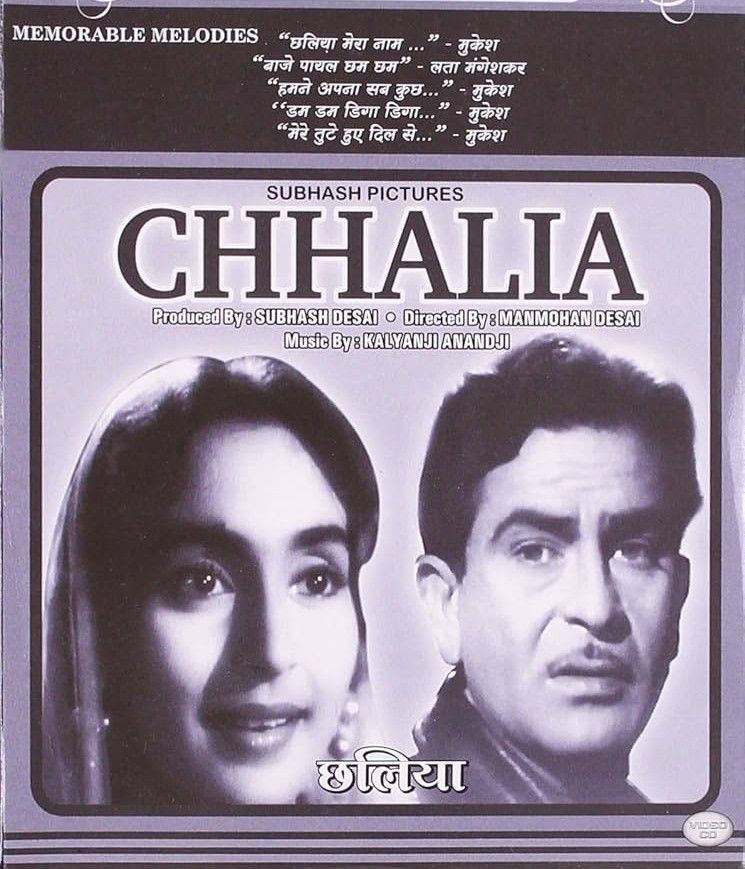
Chhalia is a 1960 Indian Hindi-language film directed by Manmohan Desai. The story is loosely based on the 1848 short story “White Nights” by Fyodor Dostoyevsky. Film has Partition story, which destroys a husband-wife relationship, and the rivalry between a Hindu and a Pathan crook. Film was shot in black-and-white.
Film opens with a speeding Lahore-Delhi train, and that it carries Hindu and Sikh women being repatriated to India five years after Partition. One of these is Shanti (Nutan) tells her sad story to fellow refugee women, via flashback. Luxurious Lahore of sprawling parks and rustic lanes, in which Shanti and her girlfriends dance and wave their billowing dupattas to the carefree and romantic song “Baaje payal zoon zoon hoke bekarar, jane mera jiya kare kiska intjar” (“The anklets are ringing quiet restlessly out of anxiety, I don’t know for whom my heart is waiting for”).
Returning to her parents’ mansion, Shanti discovers that her engagement is indeed being arranged, to the same handsome but haughty young motorist Kewal (Rehman). Shanti is married off to Kewal on the eve of Partition. While the two families move away to Delhi from Lahore. She inadvertently is left behind.
Shanti, stumbling alone through the lanes of riot-torn Lahore, saved from a mob by a powerful Pathan named Abdul Rehman Khan (Pran). Though Shanti is terrified of what this “rescuer” may do to her, Khan greets her as a sister and announces that his own sister, Sakeena, has been left behind in India. He will shelter Shanti while never even looking at her face, in the hope that his sister may receive similar treatment “from some Hindu or Sikh.”
She returns to India five years later with her son, she is first welcomed by the husband with open arms but disowned when the child identifies himself as Anwar, and his father as Abdul Rehman. Even her own father refuses to give her shelter.
Physically and emotionally shattered, Shanti to resolve to end her life, but the suicide note she composes accidentally falls into the hands of Chhalia (Raj Kapoor) and he intercepts and saves her. Chhalia welcomes Shanti, who has now lost her son to an orphan boys’ school, where the teacher is his own father, Kewal.
Abdul Rehman Khan, who has journeyed to India in search of his lost sister and also to settle some old score with Chhalia. Pran gives a strong performance as the Pathan heavy, including an impressive fight scene with Chhalia, but he is finally bested and then further devastated by the knowledge that the woman he planned to dishonor is his own adopted “sister.” When he is told that he must return to Pakistan, as his visitor’s permit is about to expire, his dazed and pathetic queries: Pakistan? Pakistan kahaan hai? Hindustan kahaan hai? (“Pakistan? Where is Pakistan? Where is Hindustan/India?”) offer one of the film’s most touching moments, at the lunacy of man-made boundaries.
The film effects it through a bang-up finale set during the Dussera festivities annual re-enactment of the story of Rama and Sita. The film invokes another Rama story, known to all Indians and already implicit in Chhalia. Chhaliya as India’s conscience, and naturally he does it through a song, heavy with mythological allusions, about the plight of abducted women (Gali gali Seeta, “In every lane, Sita”). The delivery of this song’s rousing lyrics, accompanied by dramatic quick cuts of the confluence of milling crowds, the principal characters, and the towering effigy, makes for a most satisfying climax.
The soundtrack of Chhalia is composed by the duo Kalyanji-Anandji with lyrics by Qamar Jalalabadi. The songs “Dum Dum Diga Diga” and “Chhalia Mera Naam” are still popular today.
Raj Kapoor and Nutan were nominated for 1961 Filmfare Awards in the category of Besr Actor and Best Actress respectively.
Photos courtesy Google. Excerpts taken from Google.

