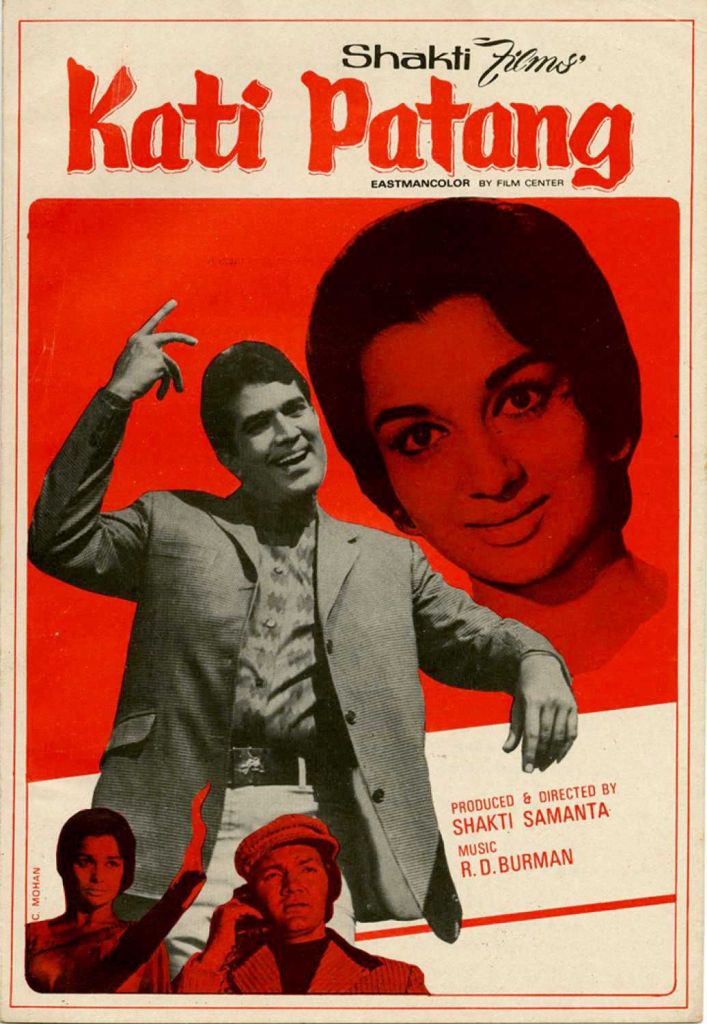
Kati Patang (The Severed Kite) is a 1971 Indian Hindi-language musical drama film produced and directed by Shakti Samanta. Kati Patang was adapted from a novel of the same name by Gulshan Nanda. The novel and the film’s story, also written by Nanda, was based on Cornell Woolrich’s 1948 novel ‘I Married a Dead Man’ which had earlier been adapted as the 1950 film ‘No Man of Her Own’.
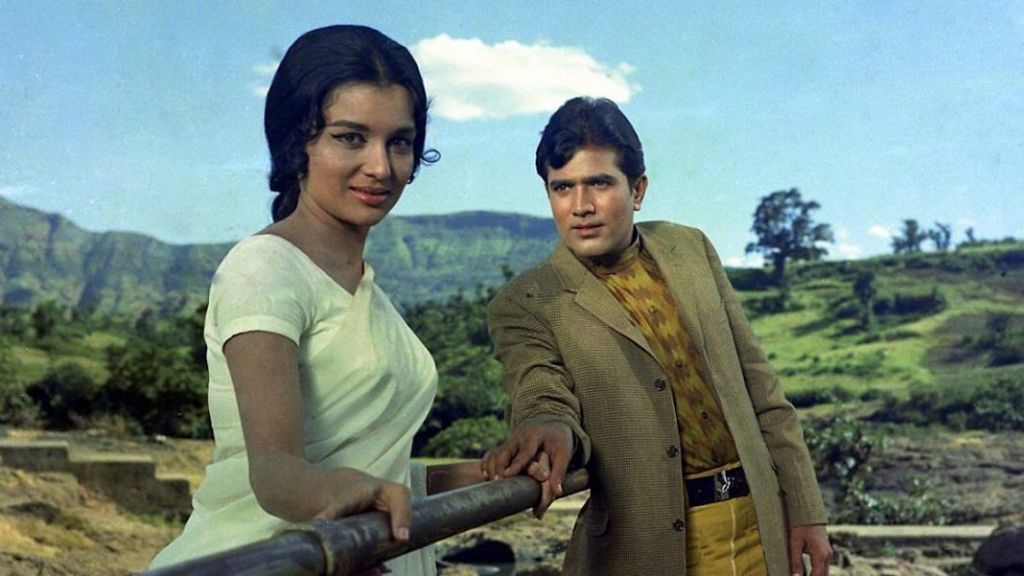
It is based on a runaway bride who promises her dying widowed friend that she will assume her identity and look after her infant. The film stars Asha Parekh as a woman pretending to be a widow, and her ensuing trials and tribulations opposite her charming neighbour, played by Rajesh Khanna.
Madhavi “Madhu” (Asha Parekh) is an orphan living with her maternal uncle, who arranges her marriage with someone she does not know. Blinded by her love for Kailash (Prem Chopra), she runs away on the day of the wedding only to discover Kailash with another woman, Shabnam (Bindu). Heartbroken and dejected, she returns to her uncle, who had committed suicide from the humiliation. Realising that she has no one in life, Madhavi decides to leave town and head somewhere else.
Madhu makes her way to the railway station but has no idea where to go. In the waiting room, she meets Poonam (Naaz) along with her baby boy Munna, an old school friend. She is shocked to find that Poonam is a widow. Poonam explains that her husband died in a recent accident, and she’s now on her way to Nainital to her in-laws’ place. She has never met them before. Poonam explains that her husband had married her against his parents’ wishes. Now that he is no more, her father-in-law had written asking for forgiveness and begging her to bring their grandson to live with them. She shows Madhu her husband’s photograph (Sujit Kumar) and her father-in-law’s letter. Learning that Madhu has no idea where to go, she insists that Madhu join her in Nainital. She will introduce Madhu as her sister, and they can be each other’s solace. With no one to call her own and nowhere to go, Madhu agrees. Unfortunately, there’s a train accident and Poonam knows that her end is near, so she makes Madhu promise that she will assume Poonam’s identity, bring Munna up and continue life in Poonam’s in-law’s house.
Madhu has no choice but to give in to a dying mother’s wish. In the downpour on the way, the cabbie attempts to rob her but Kamal (Rajesh Khanna), a forest ranger, rescues her and gives her shelter until the sky is clear the next day. She learns that Kamal is the very man with whom her marriage was arranged. Realizing that she was the runaway bride gives Madhu quite a shock.
Madhu leaves Kamal’s home in shame and reaches Poonam’s in-laws. Her father-in-law, Dinanath (Nazir Hussain) and mother-in-law accept her and let her stay there. Kamal keeps visiting the house as he was the son of Dinanath’s best friend. Soon, he realises that he is in love with “Poonam”.
Madhu’s ill fate brings Kailash to Dinanath’s house. He is after their money and is very close to revealing Madhu’s identity. To be successful, he impresses all the members of the house, but Poonam takes a resentment to him. Dinanath soon realises Poonam’s true identity and asks for the truth. When he realises what the matter really is, he accepts Madhavi and makes her the guardian of the Dinanath property which will be inherited by Munna. That night, Dinanath is poisoned by Kailash. Mrs. Dinanath accuses Poonam for what has happened and she is imprisoned.
Now Shabnam enters the life of the Dinanaths claiming that she is the real Poonam. Mrs. Dinanath, in rage, sends her away and is ready for no story. Kamal takes a dislike towards Madhu, learning the truth. However, he eventually realises the truth and gets Shabnam and Kailash arrested for their evil intentions and Madhavi is freed. When Kamal searches for Madhu, he realises that she has left without any notice, but a letter for Kamal, stating that she is going out of his life and so, he should not try to find her. Kamal starts searching for her.
Kati Patang is a breezy entertainer with all of Shakti Samanta’s trademark touches – hill stations, drama, great music.
The music was composed by R. D. Burman and the lyrics were penned by Anand Bakshi. “Ye Shaam Mastani”, “Pyaar Deewana Hota Hai”, “Ye jo Mohabbat Hai” and “Mera Naam Hai Shabnam” songs were particularly famous.
“Aj Na Chodenge Bass Humjoli Khelenge Hum Holi” song symbolizing Parekh’s exclusion from joyous celebrations. The songs’s climax, takes a daring turn as Khanna’s character dares to defy societal norms by applying color to Parekh’s hair, a symbolic gesture suggesting a proposal of marriage. Film showcased her versatility as an actress. The holi song, in particular remains a standout moment, highlighting Parekh’s character’s resillience and the transformative power of love. Scene protrays the widow’s inner turmoil and colorless existence.
The performances of Parekh and Khanna were praised by the audience and critics alike. He infuses his Kamal with a soft-spoken graciousness, and the romance with gentle intensity. The only reason the romance works is because of Rajesh Khanna, he gets no help at all from Parekh. Rajesh Khanna uses his eyes and his voice to great effect, cementing his place as possibly the best purely romantic hero of all time.
Prem Chopra and Bindu are so good at being bad. Kailash is manipulating Shabnam, the conversation they have about an unexpected pregnancy is unexpectedly sensible. Prem Chopra could play the sleaze so well and he does it in style. Bindu was not just the villain’s moll, she actually got to emote as well, playing an important part in the latter half of the movie.
According to The Hindu, “On screen, Rajesh Khanna never appeared to be lip-syncing. So, convincing were his expressions. His presence, backed by the music, remained the main source of strength for a movie’s success”.
The film was a box office success. Parekh’s performance as Madhavi was critically acclaimed and earned her the Filmfare Award for Best Actress.
Filmfare Award, film nominated for Best Director, Best Actor, Best Lyricist for song ‘Na Koi Umang Hai’ , Best Male Playback Singer for song ‘Yeh Jo Mohabbat Hai’ and Best Story.
Photos courtesy Google. Excerpts taken from Google.

