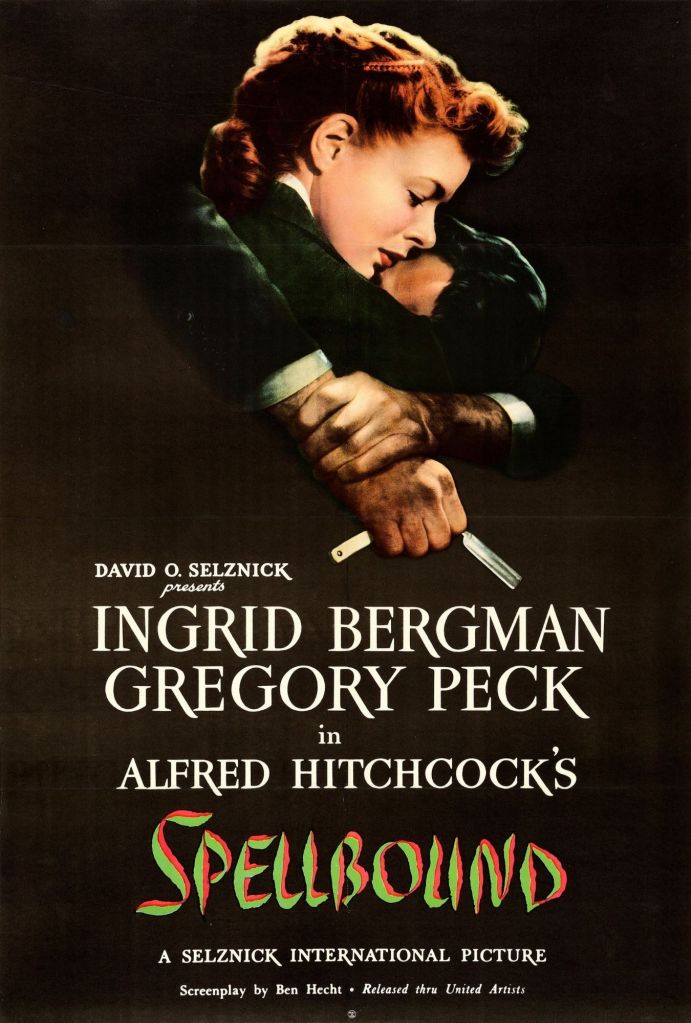
Spellbound is a 1945 American psychological thriller directed by Alfred Hitchcock. The film stars Ingrid Bergman, Gregory Peck, Michael Chekhov, and Leo G. Carroll in prominent roles.
The story revolves around a psychoanalyst who falls in love with the new head of the Vermont mental hospital where she works. Although the film is based on the 1927 novel The House of Dr. Edwardes by Hilary St. George Saunders and John Palmer, the novel and the film differ greatly in their narratives. The plot gradually centers on an amnesiac man accused of murder, whose identity the psychoanalyst keeps secret while attempting, through psychoanalysis, to recover his lost memories and prove his innocence.
Dr. Constance Petersen (Ingrid Bergman) is an intelligent and highly competent psychiatrist who believes she has a firm understanding of human nature, yet remains emotionally detached. She works at Green Manors, a psychoanalytic institution in Vermont that treats patients with emotional disturbances. Dedicated entirely to her profession, Constance shows little interest in romance or personal life. Her colleague, Dr. Fleurot, harbors romantic feelings for her, but after being rejected, he regards her as cold and unfeeling.
Meanwhile, the institution’s director, Dr. Murchison, is forced into retirement due to severe mental strain caused by overwork. His successor is the enigmatic and unexpectedly young Dr. Anthony Edwardes (Gregory Peck). His arrival creates curiosity throughout the institution. Constance, usually in complete control of her emotions, finds herself unexpectedly drawn to Edwardes, and he too begins to develop feelings for her.

Soon, the inevitable happens, Dr. Anthony Edwardes arrives at Green Manors, and an immediate bond forms between him and Constance at their very first meeting. Her male colleagues, especially Dr. Fleurot, appear irritated and resentful of this change.

One night at dinner, Constance absentmindedly traces the shape of a swimming pool on the tablecloth with her fork. At the sight of this, Edwardes becomes visibly distressed and reacts rudely, leaving Constance shaken. The next day, Mr. Garmes complains about her, but Constance calmly brings the situation under control. Soon after, Edwardes receives a phone call from an unknown woman named Mrs. Cramer. He brusquely tells her that he does not know her and ends the call, deepening Constance’s suspicions.
These incidents are temporarily set aside when Edwardes invites Constance to spend the entire day with him. They go on a long walk and, over the course of the afternoon, fall deeply in love. When they return, her colleagues mock her, but Constance insists that she is devoted only to her work. Unable to sleep that night, she goes to the library and takes out Edwardes’s book, Labyrinth of the Guilt Complex. Using the book as an excuse, she visits his room, and the two confess their love for each other. However, as he embraces her, Edwardes suddenly becomes intensely uneasy and fearful upon seeing the thin black parallel lines on her white dressing gown.
This strange reaction heightens Constance’s doubts. She compares Edwardes’s signature with the one in his book and discovers they do not match. A shocking truth emerges—he is not the real Dr. Edwardes, but an impostor. He then tells her that the real Dr. Edwardes has been murdered and that he has taken his place. Suffering from amnesia, he does not know who he truly is, though his medical knowledge suggests that he himself is a doctor. Constance becomes convinced that he is not a murderer, but an innocent man tormented by guilt. Yet one night he suddenly disappears, giving the story a dramatic turn.
The next day, Dr. Edwardes’s assistant arrives and reveals that the man who spoke on the phone was an impostor and that the real Dr. Edwardes has mysteriously vanished. The situation now becomes even more serious and dangerous for Constance.
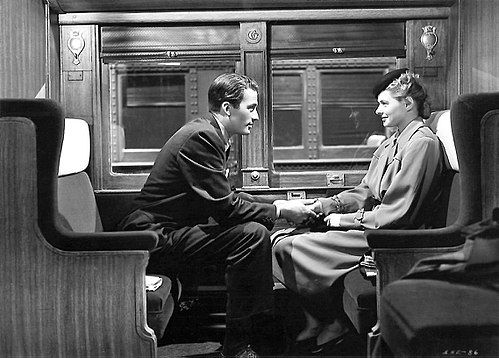
After this, the two travel to Rochester, New York, where they stay with Dr. Alexander Brulov, Constance’s former mentor and close friend.
There, the two psychoanalysts analyze a strange dream described by “Brown.” In the dream, he is playing cards in a mysterious club. A scantily clad woman—who resembles Constance, moves around the room kissing everyone. An elderly man playing cards with him is accused of cheating, and the masked proprietor of the club threatens him.
The dream then shifts. The elderly man is seen standing on the edge of a sloping roof and falls to his death. Later, the club owner is shown standing behind a chimney and dropping a wheel from his hand. The dream ends with “Brown” being chased down a mountain by a pair of giant wings.
As they analyze the dream, they realize that “Brown’s” fear of dark parallel lines on a white background actually symbolizes ski tracks on snow. The elderly man in the dream represents the real Dr. Edwardes, who died in a skiing accident. The wings, they conclude, symbolize the Gabriel Valley ski lodge.
Based on these conclusions, Constance and “Brown” travel to Gabriel Valley to recreate the circumstances surrounding Edwardes’s death. However, “Brown” fears that if he truly is Edwardes’s murderer, returning to the same setting might cause him to kill again unintentionally.
While skiing down the slopes, memories from “Brown’s” past begin to surface. He realizes that he is burdened by a deep sense of guilt, rooted in a childhood accident in which he accidentally slid down a concrete banister and knocked his brother onto a spiked fence, killing him.
After this, “Brown” recognizes the cliff from which Dr. Edwardes had fallen. At that very moment, he suddenly remembers his real name, he is John Ballantyne.
Petersen and Ballantyne later meet with the police. Acting on Ballantyne’s directions, the police discover Edwardes’s body. However, the investigation reveals that the corpse has a bullet wound in its back. As a result, Ballantyne is arrested, put on trial, and convicted of murder.
Completely heartbroken, Constance Petersen returns to Green Manors. There, Dr. Murchison—who has once again become the director, lets slip that he had known Edwardes slightly and disliked him. This contradicts his earlier claim that he had never met Edwardes, arousing Constance’s suspicion.
Prompted by this inconsistency, Constance re-examines her notes on Ballantyne’s dream. She realizes that the masked proprietor in the dream represents Murchison, and the wheel symbolizes a revolver. This leads her to conclude that Murchison murdered Edwardes and discarded the gun on the ski slope.
To confirm her suspicion, Constance confronts Murchison. During their conversation, he indirectly admits that the figure in the dream likely represents himself. When Constance openly accuses him, Murchison replies that she got every detail right—except one: he still has the gun. He then draws the revolver and points it at her.

Calmly, Constance explains to him that he could plead insanity for Edwardes’s murder and receive a lighter sentence, but if he were to cold-bloodedly shoot her, he would certainly face the death penalty. While the gun is still trained on her, she steps out of the office to call the police. At that moment, Murchison turns the gun on himself and commits suicide.

Later, Constance Petersen and John Ballantyne marry. As they depart for their honeymoon from Grand Central Terminal, Dr. Brulov bids them farewell and offers his good wishes, bringing the complex mystery to a satisfying close.
Spellbound was directed by Alfred Hitchcock, and his distinctive, tension-building approach—blending psychological thriller elements with romantic suspense, is clearly evident throughout the film.
Ingrid Bergman, as Dr. Constance Petersen, delivers a compelling performance marked by intelligence, restraint, and emotional depth. Gregory Peck elevates the role of an amnesiac man trapped in suspicion with a calm, sensitive portrayal. The chemistry between the two leads adds significant emotional richness to the film.
The film’s music was composed by Miklós Rózsa, who made innovative and effective use of the theremin, performed by Dr. Samuel Hoffman.
According to Newsweek, Spellbound is an excellent and suspenseful melodrama. The New York Times critic Bosley Crowther noted that although the story may seem familiar, its presentation, flowing dialogue, striking visual language, and unexpected shocks lift it to a higher level. Variety praised Ingrid Bergman’s performance in particular, calling Gregory Peck’s role one of the finest of his career. Harrison’s Reports highlighted the uniformly strong performances and the fine balance of mystery, fear, human emotion, and romance. Writing in The New Yorker, John McCarten observed that when the film sets aside abstruse theorizing and becomes a straightforward thriller, it moves forward with Hitchcock’s trademark effectiveness—making it well worth seeing.
Spellbound was filmed during the summer of 1944 in Vermont, Utah, and Los Angeles. It premiered in New York City on October 31, 1945 (Halloween), followed by a nationwide U.S. release on December 28, 1945.
The film received excellent critical acclaim and was also a major commercial success, earning approximately $6.4 million in the United States and breaking box-office records in London as well.
Spellbound received recognition from several prestigious award bodies. At the Academy Awards (Oscars), the film earned nominations for Best Picture (producer David O. Selznick), Best Director (Alfred Hitchcock), Best Supporting Actor (Michael Chekhov), Best Cinematography (George Barnes), and Best Visual Effects (Jack Cosgrove). Among these, Miklós Rózsa won the Oscar for Best Original Score for his innovative and memorable music. In addition, Ingrid Bergman received the Best Actress Award from the New York Film Critics Circle (NYFCC). Alfred Hitchcock was also nominated for the Grand International Award at the Venice Film Festival.
Spellbound stands out as an important Hitchcock film that explores psychology while remaining within the limits imposed by censorship of its time.
The film presents a powerful fusion of psychology, romance, and mystery. Alongside love, themes of identity, suspicion, and intense psychoanalysis grow steadily darker. With its sustained suspense, striking visual design, and passionate love story, Spellbound remains a significant, memorable, and classic work in Alfred Hitchcock’s career.
📸 Photo Courtesy: Google ✍️ Excerpts: Google

