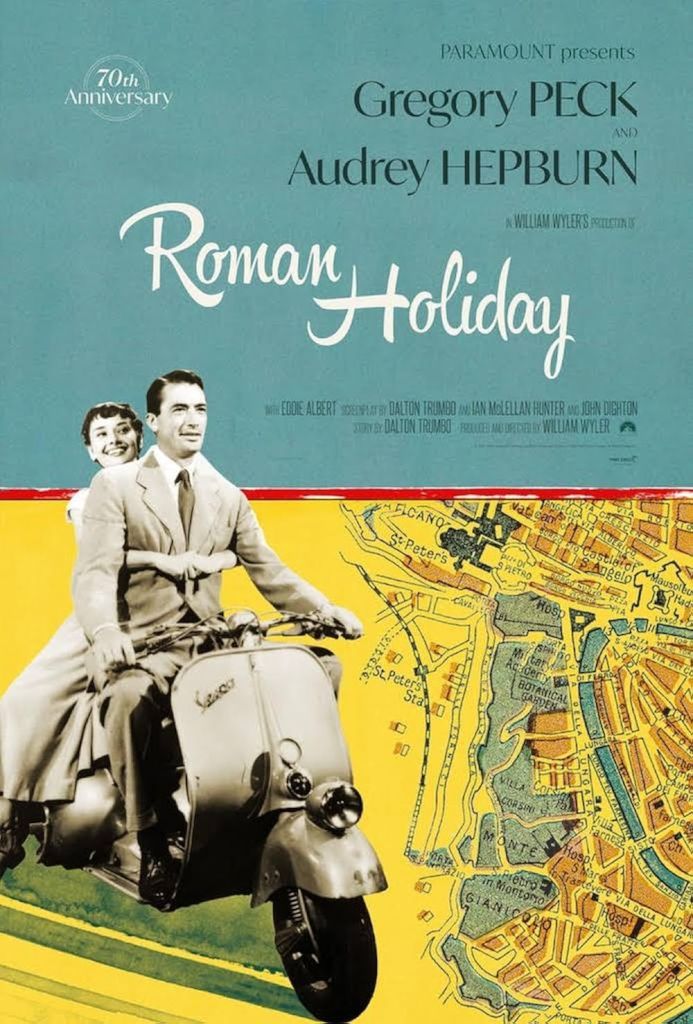
Roman Holiday is an American romantic comedy directed and produced by William Wyler, with a screenplay by Dalton Trumbo and John Dighton.
At the beginning of the film, Crown Princess Ann arrives in Rome as part of her European goodwill tour. Exhausted by endless official engagements, formal speeches, and strict protocol, she becomes emotionally overwhelmed upon hearing the schedule for the following day. To calm her, the royal doctor administers a sedative and advises her to “do exactly what you wish for a while.”
As the medication begins to take effect, Ann secretly slips out of the embassy to experience ordinary life in Rome. This marks the start of her brief but meaningful search for freedom.
Meanwhile, Joe Bradley, an American reporter based in Rome, is a carefree young man who spends his evenings playing poker with friends. One night, on his way home, he finds Ann asleep on a park bench, dazed from the sedative. Mistaking her for a drunken young woman, he kindly takes her to his small apartment so she can rest safely.
She chatters happily and recites poetry, while Joe, confused but gentlemanly, gives her pajamas and lets her sleep on the couch. He has no idea that she is a princess. This light and humorous encounter becomes the beginning of their unexpected relationship.
Back at the palace, officials are thrown into panic when Princess Ann is discovered missing. A discreet but urgent search begins, with strict orders to keep the matter confidential.
The next morning, Joe oversleeps and realizes he has missed the princess’s scheduled press conference. At the office, he lies to his editor, Hennessy, claiming he has secured an interview—only to learn that the conference was canceled due to the princess’s “sudden illness,” exposing his lie and putting his job at risk.
Moments later, Joe is stunned when he sees a newspaper photograph and recognizes the young woman sleeping in his apartment as Princess Ann. Instantly, he devises a plan for a major scoop. He promises Hennessy an exclusive, personal interview with the princess. The editor offers $5,000 for the story, and Joe eagerly accepts the challenge, dreaming of returning to New York with success.
When Ann wakes up in Joe’s apartment, she initially believes she is still in the palace. Gradually, she realizes she is in a modest flat. After her confusion fades, she introduces herself as “Anya,” and the two share a polite yet playful conversation. Ann soon leaves, claiming she has important business, and even borrows some money from Joe. Now certain of her true identity, Joe secretly contacts his photographer friend Irving to help capture the exclusive story.
Meanwhile, Ann experiences the joy of freedom for the first time—wandering through Rome, cutting her hair as a symbolic act of independence, and accepting an invitation to a dance on the Tiber River. Her lively and carefree personality blossoms, while Joe finds himself increasingly torn between his growing feelings for her and his determination to secure the scoop.
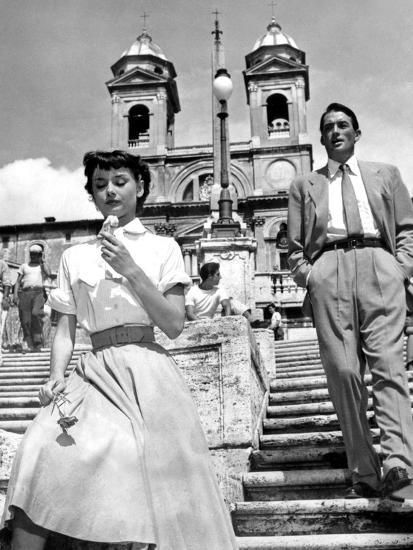
Bradley deliberately “accidentally” runs into Ann, and the two begin chatting at a café. Without revealing that he is a journalist, he presents himself as a successful businessman. Soon his photographer friend, Irving Radovich, arrives and begins to grow suspicious. However, Bradley signals him to stay quiet and convinces him that secretly taken photographs of the princess could bring them a substantial financial reward.
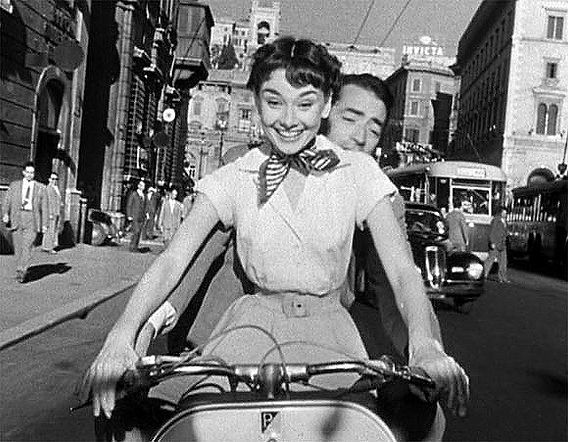
Introducing herself as “Anya,” Ann is taken on a tour of Rome by Joe—wandering through open markets, buying sandals, relaxing near the Spanish Steps, enjoying ice cream at a sidewalk café, and riding through the city on a Vespa scooter. While driving the scooter, they create quite a commotion in Roman traffic and are arrested by the police; however, Joe manages to secure their release by showing false press credentials. Meanwhile, Irving secretly snaps photographs with a camera hidden inside a cigarette lighter.
Joe then takes Ann to the “Mouth of Truth” (Bocca della Verità) and tells her the legend that the stone mouth bites off the hand of anyone who tells a lie. Hesitantly, Ann places her hand inside, and Joe mischievously pretends that his own hand has been bitten off, frightening her. This playful moment deepens their bond—Ann revels in the joy of living freely, while Joe feels an intensifying conflict between chasing a journalistic scoop and acknowledging his growing feelings for her.
That evening, they attend a dance on the boats near Castel Sant’Angelo. At the height of their happiness, plainclothes officials arrive to take Ann back, but Joe helps her escape and brings her to his apartment. As their wet clothes dry, a radio broadcast announces that people in Princess Ann’s country are worried about her “illness.” In the quiet that follows, their emotions grow deeper. Joe tries to tell her something important, but Ann stops him—duty is calling her back to her royal responsibilities. Though she expresses her longing for a simple life, she knows it is not meant for her.
She asks Joe to drop her near the embassy. As they say goodbye, she asks him to remain in the car and not look back. “It wasn’t entirely empty,” Joe says softly about their twenty-four hours together, and Ann agrees. With tearful eyes, she turns away, leaving behind a tender yet everlasting memory of their unspoken love.
Joe tells his editor, Hennessy, that he did not get the big story, though Hennessy does not believe him. He also makes it clear to Irving that he cannot physically stop him from selling the photographs. Back at the palace, Ann firmly declares that she returned out of duty to her family and country. Despite having the opportunity to sell an exclusive story, Joe refuses. In conversation with Hennessy and Irving, he states firmly, “There’s no story.” Although Irving suggests catchy captions for the photos, Joe realizes this is not merely news—it is a matter of trust. Ultimately, he chooses Ann’s dignity over money. As he prepares to attend the press conference, his inner conflict between love and duty is evident. Accepting reality with the feeling that “It ain’t much, but it’s home,” he understands that though their dreamlike romance has ended, the memory of that day will be enough for a lifetime.
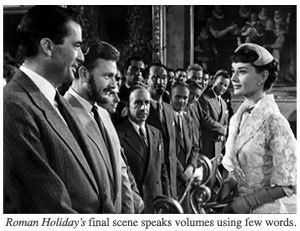
At the royal press conference, they stand before each other in their rightful roles—she as a princess, he as a journalist. The misunderstandings and false identities are over; now their feelings are expressed only through restrained, tender glances. Ann is announced as “Her Royal Highness” and answers the reporters’ questions with calm confidence. She remarks that relations between nations are built on trust. When asked which city she liked most, she first gives a diplomatic reply, but then firmly declares, “Rome… By all means, Rome.” In those words, the memories of the city—and of her day with Joe—clearly resurface. During the photo session, Irving presents her with the photographs from their secret day together. Her meeting with Joe, however, remains strictly formal—“So happy, Mr. Bradley.” Though their eyes reveal the pain of unfulfilled love, both choose duty over desire, and their dreamlike romance quietly fades away.
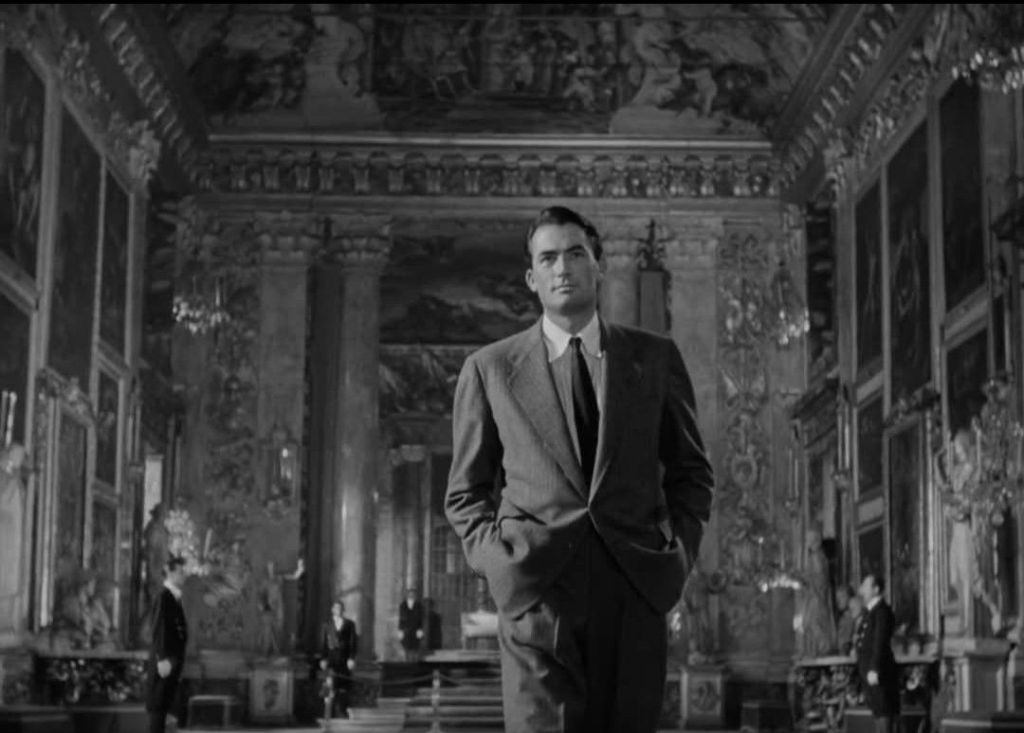
After everyone leaves, Joe lingers in the hall for a few quiet moments before slowly and silently walking out, carrying with him the weight of unspoken love.
In the context of Roman Holiday, the title carries a gentle and poignant meaning. It represents Princess Ann’s single day of freedom in Rome—a beautiful but fleeting escape from royal duty, symbolizing a brief yet unforgettable moment of joy, love, and liberation that remains cherished for a lifetime.
Director William Wyler once described Audrey Hepburn by saying that she did not possess the showy glamour traditionally associated with movie stars—no flashy costumes, no voluptuous figure, no dazzling display. She seemed different, almost as if she had come from another world. And it was precisely this uniqueness, he believed, that would make her a star who ruled audiences’ hearts. That distinct quality indeed became the foundation of Audrey Hepburn’s timeless appeal.
Known primarily for serious dramas, Wyler and Gregory Peck proved equally successful in this romantic comedy. Princess Ann’s journey through Rome becomes a celebration of freedom, simplicity, and the pure joy of living. Hepburn’s portrayal of Ann marked a turning point in her career. She begins as a disciplined yet exhausted young royal burdened by duty, but over the course of one day of freedom in Rome, her childlike curiosity, mischief, tenderness, and warmth gradually emerge. Her performance is natural, delicate, and deeply sincere; without exaggerated gestures, she conveys profound emotion through her expressive eyes, gentle smiles, and quiet dialogue. In the end, her restrained acceptance of duty over love creates a powerful emotional bond with the audience.
Gregory Peck’s Joe Bradley initially appears opportunistic, eager for a big story, but gradually reveals himself to be sensitive, principled, and honorable. Peck’s performance is subtle, composed, and convincing, effortlessly balancing humor, romance, and moral conflict. His decision not to exploit Ann after learning her true identity highlights the character’s ethical maturity. The chemistry between Hepburn and Peck feels effortless and genuine; their relationship unfolds more through silent glances and understated emotional shifts than through grand declarations. That is why Roman Holiday remains such a sweet, poignant, and timeless love story.
The film premiered on 20 August 1953 as the opening feature of the 14th Venice International Film Festival and received widespread critical acclaim upon release. Reviewers praised its charm, wit, and the seamless integration of Rome’s real locations into the narrative. The film went on to earn multiple Academy Award nominations, including Best Picture and Best Director for Wyler. Audrey Hepburn won the Oscar for Best Actress, Dalton Trumbo received the award for Best Story, and Edith Head won for Best Costume Design (Black-and-White). Hepburn also won a Golden Globe and a BAFTA Award. Over the years, the film has continued to receive recognition, including preservation in the U.S. National Film Registry for its cultural and historical significance.
Even today, Roman Holiday is celebrated as one of the most romantic films in cinema history, cherished for its elegance, emotional depth, and unforgettable bittersweet ending.
📸 Photo Courtesy: Google ✍️ Excerpts: Google
 Writer Sunita