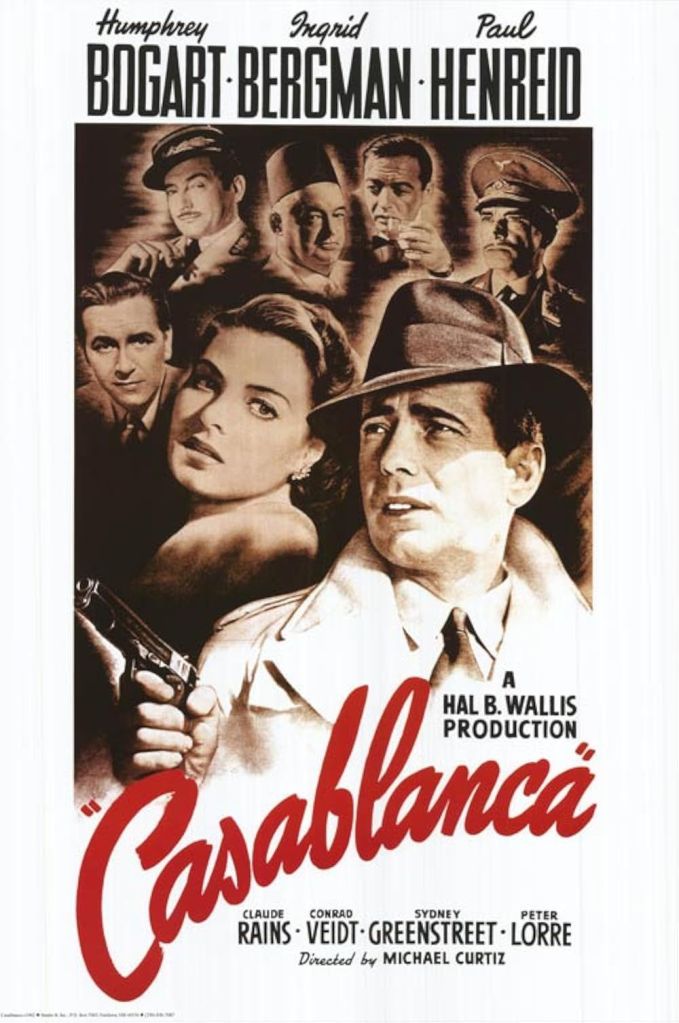
Casablanca is an American romantic drama film released in 1942, directed by Michael Curtiz. He was one of Hollywood’s most skilled directors, and in this film, he beautifully blends romance, drama, and war. His powerful direction makes the story deeply memorable and emotionally engaging for audiences.
The title “Casablanca” is taken from the city of Casablanca. In the context of the film, it is not just the name of a place but also carries symbolic meaning. During World War II, the city is portrayed as a refuge where people from different countries struggle to secure a safe future. Thus, the name “Casablanca” becomes a powerful symbol of hope, escape, love, and conflict.
Set against the backdrop of World War II, the story unfolds in the city of Casablanca. Many refugees fleeing Europe arrive there, searching for a way to reach America and start a new life.
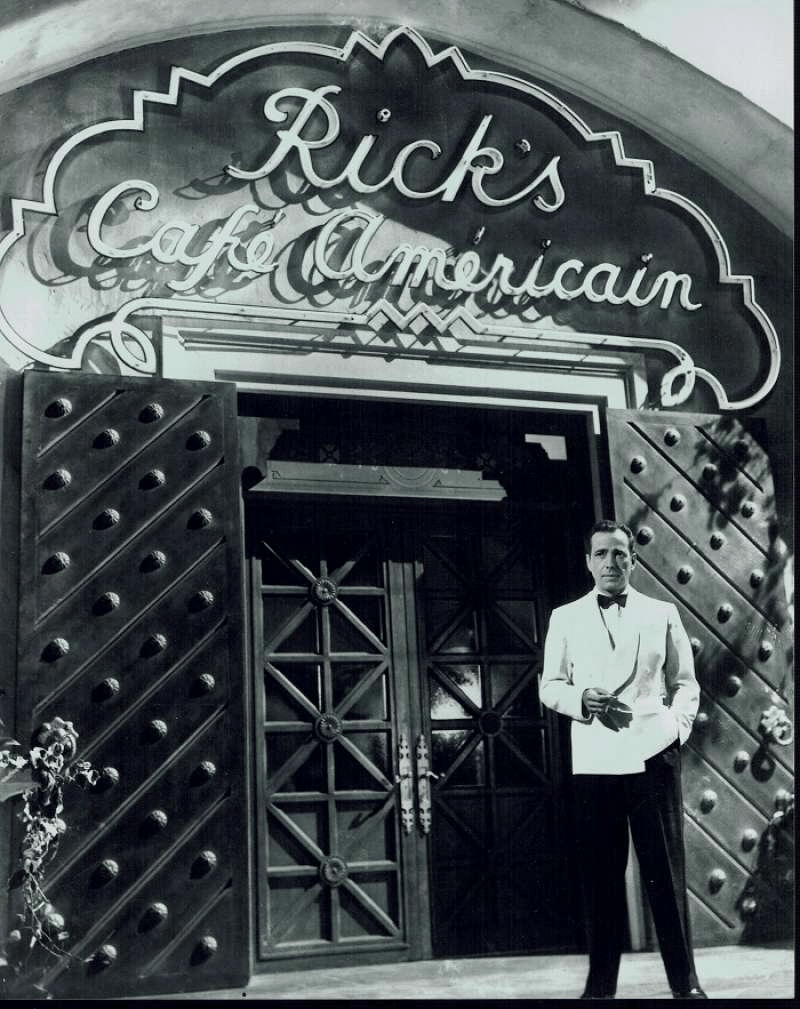
In this city, an American expatriate named Rick Blaine runs a café called “Rick’s Café Américain.” Though he appears tough and detached on the outside, he carries the pain of a past love deep within his heart.
One day, his former lover Ilsa Lund re-enters his life, accompanied by her husband, Victor Laszlo, a leader of the resistance movement. Victor is trying to escape the clutches of the Nazis and reach America.
Rick and Ilsa’s old love is rekindled, but the situation is complicated. Rick possesses two “letters of transit,” which can help Victor and Ilsa leave safely.
The story reaches its climax when Rick is faced with a major decision—whether to choose his personal love or sacrifice it for a greater cause.
In the end, Rick overcomes his personal feelings and sends Ilsa away with Victor, realizing that Victor’s mission is more important than their love. This act of sacrifice becomes the most emotional and noble moment of the story.
Director Michael Curtiz focused more on camera rhythm, movement, and lighting rather than just dialogues, giving the film a distinctive visual language.
One of the film’s greatest strengths is the powerful performances of its cast.
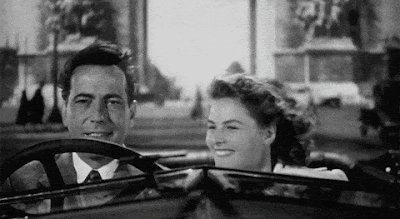
Humphrey Bogart’s portrayal of Rick Blaine is the soul of the film. Rick initially appears cold, cynical, and detached, but with Ilsa’s arrival, the love and pain buried deep within him are gradually and subtly revealed. Saying “We’ll always have Paris,” he cherishes the past while choosing to sacrifice his love, and in the end, with “I think this is the beginning of a beautiful friendship,” he steps into a new journey. Ultimately, Rick rises above his personal sorrow and sends Ilsa away with her husband; by choosing duty over love, he becomes a truly timeless hero.
No matter how much the world changes, Rick Blaine still stands in that dim café corner—cool, solitary, yet alive within. He let go of love, but never forgot it. The night in Paris may have ended, but the piano never stopped playing. The unspoken love in his eyes seems to pause time, and the selfless awareness behind his decision defines him as a hero. Rick is a man who loses love yet chooses duty—one who speaks through silence and lives on in memory.
Ingrid Bergman’s Ilsa Lund feels completely natural as a woman torn between two relationships. The emotions in her eyes—love, longing, and inner conflict—are expressed beautifully.
Paul Henreid, as Victor Laszlo, effectively portrays a character marked by courage, idealism, and strong leadership.
Claude Rains’s Captain Louis Renault may appear selfish and politically neutral on the surface, but his personality reveals wit, intelligence, and ultimately, a sense of transformation.
Conrad Veidt delivers a powerful performance as Major Strasser, a strict and dangerous Nazi officer.
The film’s music is composed by Max Steiner. The song “As Time Goes By” is considered the soul of the film, reviving the memories of Rick and Ilsa’s love and deepening the emotional impact of the story.
The cinematography makes excellent use of black-and-white visuals. Through light and shadow, it enhances tension, mystery, and emotion, while close-up shots allow the audience to connect deeply with the characters’ feelings.
The screenplay is tightly structured and highly effective, maintaining a fine balance between romance, politics, and war. The relationships between characters feel natural yet complex.
The dialogues of the film are timeless. Lines like “Of all the gin joints in all the towns in all the world, she walks into mine,” reveal Rick’s hidden love, pain, and unrest. “Here’s looking at you, kid,” becomes an enduring expression of selfless love conveyed through action. Along with “We’ll always have Paris” and “Louis, I think this is the beginning of a beautiful friendship,” these simple yet emotionally rich lines highlight the depth of love, mystery, and sacrifice.
Critics praised the film. Time magazine described it simply as “delicious.” Director Michael Curtiz focused more on the rhythm of the camera and lighting design than on the confusion of dialogue, which contributed to the film’s success.
The film won numerous awards and nominations. At the 1944 Academy Awards, it won Best Picture and Best Director (Michael Curtiz), while earning nominations for Best Actor (Humphrey Bogart) and Best Supporting Actor (Claude Rains). It won for Best Screenplay and received nominations for Cinematography, Editing, and Music. At the National Board of Review Awards, it ranked sixth among the Top Ten Films, and Curtiz won Best Director. The film was also selected for preservation in the U.S. National Film Registry. Other nominations included the New York Film Critics Circle Awards and Saturn Awards (for the DVD release).
At the Academy Awards, when Humphrey Bogart arrived with his wife, the audience reacted with tremendous excitement; the police had to manage the crowd. Shouts of “Good luck!” and “Here’s looking at you, kid!” echoed around—showing the immense popularity of both the actor and the film.
Casablanca is not just a love story, but a perfect blend of outstanding performances, touching music, striking cinematography, a strong screenplay, and unforgettable dialogue. That is why it continues to be regarded as a timeless classic even today..
📸 Photo courtesy: Google ✍️ Excerpts: Google

