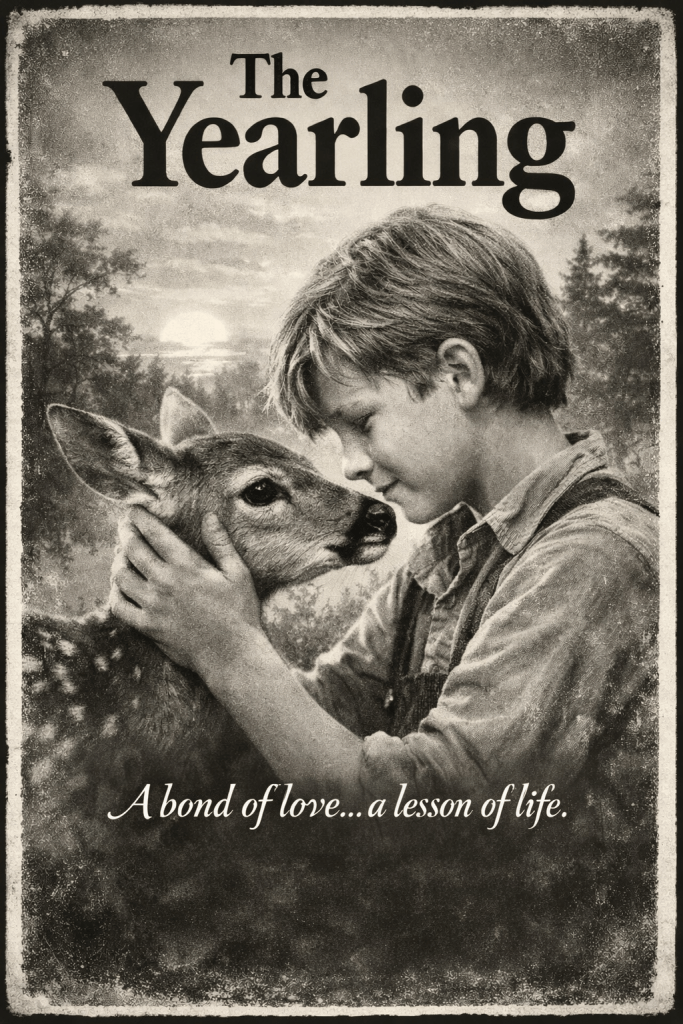
The Yearling is a 1946 Technicolor film that tells a deeply moving coming-of-age story, directed by Clarence Brown. He is regarded as a sensitive director of Hollywood’s classic era, and in this film, he beautifully brings together nature, childhood, and emotions.
The narrative is set in the 1870s in the sparsely populated, rugged backwoods of Florida, where life is shaped by isolation, hard work, and the demands of nature.
“Yearling” means a one-year-old deer. In this film, a deep bond between a young boy and a fawn is portrayed, which makes the title The Yearling meaningful and emotional.

The story revolves around a young boy named Jody and a small fawn that enters his life. Jody lives a simple life with his parents in a forest area. His father, Penny Baxter, is calm, wise, and loves nature, while his mother is somewhat strict in nature.
One day, to save his own life, Jody’s father kills a doe. The doe’s little fawn is left alone. Seeing this, Jody develops affection for the fawn and brings it home. He names the fawn “Flag” and takes great care of it. Gradually, a deep friendship develops between them. The fawn becomes Jody’s closest companion.
However, as the fawn grows, it starts eating the crops in the field, which are essential for the family’s survival. This creates a difficult situation for the parents. Jody’s mother firmly insists that the fawn must be sent away.
Eventually, the situation becomes so serious that Jody is forced to kill the fawn himself. This moment is extremely heartbreaking, as it reflects the conflict between childhood innocence and harsh reality.
After this incident, Jody matures emotionally and learns an important lesson in life— that nature, responsibility, and difficult decisions are unavoidable.
Clarence Brown beautifully presents the emotions, nature, and character journey in the film.
The cinematographer uses camera, lighting, and composition to make every scene visually appealing, making the forest feel alive. The forest is not just a background but feels like a living character. Tall trees, dense bushes, open fields, and sunlit leaves are shown so naturally that the audience feels immersed in the environment.
The calm morning forest with soft sunlight, birds chirping, and gently moving trees creates a peaceful mood, while the evening scenes with dim light feel more serious and emotional, matching the tone of the story.
Thus, the forest becomes a powerful element that reflects the characters’ emotions and their connection with nature.
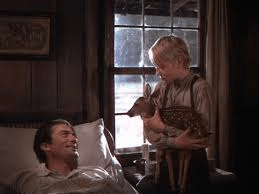
Gregory Peck portrays Penny with simplicity, humanity, and wisdom. He is not a harsh farmer but a compassionate and understanding father. Instead of punishing, he teaches through guidance, expressing life lessons through lines like “Life goes back on you.”
He gives his son the freedom to choose his path but also teaches responsibility. His silent pain while making the decision about Flag is expressed with great subtlety. He is not strict by nature, but forced to be so by circumstances.
For this role, Gregory Peck received his second Academy Award nomination.
Jane Wyman plays Ora with remarkable realism. She is a hardworking, exhausted yet deeply caring mother. Her anger reflects the hardships of life, not her lack of love.
Her longing for a well, her despair when the crops are destroyed, and her breakdown when Jody leaves reveal her emotional depth. In the final scene, when she embraces Jody, her hidden love is finally expressed.
Claude Jarman Jr. delivers a natural and powerful performance as Jody. From an innocent, dreamy boy to a young person forced to grow up through pain, his journey feels authentic.
His love for Flag, his attempts to save it, his anger in saying “I hate you!”, and finally accepting responsibility with “I’m willing” — all these moments are deeply impactful.
The film ultimately reminds us that adulthood does not arrive without the loss of innocence. Love often demands painful choices, and though life is beautiful, it is never easy. This is not merely the story of a boy and his deer—it is a timeless, tender reflection on growth, sacrifice, and the acceptance of reality.
The Yearling is far more than a simple tale of friendship between a boy and a deer; it is a deeply moving journey from childhood to maturity. It portrays love, sacrifice, and harsh reality with honesty and sensitivity. The bond between Jody and the fawn feels so genuine that the audience becomes completely immersed in their world. The ending, though painful, captures the true soul of the film and leaves a lasting emotional impact.
Love sometimes demands sacrifice, and life does not always go the way we want—one cannot reach adulthood without losing childhood.
Critics responded with great admiration. The Hollywood Reporter critic Jac. D. Grant described the film as “an emotional experience rarely encountered.” TV Guide called it “tremendously successful” and “a distinguished picture suitable for the entire family.” Variety praised it as a “heart-touching story” with powerful emotional undercurrents, noting that although a few passages move slowly, the director delivers deeply effective moments at the right time.
At the Academy Awards, the film received nominations for Best Picture (Metro-Goldwyn-Mayer), Best Director (Clarence Brown), Best Actor (Gregory Peck), Best Actress (Jane Wyman), and Best Film Editing (Harold F. Kress). It won two Oscars: Best Art Direction – Color (Cedric Gibbons and Paul Groesse; Interior Decoration by Edwin B. Willis) and Best Cinematography – Color (Charles Rosher, Leonard Smith, and Arthur Arling). Claude Jarman Jr. was honored with the Academy Juvenile Award for his remarkable performance. At the Golden Globe Awards, Gregory Peck won the award for Best Actor in a Leading Role.
📸 Photo courtesy: Google ✍️ Sources: Google

