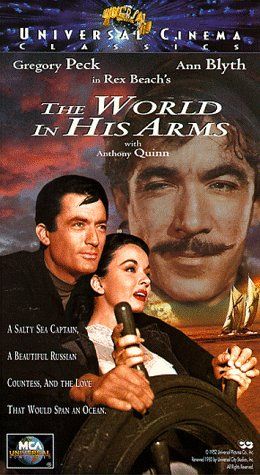
The World in His Arms (1952) was directed by Raoul Walsh, a filmmaker known for his energetic storytelling, strong action sequences, and fast-paced narrative style. His direction gives the film a lively, adventurous spirit, especially in its sea battles and dramatic moments.
“The World in His Arms” symbolically suggests a man who feels powerful enough to hold or conquer the world. In the context of the film, it reflects the bold and daring nature of Captain Jonathan Clark (played by Gregory Peck).
The film begins with Captain Jonathan Clark returning to the city and freeing his sailors. Meanwhile, “Shanghai” Kelly is trying to recruit men by announcing, “One hundred dollars—strong men wanted to work aboard the Golden Clipper.”
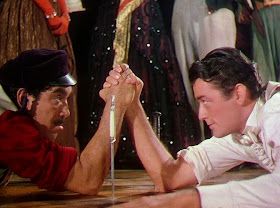
Clark then makes a deal with the merchant Cleggett for trading seal skins. When a Russian official offers a large sum to charter his ship, Clark refuses the proposal. Later, during a party, he gets into a fight with Portugee and ultimately wins a wager.
Amid this chaos, a young Russian girl named Marina meets Jonathan. He befriends her and takes her around the city. He later brings Marina aboard his ship, Pilgrim of the Sea, expresses his affection for her, and decides to take her to Sitka. Initially, due to his hatred for the Russians, he refuses to help, but after meeting Marina, his attitude changes. That night, as they explore the city together, they fall in love. Jonathan proposes marriage to her, and she happily accepts.
Prince Semyon eventually finds Marina and takes her away to Sitka. Believing that Marina has deceived him, Jonathan sets off in a race to Alaska against Portugee, wagering his ship on who will arrive first. Jonathan wins the race, but Portugee attempts to steal his ship. As the crews of both ships clash, a Russian gunboat arrives, captures them all, and takes them to Sitka.
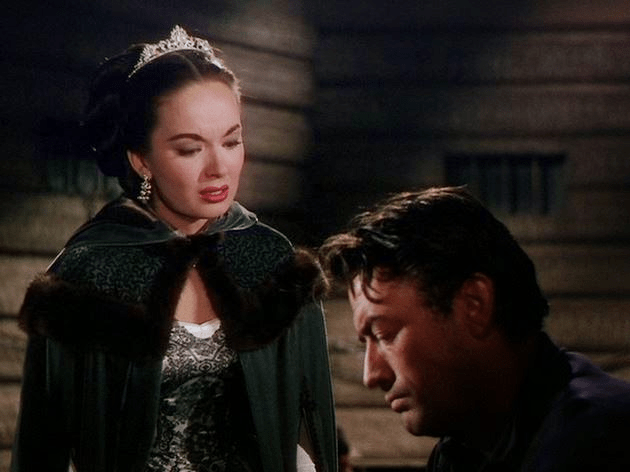
Marina rushes into a dark prison filled with chained prisoners and goes straight to Jonathan, who is among them. She stops him and explains that she had not abandoned him; Prince Semyon and his men had taken her away by force. She tells him that she still loves him and pleads with him to trust her.
However, an angry Jonathan refuses to believe her and bitterly asks whether the marriage proposal of a simple American sailor was just a joke to her. Marina responds that she had already given her answer aboard the Pilgrim—she intends to marry only him.
Jonathan sarcastically asks whether that marriage will take place before or after his execution. Meanwhile, Marina knows how to calm his anger; she gently kisses him and tells him that she still loves him. Her face is turned away from the camera, but real tears can be seen in her eyes. Seeing this, Jonathan’s anger slowly begins to melt.
In Sitka, Prince Semyon pressures Marina to agree to marry him in exchange for Jonathan’s release. However, Jonathan and his companions return, rescue Marina, and sail away with her to freedom.

The romance between Gregory Peck and Ann Blyth seems to unfold almost in the presence of a third force—the strong directorial imprint of Raoul Walsh. Ann Blyth delivers an effective performance, especially in the emotional scenes. In one striking moment, Anthony Quinn suddenly lifts her, and when Gregory Peck demands her release, Quinn tosses her toward him. As she falls into Peck’s arms, her expressions are particularly memorable—her face shifts from surprise and hesitation to a shy, blossoming joy.
The thrilling ship race between Gregory Peck and Anthony Quinn from San Francisco to Alaska is another highlight of the film, beautifully captured by cinematographer Russell Metty. Equally engaging are the romantic moments with Ann Blyth, the lively sequence in the Russian restaurant, and the episode where Peck’s companions disguise themselves as monks to infiltrate the Countess and Prince’s wedding.
In the climax, Gregory Peck dramatically crashes through a church balcony window to stop the wedding, making the sequence especially exciting and intense. In the end, the tall and handsome Gregory Peck carries the doll-like Ann Blyth away from the wedding hall, bringing the film to a triumphant and romantic conclusion.
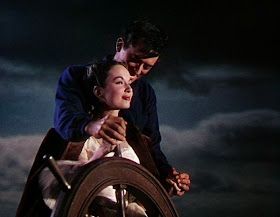
In the final scene, Marina stands at the ship’s wheel, guiding it forward in the soft glow of the evening light, while Gregory Peck stands behind her, gently placing his hands over hers with affection. When Peck looks at Marina with a warm smile, it clearly reflects his feelings of love, happiness, and deep attachment. He doesn’t say a word, yet his expression alone conveys to the audience how much he loves her and how happy he is to be with her.
Director Raoul Walsh frames the two against the darkening evening sky, beautifully suggesting that Marina is not merely a damsel in distress, but a true companion—someone who shares the hero’s adventures and has become his whole world.
Even though many people are around them, the two seem lost in their own world. Marina says something, but it cannot be heard over the music, so Peck leans closer to listen. She speaks again, and they both smile. This moment feels simple, joyful, and more tender than a conventional final kiss. What she says remains unheard, leaving it to the audience’s imagination, which makes the scene even more special.
Enhancing the emotional depth of this moment is the beautiful musical score by Frank Skinner, whose melody adds a touching layer to the scene.
As Captain Clark and Marina stand together at the helm, setting off toward a new adventure, the words spoken by John McIntire’s character gain deeper meaning: “He’s got the world in his arms.” In other words, the whole world rests within his embrace.
📸 Photo courtesy: Google ✍️ Sources: Google

