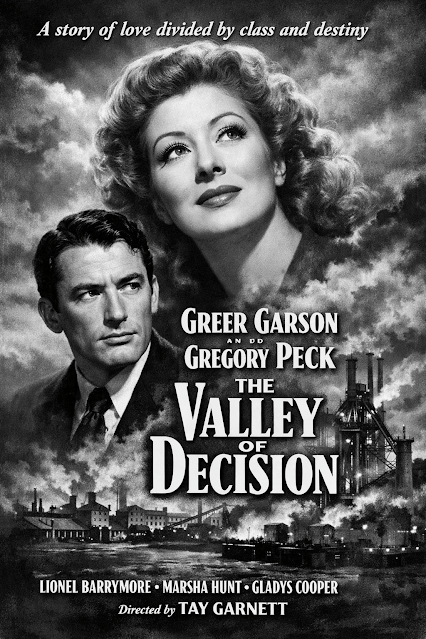
The Valley of Decision is a 1945 American drama film directed by Tay Garnett. It is a tender and powerful story of love, struggle, and class differences in society.
The film is based on a novel by Marcia Davenport, and stars Greer Garson and Gregory Peck in the lead roles.
“The Valley of Decision” symbolizes a place where life-changing choices are made. In this story, the meaning appears in two ways: first, as the literal valley where the steel mills are located, and second, as the moral, social, and personal conflicts faced by the characters—decisions about labor, class differences, and love.
At some point in life, a person stands in such a “valley”—on one side is love, on the other is duty; on one side are emotions, and on the other, society’s expectations. The decisions made in such moments shape relationships, legacy, and the future.
Thus, this film is not just a love story, but a journey through those difficult moments where every step must be taken thoughtfully… because that is what defines the “Valley of Decision.”
The story is set against the backdrop of the steel industry in 19th-century Pittsburgh and revolves around the love between a poor girl and a boy from a wealthy family.
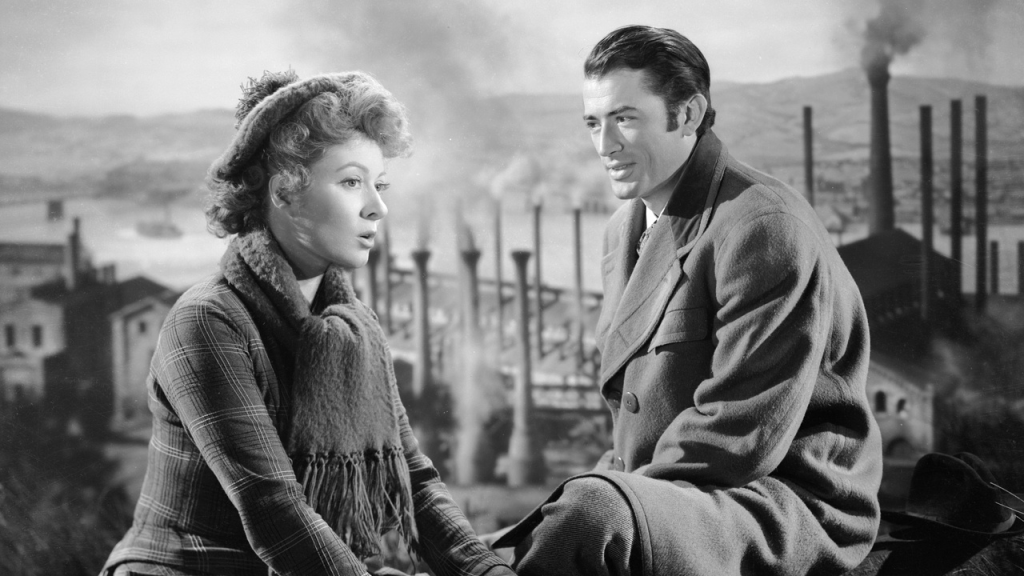
The protagonist of the story, Mary Rafferty, is a girl from a poor Irish family. Due to circumstances, she begins working in the household of the wealthy Scott family, who are major steel mill owners.
While working there, Mary and the family’s son, Paul Scott, fall in love. However, their love is not easy—because they come from very different social backgrounds. On one side are the struggles and hardships of the workers fighting for their rights, and on the other side are wealth, power, and family prestige. Mary finds herself in a difficult situation: should she stand with the workers or become part of the wealthy family for the sake of her love?
As workers’ protests, strikes, and conflicts intensify, Mary and Paul’s relationship is also put to the test. Ultimately, they must make a decision by balancing love, duty, and justice.
Director Tay Garnett presents the film with a realistic tone, maintaining a fine balance between romance and social conflict. The steel mills, smoke, and industrial environment are portrayed effectively. The use of light and shadow enhances tension and emotion, while large sets and realistic locations give the film a grand and vivid feel.
The narrative progresses smoothly and calmly; emotional scenes are handled with a slower pace, while conflict sequences use faster cuts, keeping the audience constantly engaged.
The screenplay beautifully blends the worker–owner conflict with the love story. The dialogues are simple yet impactful, and the inner struggles of the characters are clearly portrayed. As a result, the film goes beyond being just a love story and becomes a thought-provoking experience about class division, संघर्ष, and life’s difficult decisions.
Greer Garson’s portrayal of Mary is not just that of a woman in love, but of a strong and self-respecting individual who balances duty and social awareness. Her love is not limited to Paul; she also embraces his family. She advises Constance not to sell her share and acts as a bridge between the owners and the workers.
Through her restrained and nuanced performance, Garson effectively conveys the inner conflict between love and family loyalty. In scenes of strikes and class struggle, the pain in her eyes deeply touches the audience. Her quiet strength makes Mary the moral center of the film.
For this powerful performance, she received a nomination for the Academy Award for Best Actress.

Gregory Peck, though relatively new at the time, delivers a remarkably effective performance as Paul. From his very first appearance—casually whistling as he enters, and then whistling again to catch Mary’s attention—Paul instantly comes alive on screen: charming, confident, and full of vitality. Peck not only brings romantic appeal to the character but also subtly reveals his idealism, passion, and inner conflict.
His feelings for Mary go beyond mere attraction; they are rooted in his admiration for her simplicity, honesty, and compassion. Mary becomes a quiet yet strong source of support in his life, inspiring him to rise again after failure.
Paul is a sensitive character shaped by the conflict between love, duty, and self-respect, and Gregory Peck’s powerful performance ensures that he remains memorable in the audience’s mind.
While Greer Garson provides the emotional core of the film, Gregory Peck adds romantic and dramatic intensity. Together, their compelling performances make the film a memorable classic of Hollywood’s Golden Age.
The film nominated for the Academy Award for Best Music, Scoring of a Dramatic or Comedy Picture. In addition, it won the prestigious Photoplay Gold Medal Award for Film of the Year. These honors stand as formal recognition of the film’s artistic quality, compelling performances, and memorable music.
📸 Photo courtesy: Google ✍️ Sources: Google.

