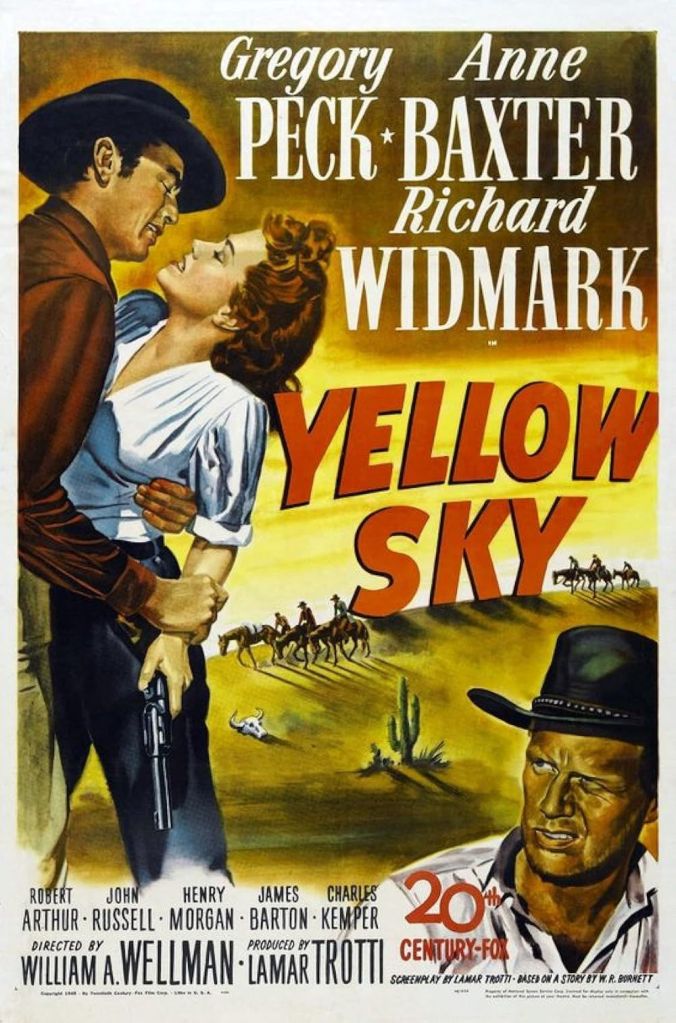
Yellow Sky (1948) is an American Western directed by William A. Wellman, who was known for his strong and realistic style during Hollywood’s classic era. The film is based on an unpublished novel by W. R. Burnett.
“Yellow Sky” literally means “a yellowish sky,” but in the context of the film, it carries a deeper meaning. It is not just a natural image, but a symbolic representation of tension, greed, and transformation within the story. It reflects the heat, dryness, and harsh conditions of the desert, while also portraying greed, moral conflict, and changes in human nature—making it a metaphor for a dangerous world where a person’s true character is tested.
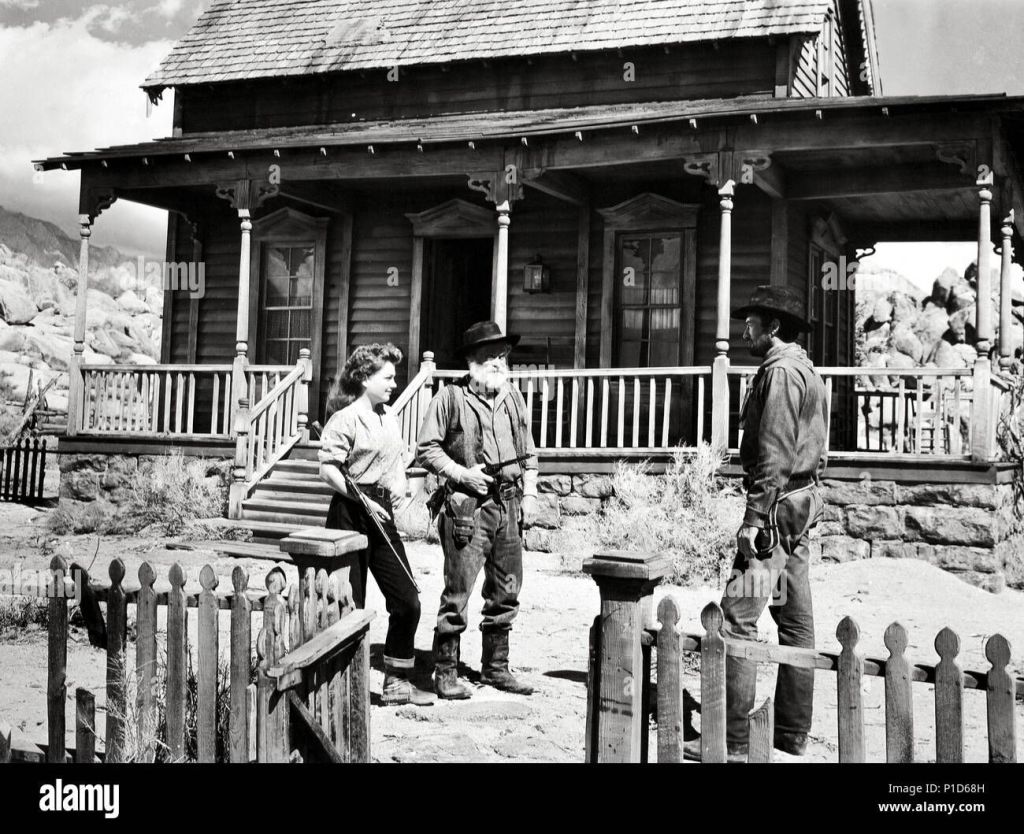
The film revolves around a gang of criminals led by James “Stretch,” played by Gregory Peck. After robbing a bank, the gang flees into the desert to escape the police. After a long and exhausting journey, they arrive at an abandoned ghost town called Yellow Sky, eerily silent and desolate. There, they encounter an old man and his granddaughter, Mike.
While investigating, the gambler Dude discovers that the old man has secretly mined gold. He shares this information with the gang, though Stretch initially pays little attention. However, as greed for the gold grows, suspicion, betrayal, and power struggles begin to emerge. In this barren setting, the true nature of each character—good and bad—is tested.
As the story progresses, greed and conflict intensify. Some gang members become more violent and ruthless, “While Stretch gradually undergoes an inner transformation, Mike’s courage and honesty deeply influence him, leading him to reflect on his life and actions. Ultimately, through conflict, betrayal, and moral choices, the story reaches a decisive climax.”
Gregory Peck’s Stretch is a leader who appears tough, calm, and thoughtful on the outside, but internally struggles with moral conflict. Though he begins as a “bad boy” criminal, a spark of conscience exists within him. Mike’s contempt shakes him, and he begins to change in order to earn her respect. His journey from force to dignity highlights his transformation, and Peck’s restrained yet powerful performance makes the character feel authentic and compelling.
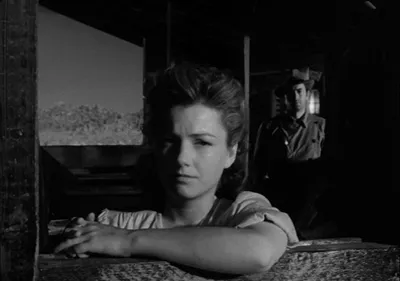
Anne Baxter plays Mike, a strong, brave, and self-respecting young woman who lives with her grandfather in the deserted town. Determined to prove herself equal to any man, she rejects the name “Constance Mae” and adopts the nickname “Mike.” Proud of being raised among the Apaches, she is ready to do anything to protect her grandfather. Though outwardly tough, she is internally conflicted—symbolized by a scene where she tears up a picture of a well-dressed woman, representing her suppressed emotions and hardened life. Initially hostile toward Stretch, she ultimately risks her life to save him—not just physically, but morally as well—playing a key role in his transformation.
Richard Widmark portrays Dude, a greedy, aggressive, and dangerous man driven solely by his desire for gold. He represents the moral downfall within the gang, and Widmark’s intense performance makes him a memorable antagonist.
The film powerfully presents the conflict between greed and humanity, showing how far a person can fall due to the lure of wealth. At the same time, it emphasizes redemption—the idea that even a criminal like Stretch can change. The desert, the yellow sky, and the ghost town symbolize isolation, struggle, and survival. As suspicion over hidden gold grows, tensions rise, and true character is revealed under pressure. In the end, Stretch faces a difficult choice—gold or Mike’s love—making Yellow Sky not just a Western, but a subtle psychological study of the human mind.
The film’s cinematography, direction, and screenplay were widely praised. Critic Christopher Tookey highlighted Wellman’s atmospheric direction, the use of natural sounds, and Joseph MacDonald’s striking black-and-white cinematography. Screenwriter Lamar Trotti also received recognition, winning an award from the Writers Guild of America for the film’s powerful script.
Bosley Crowther observed, “Gunfire, fistfights, and emotional entanglements are all rendered in an excellent, realistic Western style. William A. Wellman sustains tension from beginning to end.” He further noted that the story “operates mainly on the level of action and a somewhat constructed love story. But within this popular framework, it is made tough, tense, and effective… The film proves to be solid and exciting entertainment throughout its running time.”
The film’s success led to a radio adaptation. Gregory Peck reprised his role, and director William A. Wellman served as host. The adaptation was broadcast on July 15, 1949, on NBC Radio’s Screen Directors Playhouse.
📸 Photo courtesy: Google ✍️ Sources: Google

