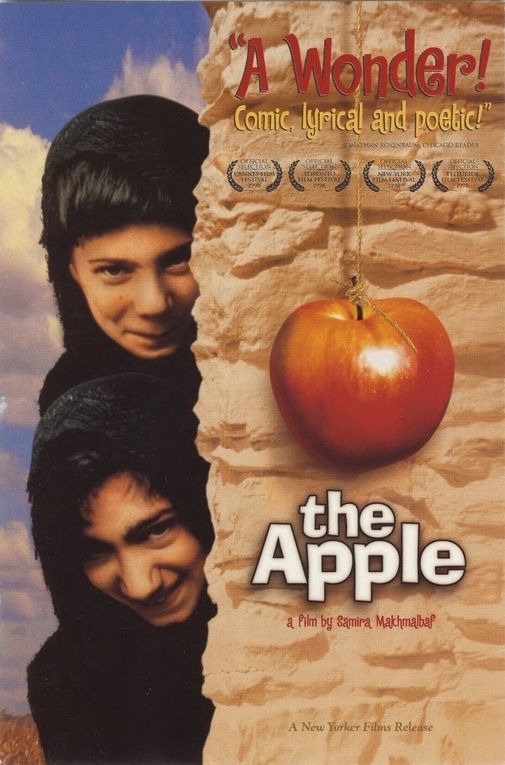
The Apple, film is directed by Samira Makhmalbaf. Remarkably, she became a director at a very young age and made this film based on a true story.
“Apple” is not just a fruit here—it carries a symbolic meaning. It represents new experiences, freedom, and awakening.
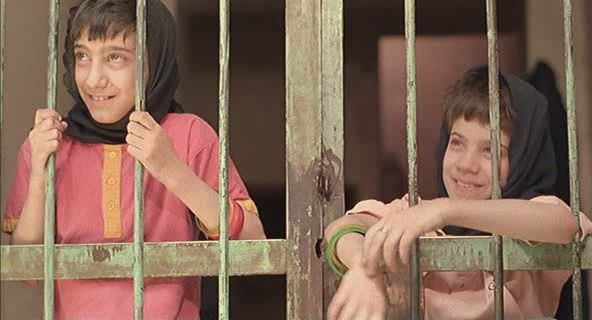
This is the story of two young twin sisters, Masoumeh and Zahra. Their father is very strict and fearful. He believes the outside world is dangerous, so he keeps his daughters locked inside the house.
For many years, they are not allowed to step out, they cannot play with other children, and they do not even know what the world is like. They live a life completely confined within four walls.
One day, the neighbors notice this situation, and social workers intervene. Finally, the girls get a chance to step outside. This marks the beginning of their journey into a new world—feeling sunlight for the first time, playing with other children, and being amazed by roads, people, and sounds.
This film does not feature professional actors, but real people. Zahra Naderi is one of the twin sisters. She and her sister Masoumeh were kept confined for 12 years. Zahra’s role shows how isolation affects a child’s emotional and mental development. Gradually, she learns to communicate, speak, and experience freedom. The girls’ performances feel extremely natural and innocent.
Their real-life father, Ghorbanali Naderi, plays himself. He believes he is protecting his daughters, but due to fear and misunderstanding, he ends up imprisoning them. His character feels very real—his fear and ignorance are clearly visible. It doesn’t feel like acting; it feels like watching real life.
Samira Makhmalbaf directed this film at just 17 years old. She uses a real-time style, presenting events exactly as they unfold. There is no dramatic exaggeration—everything is calm and realistic, encouraging the audience to reflect.
A social worker gives the girls a mirror and a comb—simple objects with deep meaning. For girls who have been isolated for years, this becomes the first step toward self-awareness.
As the director says, “Women look into mirrors and find themselves.”
Through simplicity and symbolism, the film powerfully presents complex themes.
The cinematography is simple yet effective. It uses natural light, long shots, and simple frames to portray reality. The contrast between the confined home and the open outside world is clearly shown. The camera feels like an observer—it does not force anything.
The editing makes the film calm and thoughtful. There are no unnecessary cuts, allowing scenes to be fully experienced. The story moves slowly, helping the audience absorb every moment.
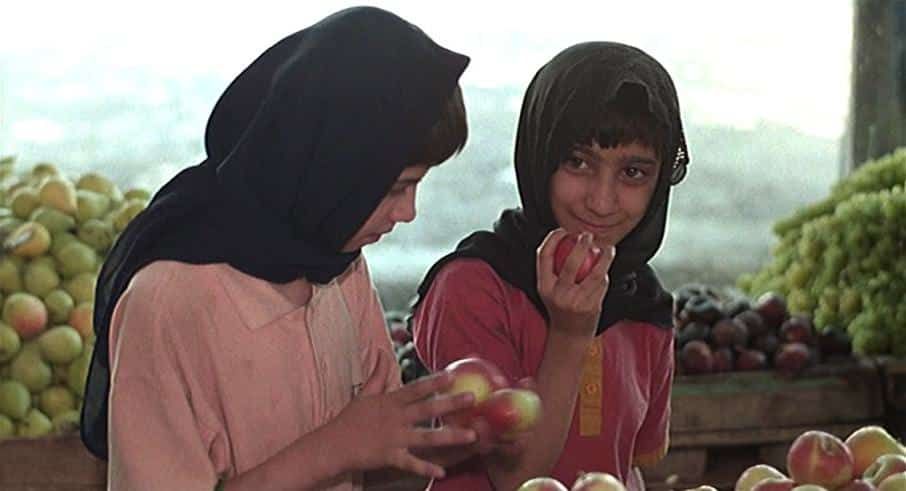
A simple yet meaningful moment in the film is the apple itself. For the girls, it represents a new experience, their first connection to the outside world, and a small but powerful glimpse of freedom.
This film gives a strong message: children need freedom and experiences. Overprotection can sometimes become imprisonment. Society should not ignore such situations and must step in to help.
The Apple is a simple film, but its emotions run very deep. It shows that even small things—like an apple—can bring a big change in someone’s life.
The Apple received widespread international acclaim, earning several prestigious awards. At the 1999 Independent Cinema Festival in Argentina, it won the Audience’s Prize, the Critic’s Prize, and the Jury’s Special Prize. The film also received the Jury’s Special Prize at both the 1998 São Paulo Film Festival in Brazil and the Thessaloniki Film Festival in Greece. At the 1998 Locarno Film Festival in Switzerland, it was honored with the International Critics Prize, and in the same year, it received the Sutherland Trophy at the London Film Festival in the UK.
The film was screened in the Un Certain Regard section at the 1998 Cannes Film Festival, a category known for showcasing innovative and daring works by emerging filmmakers.
📸 Photo courtesy: Google ✍️ References: Google
 Writer Sunita