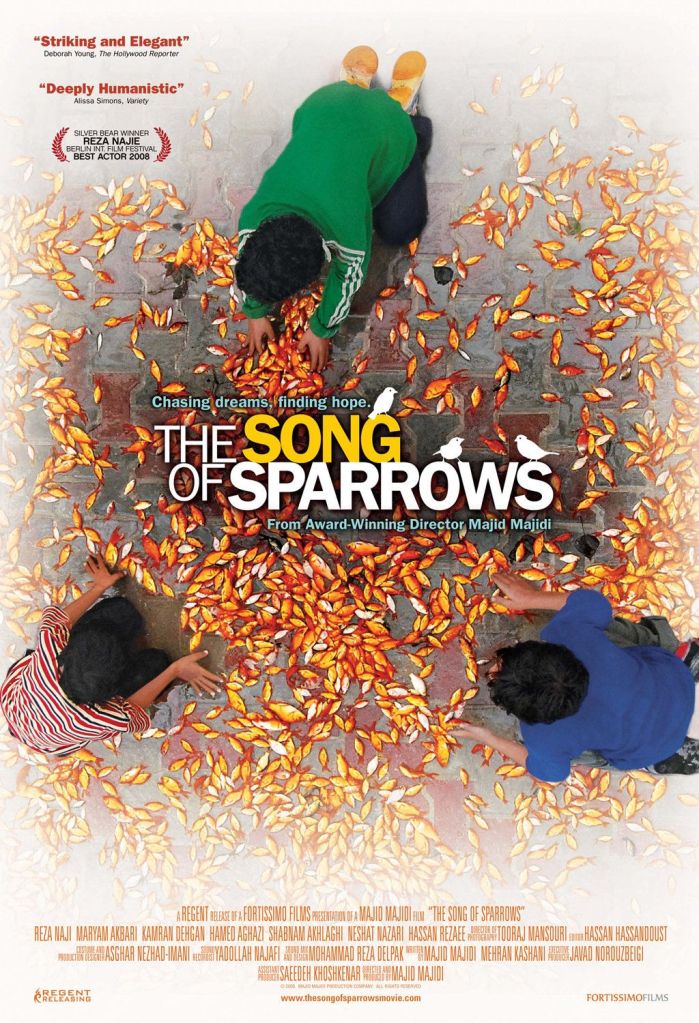
The Song of Sparrows is a 2008 Iranian drama film directed by Majid Majidi. It is a deeply touching film that beautifully portrays human emotions and a family’s struggles through a simple narrative.
The film opens with serene images of ostriches. Karim works at an ostrich farm and lives a simple, content life with his family. When his daughter Hanieh’s hearing aid falls into water and gets damaged, he becomes worried about repairing it. Soon after, an ostrich escapes and Karim loses his job. He travels to Tehran to fix the hearing aid, only to learn that a new one is too expensive. Outside the hospital, a man mistakenly assumes he is a motorcycle taxi driver, and this incident changes the course of his life.
Karim begins working as a motorcycle taxi driver. As he transports people and goods, he witnesses the showiness and dishonesty of city life. He starts bringing home discarded items to repair and reuse. Meanwhile, his son Hossein dreams of starting a goldfish farm, an idea Karim initially dismisses as unrealistic. Tempted by money, Karim begins transporting larger goods and even considers dishonest shortcuts. Yet, when he sees an ostrich again, he is reminded of his former honest life and steps back from wrongdoing.
Gradually, the lure of money changes him. He grows angry when he sees his children selling flowers, only to realize they are saving for Hossein’s dream. After an accident leaves him injured, his family works together to support the household, helping him rediscover the value of simple living. Later, when Hossein saves the fallen goldfish, Karim feels proud and begins to see his children’s innocence differently. In the final moments, he frees a trapped sparrow, symbolizing his inner transformation, while the return of the ostrich suggests spiritual renewal.
In The Song of Sparrows, ostriches symbolize both the wonder of life and the mystery of death. Their size and eggs suggest renewal and rebirth. Each time Karim sees them, he pauses to reflect, as if reminded of a deeper meaning beyond his daily troubles. These moments guide his moral choices and personal growth.
In contrast to ostriches, sparrows are small and often overlooked, yet they represent the lively, everyday beauty of nature. After the boys clean the reservoir, sparrows come to nest, symbolizing renewal. When Karim frees a sparrow from his room, it shows his new appreciation for life’s simple, shared moments. While ostriches suggest individuality, sparrows symbolize community.
The boys’ goldfish farm symbolizes the human tendency to chase foolish dreams. Karim once saw their plan as silly, but after his accident, he views it with gentle understanding. This shift reflects a deeper idea: just as Karim now sees the boys’ efforts with kindness, so might God look upon our own mistakes with compassion. The boys’ dream mirrors Karim’s own misguided chase for wealth, showing how small our struggles may seem from a higher perspective.
Majid Majidi, as the director of The Song of Sparrows, plays a crucial role in shaping the film’s tone and message. Known for his sensitive and humanistic storytelling, Majidi brings warmth, realism, and emotional depth to the story of Karim. He blends humor with hardship and uses simple, everyday moments to explore larger themes such as pride, family, survival, and the conflict between traditional rural values and modern urban life. Majidi’s direction is subtle yet powerful, allowing the performances—especially Reza Naji’s—to shine while grounding the film in a deeply Iranian cultural and moral context.
The film celebrates Karim’s tireless spirit and his willingness to adapt and keep going. Though he’s a simple man from the countryside, Karim is full of drive and resourcefulness. The real message is that such energy, when combined with an awareness of life’s deeper, more communal rhythms, leads to true growth. Ultimately, The Song of Sparrows is another strong example of Majidi’s thoughtful look at the spiritual side of everyday human life.
Although Reza Naji was the only professional actor in The Song of Sparrows. He takes the lead as Karim and appears in nearly every scene. Naji’s performance in the film is criticized for being overly theatrical and exaggerated, with too much grimacing and dramatic posturing. This clashes with the film’s realistic tone and the more natural performances from the rest of the cast. His altered appearance longer nose, changed jawline, and odd teeth adds a clownish look, making some scenes feel like they’re meant for comedy. While this may lighten the mood, it also creates distance between the viewer and Karim’s emotional journey. As a result, Naji’s performance weakens the film and prevents it from reaching the emotional depth of Majidi’s best work.
While his performance won major awards like the Silver Bear and Best Actor at the 2008 Asia Pacific Screen Awards, the writer feels that, his performance here is the film’s one major weakness.
Turaj Mansuri’s cinematography beautifully captures both the peaceful, wide-open landscapes of the Iranian countryside and the crowded, chaotic scenes of Tehran. He uses natural lighting and thoughtful framing to reflect the contrast between rural and urban life, and to show the emotional state of the characters—especially Karim’s journey.
Hassan Hassandoost’s editing helps keep the pace steady and the emotions strong. He smoothly shifts between lighter family moments and more serious ones, helping the audience stay connected to Karim’s changing world.
Hossein Alizadeh composed the film’s music. A master of traditional Persian music, Alizadeh uses subtle, emotional melodies to support the mood of the story. His music enhances key moments, adding depth without overwhelming the scenes, and helps express feelings that words alone cannot.
The Song of Sparrows received several prestigious awards and nominations. Reza Naji won the Best Performance by an Actor at the Asia Pacific Screen Awards in 2008 and also received the Silver Bear for Best Actor at the Berlin International Film Festival the same year. The film was selected as Iran’s official entry for Best Foreign Language Film at the 81st Academy Awards. Director Majid Majidi was honored with the Best Director Award at the Fajr International Film Festival in 2008. Reza Naji also won the Best Actor Award at the Damascus International Film Festival, and the film received a Special Award for Best Foreign Language Film from the National Board of Review in 2008.
📸 Photo courtesy: Google ✍️ References: Google

