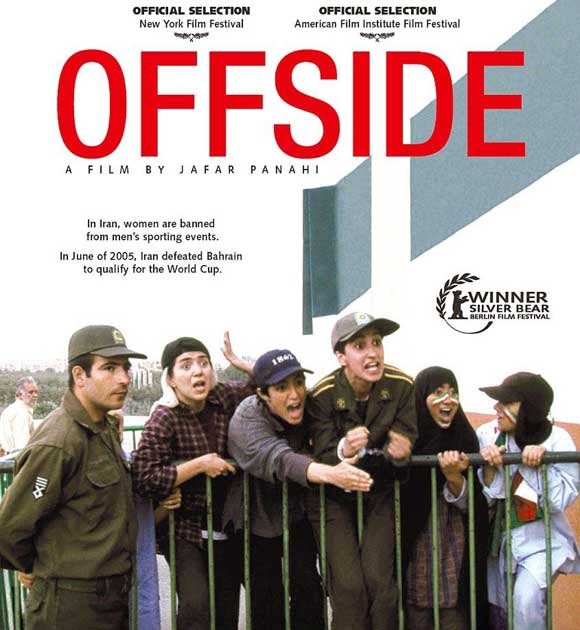
Jafar Panahi’s Offside is based on a real-life incident. The story was inspired when the director’s own daughter was denied entry into a stadium.
The film follows seven young girls who attempt to sneak into Azadi Stadium in Tehran to watch the Iran–Bahrain World Cup qualifying match. At that time, women were not allowed to enter stadiums in Iran. Some of the girls disguise themselves as boys to get inside, but they are caught and detained in a temporary holding area on the stadium’s rooftop.
There, they find other girls with different personalities already being held. Despite their deep love for the game, they are denied the chance to watch the match for trivial reasons. Although they can hear the excitement and cheers from outside, they cannot see the game, making the experience feel like psychological torment.
In Offside, the soldiers assigned to keep the women outside the stadium are themselves confused young men, simply following orders. One of them, a boy from Tabriz, dreams only of returning home. Despite the restrictions, he watches the match through a small hole in the wall and describes the action to the girls.
In one scene, when a girl needs to use the restroom, a soldier secretly takes her to the men’s restroom. She briefly escapes into the stadium but returns so that the soldier does not get into trouble—offering a delicate glimpse of humanity.
Before the match ends, a minibus arrives to take the girls to the vice squad office. From the radio, they learn that Mohammad Nosrati has scored the winning goal, leading Iran to a 1–0 victory over Bahrain. The soldiers and the girls celebrate together inside the bus. However, the first girl remains quiet; she reveals that she is not particularly interested in football—she came to honor the memory of a friend who had died during unrest following a previous Iran–Japan match.
As Tehran erupts in celebration, the minibus gets stuck in traffic. The girls and soldiers step out with sparklers and join the festivities. Beyond restrictions, they experience a brief moment of freedom. In Iran, as in many other countries, football holds great importance—it is not just a sport, but a powerful medium for entertainment and emotional expression.
A match becomes an opportunity for people to shout freely and release suppressed emotions. At times, matches and protests occur simultaneously, and when Iran wins, those emotions intensify even further.
Jafar Panahi is known for his deeply humanistic approach to filmmaking. Most characters in the film are unnamed, representing ordinary people rather than individuals. Through football, he highlights restrictions on women’s rights, while also showing how the game can bring people together.
By the end, the tired and frustrated soldiers, the disappointed girls, and the mischievous boy all come together. Iran’s victory unites them, if only for a moment. This is not just a victory in football, but a moment of hope, unity, and shared humanity—suggesting that even in a world worn down by conflict, unity is still possible.
One of the most striking sequences in the film is when the girls, disguised as boys, attempt to enter Azadi Stadium and are later confined. Their inability to watch the match, while only hearing the distant cheers, speaks volumes. The light-hearted moment involving a soldier with a mobile phone and the tense restroom scene—where the girl’s face is covered with a poster—are particularly memorable. Panahi’s decision to shoot during an actual match adds a layer of realism, making these scenes even more powerful.
The film presents the issue of women’s freedom in a way that is both humorous and realistic. Offside stands as a powerful depiction of the struggle for equality and women’s rights.
The film received widespread critical acclaim. In 2006, it won the Silver Bear award at the Berlin International Film Festival. It was also selected for prestigious festivals such as the New York Film Festival and the Toronto International Film Festival.
📸 Photo courtesy: Google
✍️ Excerpts: Google

