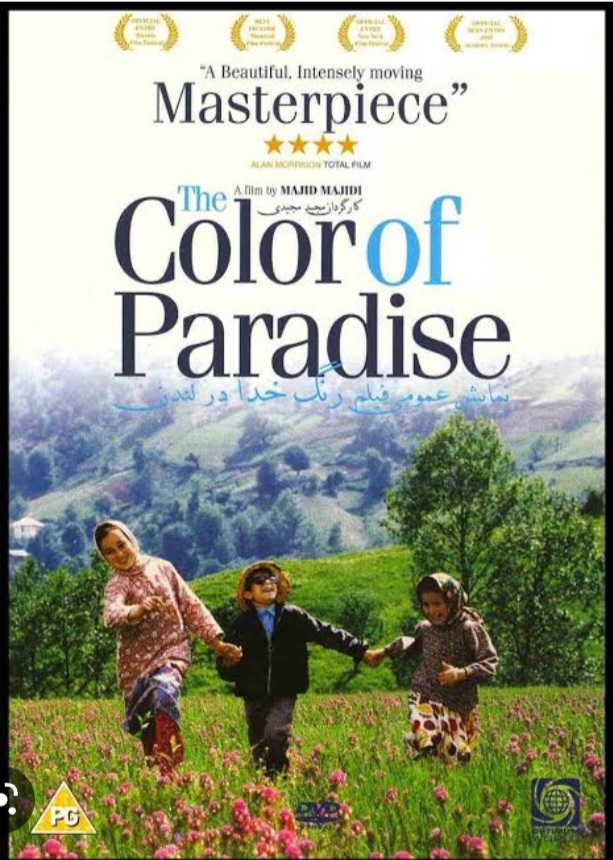
The Color of Paradise, deeply touching film is directed by Majid Majidi, a highly sensitive filmmaker known for presenting profound philosophy through simple stories. In his films, he beautifully explores the world through a child’s perspective, the bond with nature, poverty, human emotions, and a subtle touch of spirituality. In The Color of Paradise, he avoids preaching and instead encourages the audience to reflect through experience.
The title “The Color of Paradise” symbolically represents the “color of God.” This is not something visible to the eyes, but something that can be felt through the heart and soul. Mohammad, who is blind, experiences the presence of God through nature, sound, and touch, making him spiritually illuminated. In contrast, his father Hashem, though physically sighted, is blind to life’s deeper truths. The film suggests that heaven and God are not external, but exist within us. Thus, the title symbolizes not just natural beauty, but a spiritual experience—one of Majidi’s greatest strengths as a director.
The film tells the emotional journey of a blind boy named Mohammad and his relationship with his father. Mohammad is lively, gentle, and eager to learn, with a deep connection to nature—he experiences the world through sound, touch, and sensation. At home, his grandmother and two sisters love him dearly, but his father Hashem sees him as a burden. A widower, Hashem is trying to remarry into a wealthy family and feels ashamed of his son’s blindness, attempting to keep him away.
After school ends, Mohammad waits alone like other children for his father. Though his father takes him home, he does not allow him to continue his education and eventually sends him to work with a blind carpenter, despite Mohammad’s desire to prove himself in the “sighted” world. This moment, where Mohammad breaks down due to his blindness and loneliness, is deeply heartbreaking.
Meanwhile, Hashem faces sorrow when his mother dies and his marriage plans fall apart. Eventually, he sets out to bring Mohammad back. However, on their return journey, an accident occurs, and Mohammad is swept away by a river. In the final moments, Hashem collapses in grief upon seeing his son seemingly lifeless, but a slight movement in Mohammad’s fingers suggests that he is still experiencing the presence of God—almost as if he is “touching” the divine.
Director Majid Majidi presents this relationship with great sensitivity and emotional depth. The film beautifully captures both the charm and the destructive power of nature. It offers a spiritual experience through visuals and sound—flower-filled fields, misty forests, streams, and rugged mountains. The soundscape—birds chirping, insects buzzing, wind, and rain—creates a constantly evolving natural symphony. The film avoids melodrama, embracing simplicity and beauty. These vivid sounds are so powerful that even a blind person can imagine the visuals, just as Mohammad does.
The child actor delivers an incredibly natural performance, making Mohammad’s pain feel real and deeply connecting with the audience. In one beautiful scene, he hears a fallen baby bird, gently picks it up, and returns it to its nest—almost as if God is working through him to help another life.
Hossein Mahjoub, who plays Hashem, is equally impressive. His internal conflict, helplessness, and final repentance feel very natural and convincing.
The film ultimately conveys that true “vision” lies not in the eyes, but in the heart. There is no need to search for God or heaven outside—they exist within us. Innocence and love reveal the true meaning of life.
Majid Majidi’s screenplay is simple yet powerful. Even with minimal dialogue, every scene communicates meaning. The film does not preach, but makes the audience reflect through experience—this is its greatest strength.
📸 Photo courtesy: Google
✍️ Excerpts: Google.

