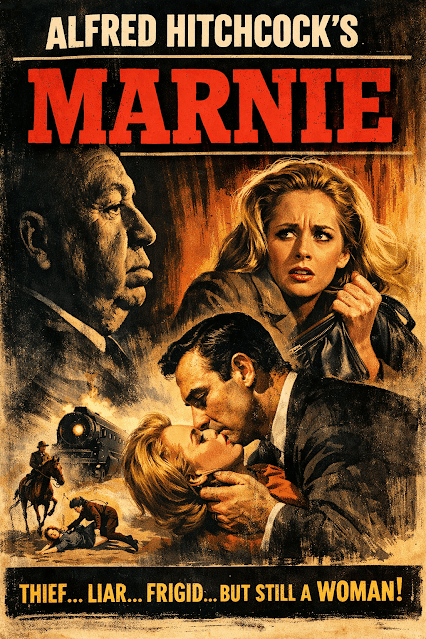
“Marnie” (1964) is an American psychological thriller directed by Alfred Hitchcock, widely known as the “Master of Suspense.”
This film goes beyond his usual style and explores the mysterious depths of the human mind. The story revolves around a woman who appears calm and attractive on the outside, but is internally troubled by fear, guilt, and the wounds of her past.
The title Marnie is not just a name, but a symbol of her inner wounds, fears, and search for identity. Through his direction, Hitchcock brings this complex psychological world vividly to the screen.
The story begins with Marnie constantly moving from one place to another. She takes up jobs, steals money, and quickly changes her identity. Her life is a continuous escape—not just from others, but from herself. Right from the beginning, Hitchcock suggests that this is not merely a story about crime, but about her inner conflict.
She then starts working at Mark Rutland’s company. Mark is calm, observant, and somewhat mysterious. He senses something unusual about Marnie and becomes drawn to her. From here, a relationship begins to develop, marked by tension and control.

When Mark discovers her theft, instead of handing her over to the police, he marries her. This situation is quite complex, blending elements of love and control. It makes the audience question whether he truly wants to help her or dominate her.
After marriage, Marnie shows a deep fear of physical intimacy and tries to stay away from him. However, Mark does not see this as rejection; instead, he realizes that her fear is rooted in past trauma.
Mark begins investigating her past and takes her to her mother. There, a shocking truth is revealed—when she was a child, while trying to protect her mother, she killed a man by striking him with a fireplace poker. This incident left a deep psychological scar. Seeing blood created her intense fear of the color red, and the stormy night of the incident caused her fear of storms. This revelation explains her behavior and becomes a turning point in her life.
The film does not offer a clear conclusion but gives a sense of partial resolution. After the truth comes out, Marnie appears calmer, but whether she is completely healed remains uncertain. Hitchcock leaves this question open for the audience.
Hitchcock directs Marnie in a deeply psychological manner. Through the use of red color, camera angles, and close-ups, he effectively portrays her fear and tension. The color red symbolizes her hidden trauma—whenever she sees it, she becomes anxious and loses control. Thus, the film is not just a thriller, but an experience of her inner struggle.
In short, Hitchcock has shot the film in such a way that the audience does not just watch the story, but actually feels Marnie’s fear and conflict.
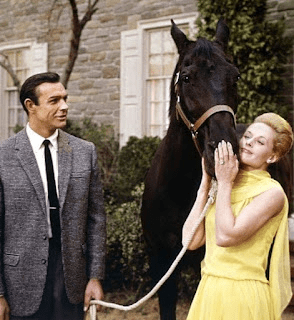
Sean Connery delivers a restrained and emotional performance as Mark Rutland. Unlike his bold James Bond image, here his acting feels subtle and realistic. Mark is caring and tries to understand Marnie, though at times he also shows a tendency to control. Connery balances warmth and firmness effectively.
Tippi Hedren portrays the complex character of Marnie Edgar with great depth. Her instability and emotional fragility are expressed naturally, making her fear and inner conflict clearly visible. Her facial expressions, tense eyes, and silent moments are especially powerful.
The horse scene in the film is highly symbolic. The horse represents freedom and peace for Marnie, but when it is injured, she kills it herself. This moment symbolizes the destruction of her only source of comfort and deepens her internal struggle.
Editor George Tomasini gives the film its rhythm, suspense, and psychological depth. The use of flashbacks, dreams, and memories builds tension gradually, creating a dreamlike flow.
Similarly, the music by Bernard Herrmann enhances the emotional intensity of the film. His score is gentle, serious, and deeply empathetic, highlighting Marnie’s inner pain and conflict.
Marnie is ultimately a study of the human mind. Hitchcock shows how deeply past wounds can affect the present. Rather than just thrilling the audience, the film makes them think—and that is what makes it special.
📸 Photo courtesy: Google ✍️ Excerpts: Google

