
Notorious is a 1946 American spy film directed and produced by Alfred Hitchcock. Alfred Hitchcock, famous as the king of thrillers in Hollywood, he masterfully combines suspense, emotional tension, and excitement in his unique style.
The word “Notorious” means a person known for a bad reputation.
In the film, Alicia carries a kind of “stigma” because of her father’s treason, which damages her image in society. That is why the title perfectly reflects her life. Additionally, the world of espionage, betrayal, and dangerous schemes makes all the characters live in a truly “notorious” world.
The story revolves around Alicia Huberman, a woman burdened by her father’s past, which has given her a bad reputation in society. She is beautiful, yet emotionally broken inside.
At this point, an American agent, Devlin, enters her life — a spy who is calm, composed, and someone who hides his emotions. He recruits Alicia for a dangerous mission: to infiltrate a Nazi group led by Alexander Sebastian, a seemingly polite but deeply dangerous man. Alicia must get close to Sebastian to gain his trust.
During the mission, Alicia and Devlin fall in love, but a conflict arises between duty and emotions.
Devlin prioritizes duty and persuades Alicia to marry Sebastian. Though heartbroken, she accepts this sacrifice for her country. After marriage, she becomes trapped in Sebastian’s house, constantly watched. Still, she manages to gather crucial information and uncovers a dangerous plot.
However, once the truth is revealed, Sebastian and his mother begin slowly poisoning her. She grows weaker and more isolated, and Devlin realizes the truth too late. When Alicia is on the threshold between life and death, Devlin arrives — and at the sight of him, a ray of hope appears in her eyes.
In this film, Hitchcock creates a slow-burning suspense, focusing more on emotion and tension than action. He beautifully blends a love story with a spy narrative. His specialty lies in gripping the audience using atmosphere, camera work, and performances rather than large action scenes.

The cinematography is highly effective. Hitchcock cleverly uses Cary Grant’s star power — in his first appearance, only the back of his head is shown, creating mystery. A close-up of a fizzing aspirin glass reveals Alicia’s condition, while a scene from her perspective shows Devlin upside down, reflecting her confusion. In the famous party scene, the camera moves down to a key in her hand — a small object holding a dangerous secret. Close-ups, along with the use of light and shadow, powerfully convey emotion, tension, and danger.
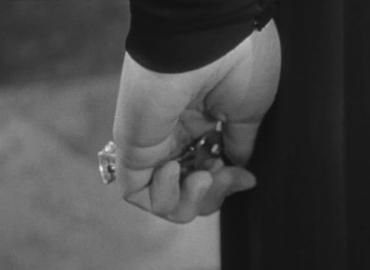
One of the most famous shots in the film happens at Sebastian’s mansion in Rio de Janeiro. The camera starts high above the entrance hall, then slowly moves down to show Alicia’s hand, nervously twisting the key. This long and smooth camera movement, shot by Ted Tetzlaff, builds tension and shows how afraid Alicia is at that moment.
The love theme in Notorious, composed by Roy Webb, is a typical Hitchcock-style romantic theme but it is not used in the usual romantic way. Even in the scene where Alicia and Devlin walk up a hill, enjoying a beautiful view and sharing a romantic moment, the music only plays briefly and softly, not as a loud, emotional love theme.
Most of the time, the love theme appears at unexpected moments and in troubled-sounding versions. This shows the emotional tension between the couple: Alicia’s hurt feelings and deep, hidden love, and Devlin’s fear, jealousy, and hesitation.
There is also a bit of Hitchcock’s dark humor in the music. For example, when Alicia first enters Sebastian’s mansion, filled with dangerous Nazis, classical music by Schumann is playing. It’s as if Hitchcock is saying: “Yes, they’re evil—but they have good taste in music.”

Cary Grant plays T. R. Devlin, a U.S. government agent sent to recruit Alicia Huberman to spy on former Nazis in Brazil. Grant’s performance is marked by subtlety and restraint, reflecting Devlin’s internal conflict between duty and love. He conveys intelligence, charm, and emotional depth while keeping his feelings hidden, creating a tension-filled, compelling portrayal. His charisma and screen presence make Devlin both authoritative and relatable, anchoring the film’s suspense and romance.
Ingrid Bergman as Alicia Hubermand is the American daughter of a convicted Nazi spy. She is known for drinking and partying, but deep down, she wants to do something meaningful. She agrees to help the U.S. government spy on Nazis, and falls in love with Devlin. When she’s told to seduce and marry Sebastian, she feels betrayed but follows through. Her character is brave, vulnerable, and emotionally rich. Alicia’s party dress was designed by the famous costume designer Edith Head.
Claude Rains as Alexander Sebastian is a wealthy Nazi sympathizer hiding in Rio de Janeiro after World War II. He is part of a secret Nazi group and once had feelings for Alicia. When she enters his life again, he falls in love with her and marries her, not knowing she is a spy. When he finds out the truth, he is trapped, he can’t reveal her without exposing himself. His role is tragic and complex, as he is both a villain and a man in love.
The screenplay is tight and effective. The dialogues are minimal yet meaningful, and every scene moves the story forward. The relationship between Alicia and Devlin is conveyed more through their actions than words — which is the strength of the script.
This is not just a love story…
It is a story of trust, sacrifice, and inner conflict.
Through this film, Hitchcock shows us that sometimes, sacrifices made for the country can wound the heart itself.
Biographer Patrick McGilligan wrote that in Notorious, the story about smuggled uranium and the romantic pairing of Cary Grant and Ingrid Bergman was so strong, it promised to be a huge success at the box office like an atomic explosion.
📸 Photo Courtesy: Google
✍️ Source: Google

