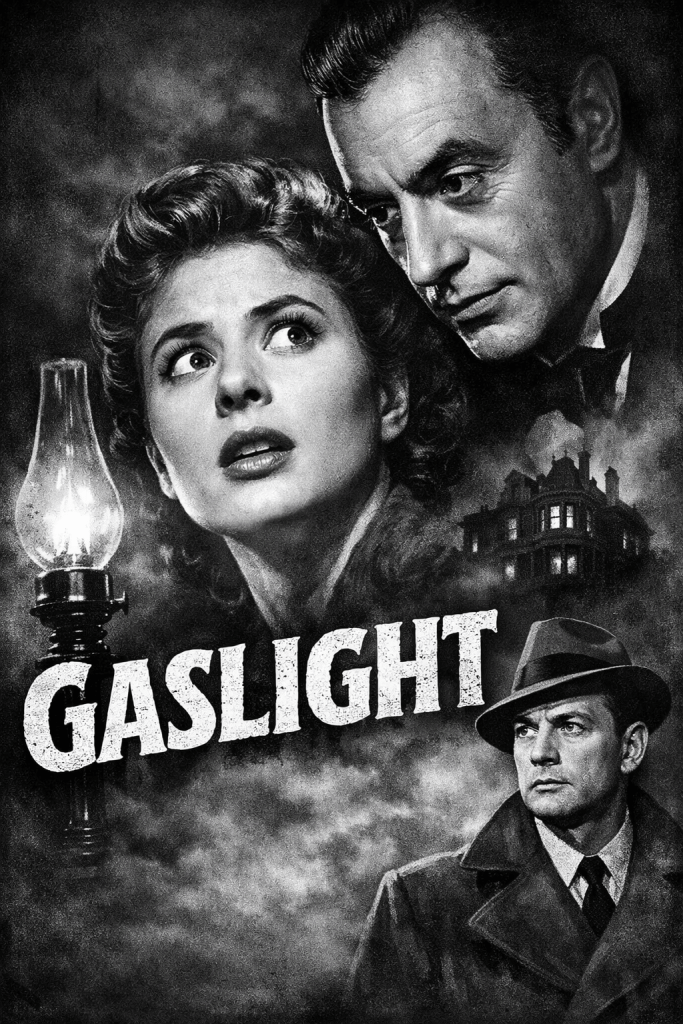
Gaslight is a renowned psychological thriller directed by George Cukor.
The title “Gaslight” carries a deeper meaning. In the film, the gas lamps in the house dim and brighten mysteriously. The heroine notices this, but her husband insists that nothing has changed. As a result, she begins to doubt her own perception.
Thus, “Gaslight” is not just about the lamps—it symbolizes psychological manipulation.
This is the story of a young woman named Paula.
As a child, her life is completely changed by the shock of her aunt’s murder, and she withdraws from the world for some time.
As time passes, Paula grows up and meets Gregory. They fall in love and get married, and move into an old house in London. At first, everything seems fine, but gradually, strange things begin to happen. Paula’s connection with the outside world slowly starts to fade.
Gregory isolates her from everyone. He asks the servants to keep an eye on her and turns Nancy against her. Paula’s only support—Miss Bessie—is also taken away from her.
Then begins an invisible game, a game of psychological abuse, doubt, and fear.
Objects in the house start disappearing, the gaslights flicker on their own and footsteps are heard from upstairs
Paula senses all of this clearly, but Gregory repeatedly tells her,
“This is all in your imagination.”
Slowly… Paula begins to doubt her own sanity. Is she really losing her mind?
But the truth is something far more terrifying. Gregory himself is the murderer of her aunt, and he is searching for the hidden jewels in the house.
By making Paula appear insane, he tries to carry out his plan right before her eyes without being suspected.
But… even in darkness, there is always a light.
Inspector Brian is the only person who senses the truth behind Paula’s suffering. In the end, he reveals the reality behind this horrifying deception.
It is a story of trust and betrayal and a dangerous game played with a woman’s mind.
Director George Cukor presents Gaslight in a highly effective manner. The confined spaces of the house, the use of light and darkness, and the quiet atmosphere create a constant sense of tension. The story unfolds slowly, and with each scene, the heroine’s psychological distress intensifies. The simple yet meaningful dialogues clearly convey the impact of “gaslighting.”
The director skillfully uses emotional subtlety, close-ups, light and shadow, and psychological tension to make the film highly impactful. Silence, pauses, and delicate expressions add depth to the narration. Overall, the storytelling is simple, slow-paced, and atmospheric, drawing the audience completely into the film.
The film is set in foggy, gaslit Victorian London. Right at the beginning, a newspaper reveals that a strangler is on the loose in the city. In one scene, Paula—only fourteen years old, frightened and confused—is taken out of the house. Close-up shots effectively capture her fear, while soft lighting gently illuminates her face.
The film is known for its outstanding cinematography, beautiful lighting, and striking visual composition. The Victorian costumes and sets further enhance the atmosphere. The use of light and shadow creates a mysterious and haunting mood, while darkness, dim lighting, and enclosed spaces emphasize the heroine’s helplessness and fear.
The central theme of the film is psychological abuse—forcing someone to believe false things and making them doubt their own reality. Along with this, fear, insecurity, and control are also important themes portrayed in the film.
The film also presents a strong depiction of a patriarchal system. Paula remains alone despite being surrounded by people, as no one is able to protect her.
In the end, through Brian, she discovers the truth and gains the strength to stand up for herself—making it one of the most powerful and impactful moments in the film.

Ingrid Bergman delivers such a powerful performance that she holds the audience’s attention throughout the film. Her expressions and emotions completely draw the viewer in, making every scene feel emotionally intense.
She portrays Paula’s helplessness, fear, and confusion with remarkable depth. The pain of an innocent and vulnerable woman is naturally visible on her face, allowing the audience to experience her psychological struggle along with her. For this outstanding performance, she won an Academy Award.
Charles Boyer brilliantly portrays Gregory’s cunning and manipulative nature. His calm yet dangerous performance is highly प्रभावी.
Even with eyes closed, one scene remains vivid— Paula standing in the room, looking upward in fear, while the gaslight flickers softly.
📸 Photo Courtesy: Google
✍️ Source: Google
 Writer Sunita