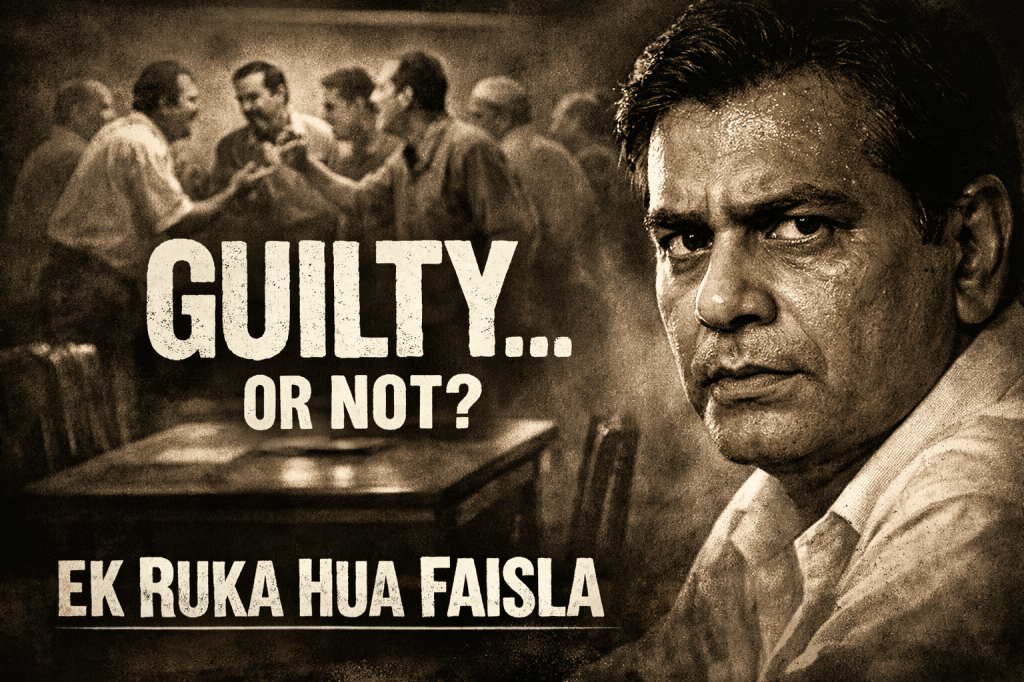
Ek Ruka Hua Faisla (A Pending Decision) is a 1986 Indian Hindi-language legal drama directed by Basu Chatterjee. It is a skillful remake of the 1957 American classic 12 Angry Men, directed by Sidney Lumet, which was adapted from Reginald Rose’s 1954 teleplay of the same name.
The meaning of “Ek Ruka Hua Faisla” is “A Stalled Decision” or “A Delayed Verdict.”
In the film, 12 jury members sit together to decide a case, but they fail to reach a unanimous verdict. As a result, the decision is “stalled,” and from that moment, the entire drama unfolds.
The film begins with 12 men sitting in a closed room. A young boy is accused of murdering his own father. All the evidence is against him. Now, the final decision lies in the hands of these 12 jury members.
11 of them say, “He is guilty.” But… one man quietly says, “I’m not sure…”
At first, everyone thinks he is wasting time. Some get irritated, while others are eager to go home. But that one man begins to ask questions:
“What if the witness is mistaken?”
“What if the evidence isn’t as strong as it seems?”
Slowly the atmosphere in the room begins to change. Arguments erupt… voices rise, some speak out of anger, others out of prejudice. But because of that one man’s calm reasoning, each person begins to re-examine their own thinking.
One by one, opinions begin to change, and in the end — where 11 people were certain he was guilty, they all unanimously declare — “He is not guilty.”
This is not just the verdict of a case. It is a journey of thinking, patience, and standing up for justice. Because sometimes, one person is enough to change the entire truth.
The central theme of the film is justice, doubt, and human bias. When you look at the same situation from different perspectives, the truth can change. The film powerfully shows how prejudice influences decisions.
K. K. Raina delivers a very effective performance as Juror No. 8. He portrays the subtlety and moral firmness required for the role quite well. While his performance may not be as impactful as Henry Fonda’s in the original film, Raina still provides a strong foundation to the movie.
However, it is Pankaj Kapur, as the aggressive and unstable Juror No. 3, who truly grabs the audience’s attention. The intensity and emotion in his performance make the character feel more real and powerful.
Apart from them, S. M. Zaheer and Annu Kapoor, along with the rest of the cast, have done an excellent job. Each actor gradually reveals different layers of their character, making the story feel more realistic and engaging.
Basu Chatterjee’s direction is outstanding. Within the limited space of a jury room, he effectively creates a tense and claustrophobic atmosphere. The film’s pacing is very precise, gradually building tension and drama. While staying true to the original story, he also beautifully incorporates Indian cultural nuances.
The emotional breakdown of Juror No. 3 in the climax—where he finally changes his vote—is portrayed in a very powerful and moving manner.
The film’s sharp dialogues, tight screenplay, and excellent performances make it timeless, and it continues to stay with the audience even today. It strongly highlights the importance of logical thinking and unbiased discussion in the pursuit of justice.
The moral of the film is, A hasty decision can be wrong, Even one person standing for truth can bring change, prejudice can blind justice.
This film is not just action or drama, it is a “thought-provoking experience.”
It forces us to question ourselves, “Do we truly think before making decisions… or do we simply follow others?”
The film ultimately tells us, Justice is not just about evidence, but also about thought, patience, and integrity. One person standing for truth can change an entire decision.
📸 Photo Courtesy: Google
✍️ Excerpts Source: Google
 Writer Sunita