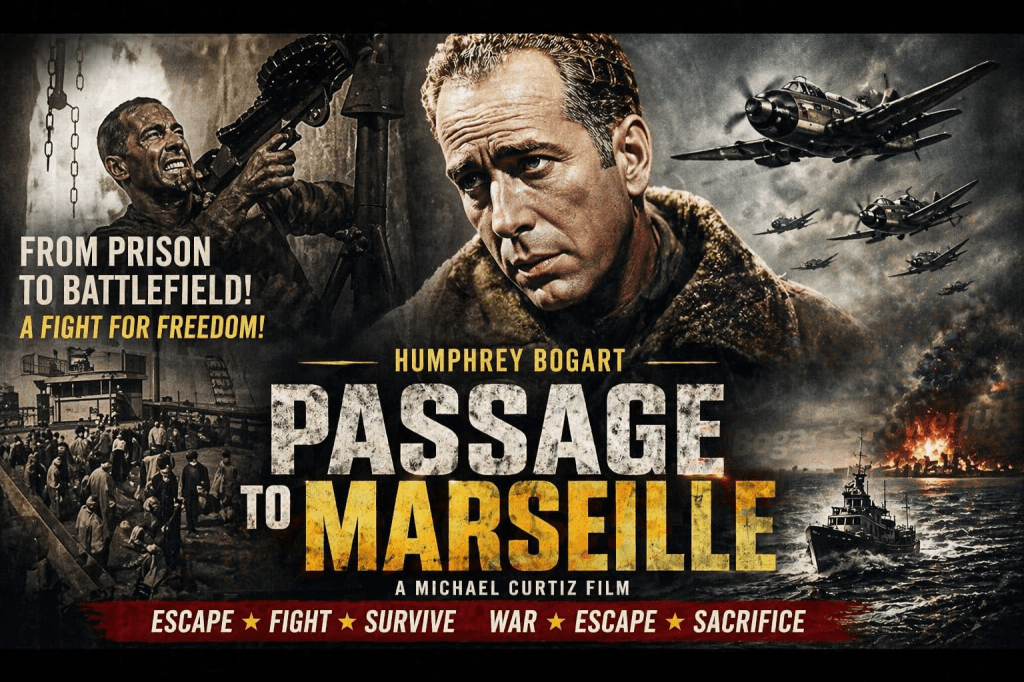
Passage to Marseille (also known as Message to Marseille) is a 1944 American war film produced by Warner Bros. and directed by Michael Curtiz.
Curtiz was one of the most successful and versatile directors of Hollywood’s Golden Age. His films are known for strong visuals, fast-paced storytelling, and emotional depth. In this film, he beautifully presents themes of war, sacrifice, and freedom.
“Passage to Marseille” means “a journey to Marseille.” Marseille is an important port city in France, and during World War II, it became a symbol of freedom, escape, and new beginnings. But this is not just a physical journey—it also represents a journey from oppression to freedom, standing up against injustice, and inner transformation.
The story begins at an airbase in England, where Free French airmen are preparing for a dangerous bombing mission. At this point, Captain Freycinet narrates the past story of his fellow pilots to a journalist. Through a series of flashbacks, the narrative unfolds and takes us into their life journey.
The story then moves to France, where a group of patriots are unjustly imprisoned. Among them is Jean Matrac, a dedicated newspaper publisher who is jailed for speaking out against the Nazis. These men are not criminals, but brave individuals fighting for their country.
They are sent to a harsh prison where they face inhumane treatment. However, their desire for freedom and determination to serve their country keeps them from giving up. They plan a daring escape and manage to flee by sea, facing many dangers, betrayals, and struggles along the way. Some lose their lives, while others reach safety.
These experiences transform them. They no longer fight just for themselves but decide to fight for their country’s freedom. Eventually, they join the Free French Air Force and prepare to battle the Nazi forces. The story returns to the present, where they embark on their mission—now as true warriors fighting for freedom.
Their goal is clear: to fight against Nazi rule and reclaim their nation’s freedom. In the end, they take part in air missions, risking their lives for their country. This is not just a war story, but an inspiring tale of resistance, sacrifice, and human courage.
Michael Curtiz uses the flashback structure very effectively. The film begins in the present and then moves into the past through narration. The present acts as a frame, while the past forms the main story. The transitions are smooth, and the use of light and shadow makes the past more dramatic. The layered storytelling helps the audience connect deeply with the characters. It focuses more on “why things happen” rather than just “what happens,” highlighting themes like freedom vs. imprisonment and personal struggle vs. national duty.

Humphrey Bogart plays Jean Matrac, the main protagonist. At first, he is a journalist imprisoned for opposing the Nazis, but later he becomes a fighter pilot. Peter Lorre appears alongside him, and their machine-gun scene against a German bomber is especially memorable. Matrac’s journey—from an ordinary man to a freedom fighter—is truly inspiring: “A life risked for freedom!”
Claude Rains plays Captain Freycinet, who initially appears strict but later reveals a conflict between duty and humanity.
The prison escape sequence is highly tense, keeping the audience on edge. The sea journey reflects both hope and fear, while the aerial combat scenes show the ultimate sacrifice for the nation. The realistic style, unexpected deaths, and the sacrifices of French citizens make this film stand out.
Overall, Passage to Marseille is not just a war film—it’s a powerful story about the value of freedom, human resilience, and the courage to fight against injustice.
📸 Photo courtesy: Google ✍️ Sources: Google

