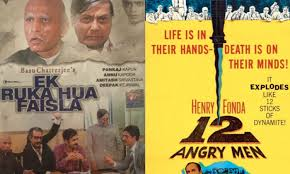
Ek Ruka Hua Faisla is a 1986 Indian Hindi-language legal drama directed by Basu Chatterjee. It is a skillful remake of the 1957 American classic 12 Angry Men, directed by Sidney Lumet, which was adapted from Reginald Rose’s 1954 teleplay of the same name.
Director Basu Chatterjee has crafted it in a very simple yet powerful style. Chatterjee was known for his sensitive and realistic storytelling, often portraying everyday life with natural ease.
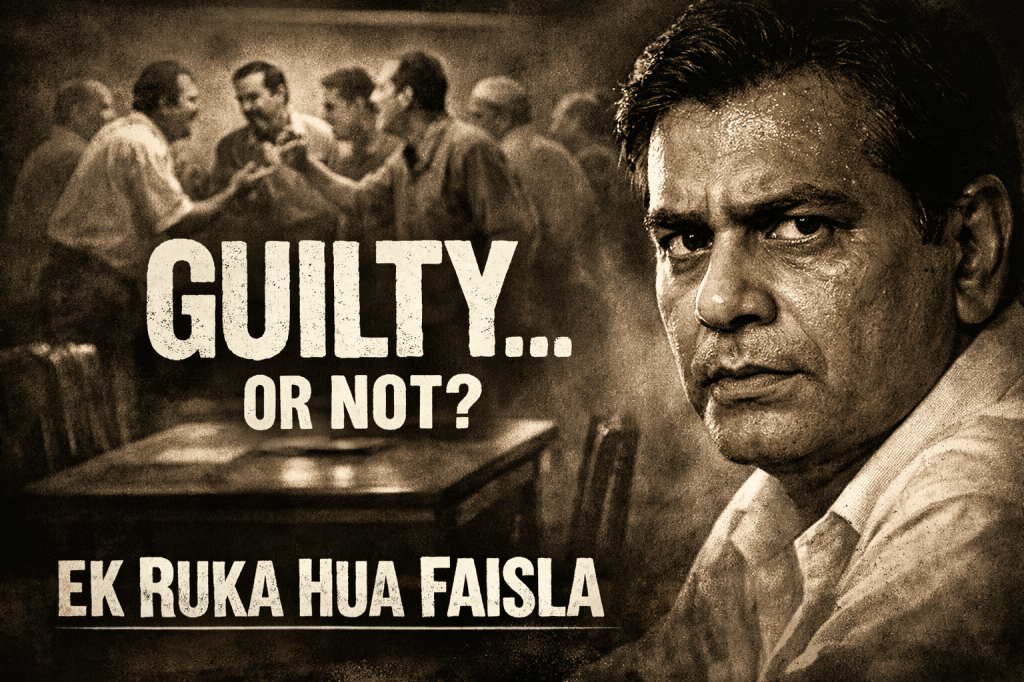
The title itself is very meaningful. “Ek Ruka Hua Faisla” means a stalled decision. At the beginning, 11 jurors say “guilty,” but one says “no,” and the decision cannot move forward. This pause becomes the driving force of the story, slowly revealing the truth.
So, the title not only reflects the situation but also captures the core conflict of the film.
The story begins with a boy accused of murdering his own father. All the evidence appears to be against him. Now, his fate lies in the hands of 12 jurors.
“This is a story of a decision… but not just a decision, it is a story of thought and the search for truth.”
Twelve men… locked in one room… a boy’s future in their hands. Each of them carries their own experiences… and their own biases.
Eleven firmly say, “He is guilty!” But one man quietly says, “I’m not sure…”
He stands against everyone. He asks questions… examines every piece of evidence carefully.
At first, others think he is just wasting time. Some get irritated… some are eager to leave.
But he doesn’t stop. He keeps asking, “What if the witness is wrong?”
“What if the evidence isn’t as strong as it seems?”
And slowly… one by one… their thinking begins to change.
The room is the same, the people are the same, but the atmosphere begins to shift. Arguments rise, voices get louder, some speak in anger
while others are still trapped in their own prejudices.
But when perspective changes, the truth begins to look different.
Because of one man’s calm reasoning, everyone starts rethinking their own beliefs. One by one, opinions begin to change.
And in the end— where 11 people once said “guilty”, they all finally agree— “he is not guilty.”
This film teaches us that true courage lies in standing against the majority,
and that understanding the truth requires an open mind.
Basu Chatterjee’s direction is highly effective. Within the limited space of a jury room, he creates intense tension and gradually builds the drama.
Despite being dialogue-driven, the film never feels dull because each character has a distinct voice.
The adaptation retains the essence of the original while subtly blending Indian context, maintaining a balanced emotional tone.
The climax of Juror No. 3—where he finally breaks down and changes his vote, is especially powerful and deeply moving.
In terms of performances, every actor delivers a natural and realistic portrayal. Each character slowly reveals different layers, making the story feel more authentic and engaging.
K. K. Raina as Juror No. 8 brings calm logic and moral strength to his role.
Meanwhile, Pankaj Kapur as Juror No. 3 stands out with his intense, aggressive, and emotionally charged performance, making the character truly memorable.
This is not just a case decision, it is a journey of thought, patience, and standing firm for the truth. Because sometimes, just one person can change the direction of a decision.
The film’s real strength lies in its writing and dialogues. Each character represents different thoughts and biases, and as the discussion progresses, their anger, ego, and fears begin to surface.
The direction remains simple. no songs, no unnecessary drama. The story moves forward purely through dialogue and emotion, keeping the audience fully engaged.
At first, everyone appears united, but gradually, tension builds. As the discussion intensifies, the camera moves closer to the faces, making the audience feel as if they are inside that room.
This film makes us question ourselves, how impartial are we when making decisions? How dangerous can rushed judgments be?
It forces us to ask, “Do we really think before making decisions, or do we simply follow others?”
📸 Photo Courtesy: Google
✍️ Excerpts Source: Google

